Robin Shure in Hairst
Behind the song
The speaker remembers sharing Robin’s harvest work without a sickle, then meeting him at his father’s gate on a journey to Dunse. Her complaint grows sharper as she recalls his boldness and his promise to supply her winter food. His possessions amount to three goose feathers and a knife.
Read the fuller story
The refrain couples labour with attachment: she stayed by Robin even without a reaping hook. The verses bring weaving, a father’s gate and a promise of provisions into the encounter. The final inventory punctures that promise, making Robin’s grand offer collapse into a few poor objects. The repeated return to the harvest lines keeps the disappointed bargain tied to their earlier companionship.
Cunningham calls this an old chant. He says Burns removed some loose expressions, added the third and fourth verses and sent it to the Museum. On that account, the complaint about Robin’s trick and the closing exposure of his promise are Burns’s additions to an inherited beginning.[1]
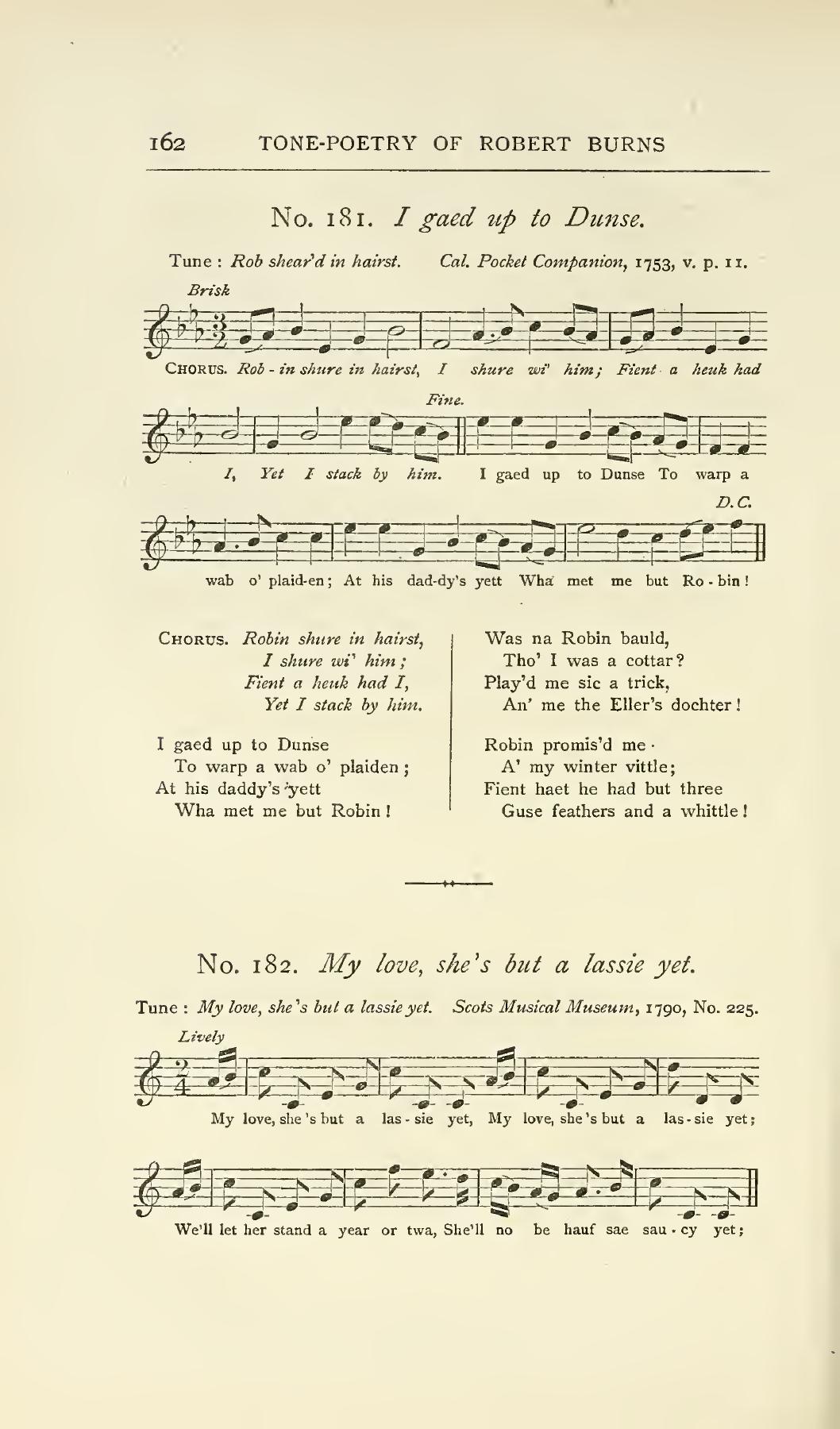 View score Dick’s Songs of Robert Burns (1903)
Lyrics
Choose an edition
Cunningham (1855)
Robin shure in hairst,
  I shure wi’ him,
Fient a heuk had I,
  Yet I stack by him.

I gaed up to Dunse,
  To warp a wab o’ plaiden,
At his daddie’s yett,
  Wha met me but Robin.

Was na Robin bauld,
  Tho’ I was a cotter,
Play’d me sic a trick,
  And me the eller’s dochter?
      Robin share in hairst, &c.

Robin promis’d me
  A’ my winter vittle;
Fient haet he had but three
  Goose feathers and a whittle.
    Robin share in hairst, &c.
Digital text from Project Gutenberg.
View the source edition · p. 248
About this edition
Cunningham’s preface discusses several poems he left out of the collection.
Dick (1903) · no. 181
The words are on the score page.
View the source edition · no. 181; p. 162
Scots Musical Museum, vol. VI (1839) · no. 543
View the source edition · pp. 562–563
About this edition
Museum no. 543.
Music
View historical scores
Dick’s Songs of Robert Burns (1903)
no. 181; p. 162
Reworking and extension attributed to Burns
Cunningham credits Burns with revising an older chant and adding its third and fourth verses.
Words Robert Burns and the earlier song tradition
Burns’s role Reworking and extension attributed to Burns