O Gude Ale Comes
Behind the song
The singer praises good ale while explaining what it has cost him. His stockings are sold and his shoes pawned, yet the chorus ends with the claim that ale keeps his heart up. The next verse takes the losses into the farm: six oxen that pulled well are sold one by one. Each disappearance is followed by the same buoyant assurance, making the refrain steadily harder to accept at face value. [1]
The final verse leaves him bare and busy and turns to his attentions towards a servant girl, followed by standing on the stool when the deed is done. The song brings loss of property and compromised respectability into the singer’s own cheerful account. Dick’s text changes the refrain after the chorus from “my heart” to “the heart”, giving the repeated defence of drink a more general sound. Its humour rests on the persistence of pleasure while the consequences accumulate. [1]
Read the fuller story
The editors disagree about Burns’s contribution. Cunningham calls the first two verses old and assigns the concluding one to Burns. Dick quotes Stenhouse assigning the song to Burns except for the old chorus. Dick also records the Museum wording “Corrected by R. Burns”, which gives a broader description of his work on the song. [2][3]
Dick heads the entry I had sax owsen in a pleugh and prints a labelled chorus followed by two quatrains. His tune heading is The bottom of the punch bowl, while Cunningham’s section has no separate tune heading. Dick traces that air through Oswald, McGibbon and Aird. The selected reading preserves the contrast within the speaker’s experience: a lifted heart accompanies the gradual spending of his livelihood. [1][2][3]
Story references
- James C. Dick, The Songs of Robert Burns (1903), No. 245; printed pp. 218–218; PDF pp. 274–274
- Allan Cunningham, The Complete Works of Robert Burns (1855), printed 247; HTML #songsCVII. Project Gutenberg transcription.
- James C. Dick, The Songs of Robert Burns (1903), Dick note 245; printed 444; PDF 500
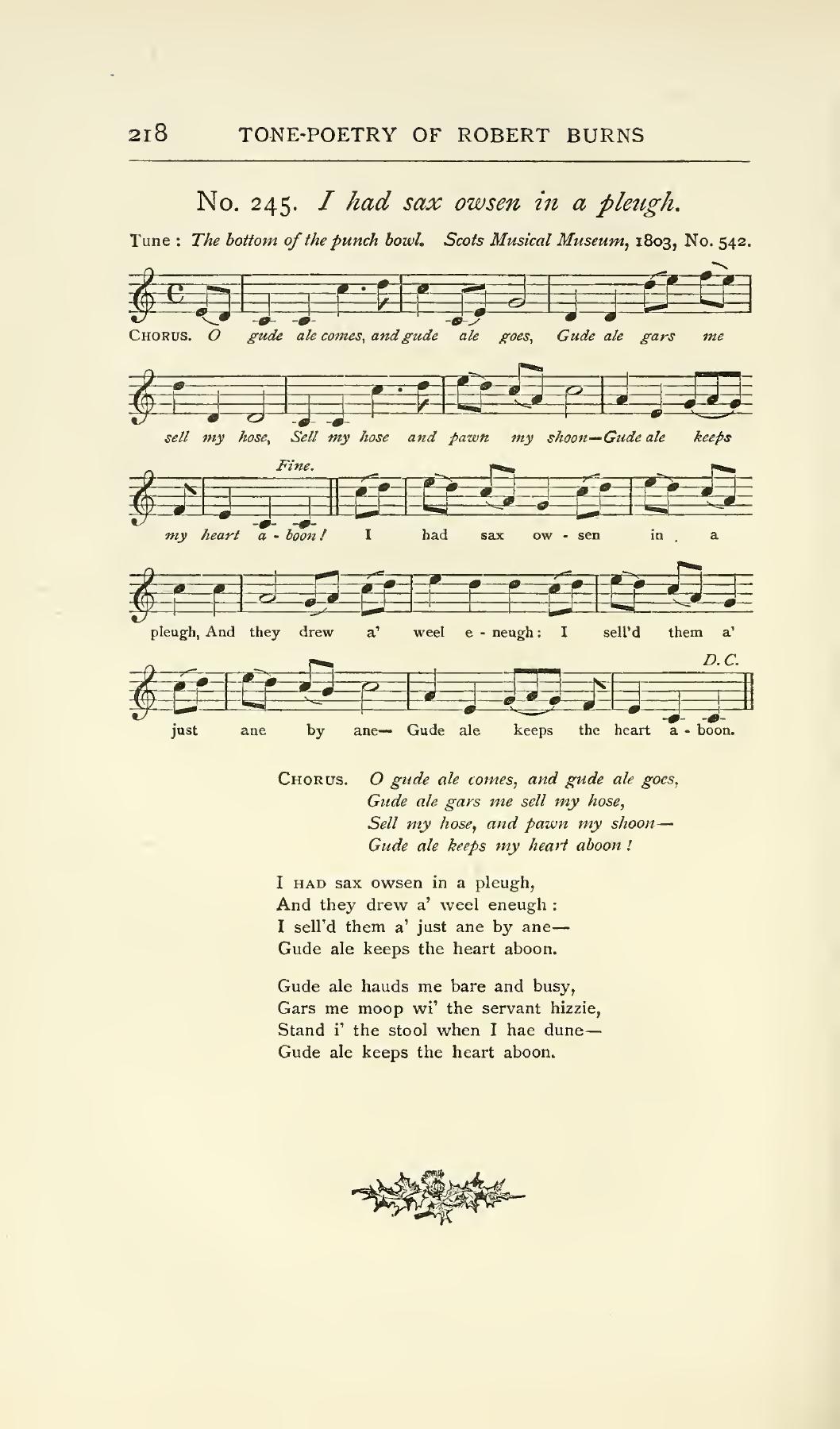 View score Dick’s Songs of Robert Burns (1903)
Lyrics
Choose an edition
Version notes
| Dick (1903) · no. 245 | Cunningham · 1855Ebook transcription |
|---|---|
| labelled chorus before two quatrains | first numbered stanza followed by two more, with O gude ale comes &c at end |
| And they drew a’ weel eneugh | They drew a’ weel eneugh |
| the heart aboon in both verses | my heart aboon throughout |
| hauds | hands |
More differences between these editions
| Dick (1903) · no. 245 | Cunningham · 1855Ebook transcription |
|---|---|
| dune | done |
Dick (1903) · no. 245
CHORUS.
O gude ale comes, and gude ale goes,
Gude ale gars me sell my hose,
Sell my hose, and pawn my shoon—
Gude ale keeps my heart aboon!

I had sax owsen in a pleugh,
And they drew a' weel eneugh:
I sell'd them a' just ane by ane—
Gude ale keeps the heart aboon.

Gude ale hauds me bare and busy,
Gars me moop wi' the servant hizzie,
Stand i' the stool when I hae dune—
Gude ale keeps the heart aboon.
View the source edition · no. 245; p. 218
About this edition
Dick prints an opening labelled chorus and two quatrains; Cunningham numbers all three blocks and adds an abbreviated return to the opening at the end. Dick has And they drew, hauds and dune against Cunningham’s They drew, hands and done. In Dick the two verses end the heart aboon, while Cunningham keeps my heart throughout. The editors’ conflicting contribution accounts remain attributed in the story.
Scots Musical Museum, vol. VI (1839) · no. 542
View the source edition · p. 561
About this edition
Museum no. 542.
Cunningham (1855)
O gude ale comes, and gude ale goes,
Gude ale gars me sell my hose,
Sell my hose, and pawn my shoon,
Gude ale keeps my heart aboon.

I had sax owsen in a pleugh,
They drew a’ weel eneugh,
I sell’d them a’ just ane by ane;
Gude ale keeps my heart aboon.

Gude ale hands me bare and busy,
Gars me moop wi’ the servant hizzie,
Stand i’ the stool when I hae done,
Gude ale keeps my heart aboon.
  O gude ale comes, &c.
Digital text from Project Gutenberg.
View the source edition · p. 247
About this edition
Dick prints an opening labelled chorus and two quatrains; Cunningham numbers all three blocks and adds an abbreviated return to the opening at the end. Dick has And they drew, hauds and dune against Cunningham’s They drew, hands and done. In Dick the two verses end the heart aboon, while Cunningham keeps my heart throughout. The editors’ conflicting contribution accounts remain attributed in the story.
Music
View historical scores
Dick’s Songs of Robert Burns (1903)
no. 245; p. 218
Reworked or extended by Burns
The printed score credits Burns with revising the words.
Words Earlier words revised by Burns
Burns’s role Correction credited in the edition