O Ay, My Wife She Dang Me
Behind the song
The chorus begins with the husband saying that his wife has beaten him, then turns his complaint into advice about the danger of giving a woman her own way. Its assertion sets the terms of a comic grievance spoken from the husband’s side. The first verse explains what he thinks went wrong: he married hoping for peace and rest, then found his intentions miserably defeated. [1]
In the final quatrain the grievance reaches beyond marriage into the afterlife. The singer imagines that his earthly suffering has already exhausted the pains of hell and should guarantee bliss above. “Sairie comfort” makes the consolation sound as poor as the situation he describes. The joke depends on the distance between his original hope for an easy life and the extravagant reward he now claims to expect for enduring it. [1]
Read the fuller story
Cunningham says that other, older verses to the air were still remembered in Scotland. Dick records two different descriptions attached to the Museum song: “Written for this work by Robert Burns” and, in Law’s manuscript list, “Mr. B’s old words”. He also reports Stenhouse’s reference to an old song called My wife she dang me, while observing that Stenhouse gave no particulars. [2][3]
Dick heads the entry On peace an’ rest my mind was bent and prints a labelled chorus followed by two quatrains. Cunningham incorporates the chorus into his first numbered block and repeats it at the end of the second. Dick traces the air through Oswald’s Companion and McGibbon’s Scots Tunes in the 1750s. The compact selected reading keeps its whole argument within the husband’s complaint and his bleak attempt to console himself. [1][2][3]
Story references
- James C. Dick, The Songs of Robert Burns (1903), No. 221; printed pp. 197–197; PDF pp. 253–253
- Allan Cunningham, The Complete Works of Robert Burns (1855), printed 291; HTML #CCXXI. Project Gutenberg transcription.
- James C. Dick, The Songs of Robert Burns (1903), Dick note 221; printed 428,429; PDF 484,485
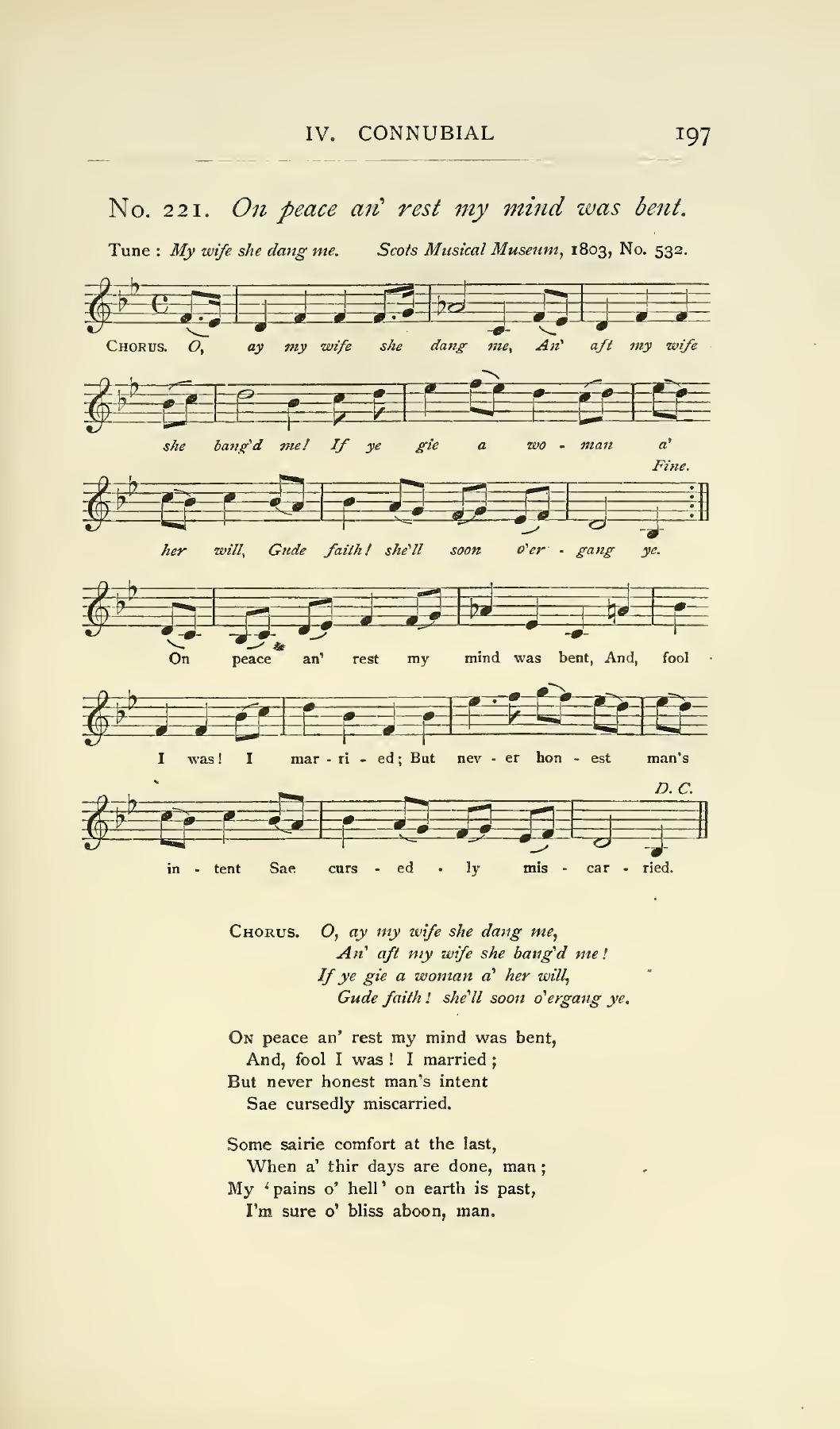 View score Dick’s Songs of Robert Burns (1903)
Lyrics
Choose an edition
Version notes
| Dick (1903) · no. 221 | Cunningham · 1855Ebook transcription |
|---|---|
| labelled chorus then two quatrains | chorus integrated into first block and repeated finally |
| An’ aft my wife she bang’d me! | And aft my wife did bang me, |
| Sae cursedly miscarried | As cursedly miscarried |
| Some sairie comfort at the last | Some sairie comfort still at last |
More differences between these editions
| Dick (1903) · no. 221 | Cunningham · 1855Ebook transcription |
|---|---|
| a’ thir days | a’ their days |
| My ’pains o’ hell’ on earth is past | My pains o’ hell on earth are past |
Dick (1903) · no. 221
CHORUS.
O, ay my wife she dang me,
An' aft my wife she bang'd me!
If ye gie a woman a' her will,
Gude faith! she'll soon o'ergang ye.

On peace an' rest my mind was bent,
And, fool I was! I married;
But never honest man's intent
Sae cursedly miscarried.

Some sairie comfort at the last,
When a' thir days are done, man;
My 'pains o' hell' on earth is past,
I'm sure o' bliss aboon, man.
View the source edition · no. 221; p. 197
About this edition
Dick has a labelled chorus and two quatrains; Cunningham incorporates and repeats the chorus across two numbered blocks. Dick reads she bang’d, Sae cursedly, comfort at the last, thir and is past, against Cunningham’s did bang, As cursedly, comfort still at last, their and are past. Dick also encloses pains o’ hell in quotation marks.
Scots Musical Museum, vol. VI (1839) · no. 532
View the source edition · p. 549
About this edition
Museum no. 532.
Cunningham (1855)
O ay my wife she dang me,
  And aft my wife did bang me,
If ye gie a woman a’ her will,
  Gude faith, she’ll soon o’er-gang ye.
On peace and rest my mind was bent,
  And fool I was I married;
But never honest man’s intent,
  As cursedly miscarried.

Some sairie comfort still at last,
  When a’ their days are done, man;
My pains o’ hell on earth are past,
  I’m sure o’ bliss aboon, man.
O ay my wife she dang me,
  And aft my wife did bang me,
If ye gie a woman a’ her will,
  Gude faith, she’ll soon o’er-gang ye.
Digital text from Project Gutenberg.
View the source edition · p. 291
About this edition
Dick has a labelled chorus and two quatrains; Cunningham incorporates and repeats the chorus across two numbered blocks. Dick reads she bang’d, Sae cursedly, comfort at the last, thir and is past, against Cunningham’s did bang, As cursedly, comfort still at last, their and are past. Dick also encloses pains o’ hell in quotation marks.
Music
View historical scores
Dick’s Songs of Robert Burns (1903)
no. 221; p. 197
Credited to Burns in print
The printed score names Burns. How much he wrote or revised is uncertain.
Words Burns credited by the printed edition
Burns’s role Credited in print. The extent of his contribution is uncertain.