Gudeen to You, Kimmer
Behind the song
A greeting receives a hiccup and an assurance that Kimmer feels better for being drunk. Questions about health become requests for more drink, then questions about her children. The chorus keeps the whole household nodding through the exchange.
Read the fuller story
Kate sits in the corner with hen broth; Kimmer asks for a pint of the best and two pints more. Asked whether all five children are Johnie’s, she readily says that two were conceived while he was away. The last verse widens the joke into appetites shared by cats, dogs, lads and lasses. Its short replies and recurring chorus turn the conversation into a communal song.
Cunningham gives the words an earlier controversial setting. He says the old song contained sarcastic references to Mother Rome and the seven sacraments, five described as illegitimate. Burns, he says, changed its meaning and published his altered version in the Museum. In the selected lyric, the exchange concerns drink, children and sexual appetite.[1]
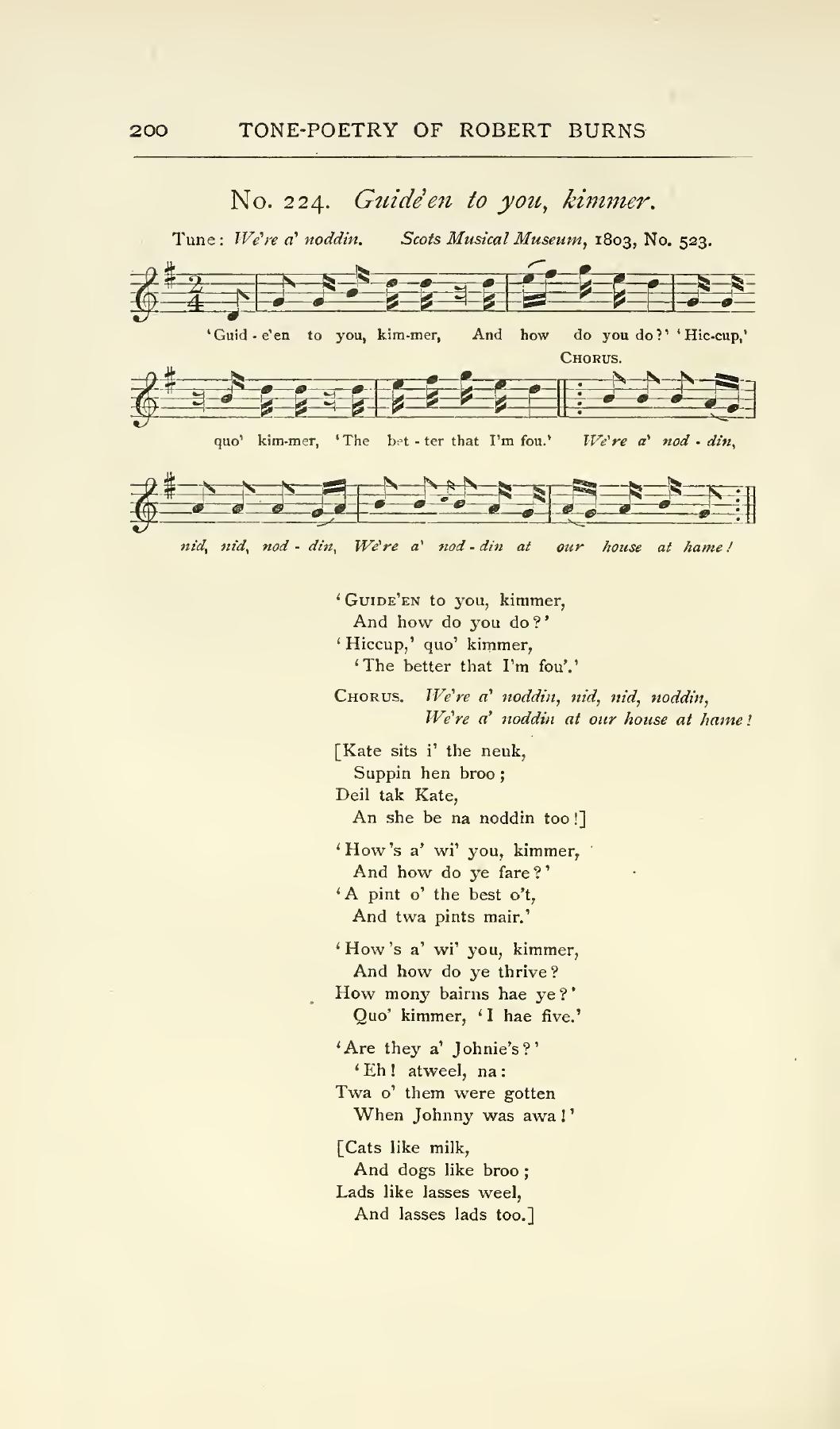 View score Dick’s Songs of Robert Burns (1903)
Lyrics
Choose an edition
Cunningham (1855)
Gudeen to you, Kimmer,
  And how do ye do?
Hiccup, quo’ Kimmer,
  The better that I’m fou.
    We’re a’ noddin, nid nid noddin,
    We’re a’ noddin, at our house at hame.

Kate sits i’ the neuk,
  Suppin hen broo;
Deil tak Kate
  An’ she be na noddin too!
    We’re a’ noddin, &c.

How’s a’ wi’ you, Kimmer,
  And how do ye fare?
A pint o’ the best o’t,
  And twa pints mair.
    We’re a’ noddin, &c.

How’s a’ wi’ you, Kimmer,
  And how do ye thrive;
How many bairns hae ye?
  Quo’ Kimmer, I hae five.
    We’re a’ noddin, &c.

Are they a’ Johnie’s?
  Eh! atweel no:
Twa o’ them were gotten
  When Johnie was awa.
    We’re a noddin, &c.

Cats like milk,
  And dogs like broo;
Lads like lasses weel,
  And lasses lads too.
    We’re a’ noddin, &c.
Digital text from Project Gutenberg.
View the source edition · p. 248
About this edition
Cunningham’s preface discusses several poems he left out of the collection.
Dick (1903) · no. 224
The words are on the score page.
View the source edition · no. 224; p. 200
Scots Musical Museum, vol. VI (1839) · no. 523
View the source edition · p. 540
About this edition
Museum no. 523.
Music
View historical scores
Dick’s Songs of Robert Burns (1903)
no. 224; p. 200
Reworking attributed to Burns
Cunningham says Burns changed the meaning of an earlier controversial song.
Words Robert Burns and the earlier song tradition
Burns’s role Reworking attributed to Burns