Wee Willie Gray
Behind the song
Wee Willie Gray needs a remarkably small wardrobe. A peeled willow wand will supply his boots and jacket; a rose on the brier will furnish his trousers and doublet. The second stanza makes the scale smaller still, dressing him in lily flowers and decorating his bonnet with the imagined feathers of a fly. Across eight lines, the ordinary business of getting someone dressed becomes a game of miniature invention. [1]
Read the fuller story
Willie arrives with a name and a leather wallet, as though he were already equipped to go about his business. Everything added to him is impossibly delicate. The practical list of garments helps the joke: boots, jacket, trousers, doublet, shirt, cravat and bonnet are put together with the brisk assurance of someone who knows exactly what is required. “Sark” is the Scots word for a shirt. The final flourish, “Feathers of a flie”, takes the fancy beyond the flowers and willow bark into something that could never be collected. [1][2]
Each stanza begins by bringing Willie and his wallet back before the listener, then repeats its last line. That repetition gives the fanciful clothing time to register. It also makes the short song easy to take up again: the ending returns to a familiar phrase, ready for another singing. The pleasure lies in the steadily assembled little figure and in the sounds that accompany his dressing. [1]
The 1839 edition of the Scots Musical Museum prints the song as no. 514, with a heading crediting its words to Robert Burns. James C. Dick, writing in 1903, identifies its Museum appearance with the volume of 1803 and names the tune Wee Totum Fogg. His account, following William Stenhouse, connects that tune-name with an older nursery rhyme about a small figure whose coat and breeches require only half an ell of cloth. The resemblance is suggestive: both verses imagine how little material a tiny person needs. [3][4]
Dick marks the setting “Cheerfully”; the Museum page says “A little Lively”. These printed directions suit the quick succession of garments and the repeated punchlines. The song allows a singer to linger over each absurd provision, especially the fly’s contribution to the bonnet. Burns’s small subject leaves room for precise, playful attention to the things used to clothe him. [1][3]
Story references
- James C. Dick, The Songs of Robert Burns (1903), no. 327, p. 307, words and setting.
- Allan Cunningham, ed., The Complete Works of Robert Burns (1855), glossary, “Sark”; Project Gutenberg transcription.
- The Scots Musical Museum, vol. VI (1839 edition), no. 514, p. 530, “Wee Willie Gray”.
- James C. Dick, The Songs of Robert Burns (1903), note 327, pp. 483–484.
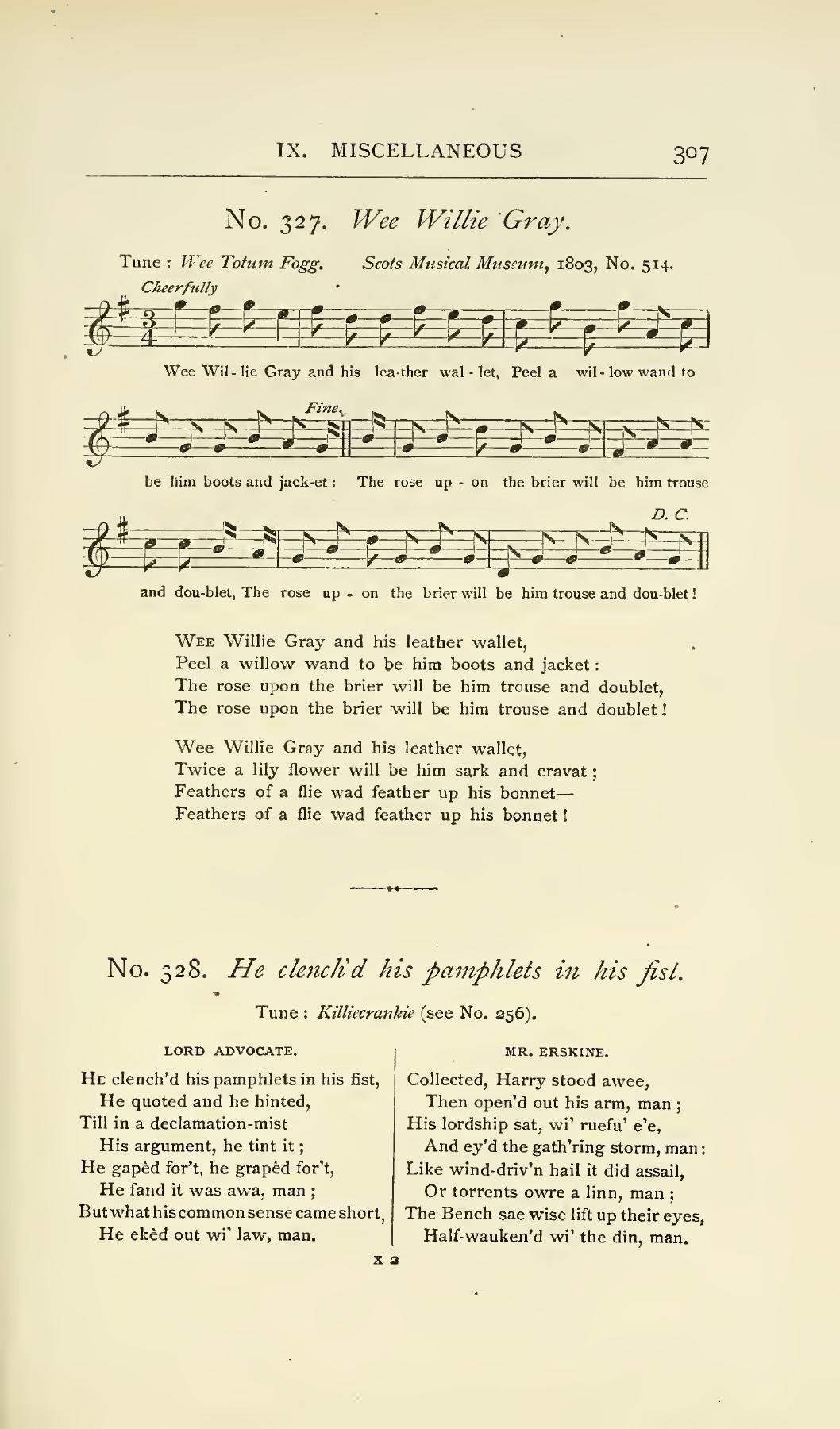 View score Dick’s Songs of Robert Burns (1903)
Lyrics
Choose an edition
Dick (1903) · no. 327
Wee Willie Gray and his leather wallet,
Peel a willow wand to be him boots and jacket:
The rose upon the brier will be him trouse and doublet,
The rose upon the brier will be him trouse and doublet!

Wee Willie Gray and his leather wallet,
Twice a lily flower will be him sark and cravat;
Feathers of a flie wad feather up his bonnet—
Feathers of a flie wad feather up his bonnet!
View the source edition · Dick1903 no. 327; p. 307
About this edition
Syllables separated by the musical notation are joined into words in this reading.
Scots Musical Museum, vol. VI (1839) · no. 514
View the source edition · pp. 530–531
About this edition
Museum no. 514.
Music
View historical scores
Dick’s Songs of Robert Burns (1903)
Dick1903 no. 327; p. 307
Credited to Burns in print
The printed score names Burns. How much he wrote or revised is uncertain.
Words Burns credited by the printed edition
Burns’s role Credited in print. The extent of his contribution is uncertain.