My Peggy's Face
Behind the song
Peggy’s beauty could warm the coldness of a hermit’s old age, while her worth and intelligence could charm the finest person. The opening moves repeatedly between outward appearance and inward character. Its eight lines arrive at a deliberate distinction in the speaker’s language: he loves her face and grace, and adores her heart. [1]
The second stanza tests what can last. Lily, rose and the brightness of an eye command admiration, yet their beauty decays. Tenderness, pity, generosity and the look that disarms anger form the closing list. These qualities make Peggy’s kindness active: she responds to suffering and changes another person’s temper. [1]
Read the fuller story
Cunningham identifies Peggy as Margaret Chalmers, later Mrs Lewis Hay, and quotes Burns asking Johnson to include the song in the second Museum volume for a strong private reason. Dick reports the same request and considers it probable that Chalmers’s dislike of public attention contributed to the delay. His proposed explanation remains a conjecture about that publishing history. [2][3]
Dick’s selected setting bears the song’s own title. His note reports that Burns first wrote the words for the Gaelic air Ha a’ chaillich, which Johnson referred for musical advice; Dick leaves Burns’s part in choosing the eventual Museum melody uncertain. He also records Thomson’s alteration of Peggy to Mary. The song’s emphasis on lasting character therefore travelled through changes of both tune and name. [3]
Story references
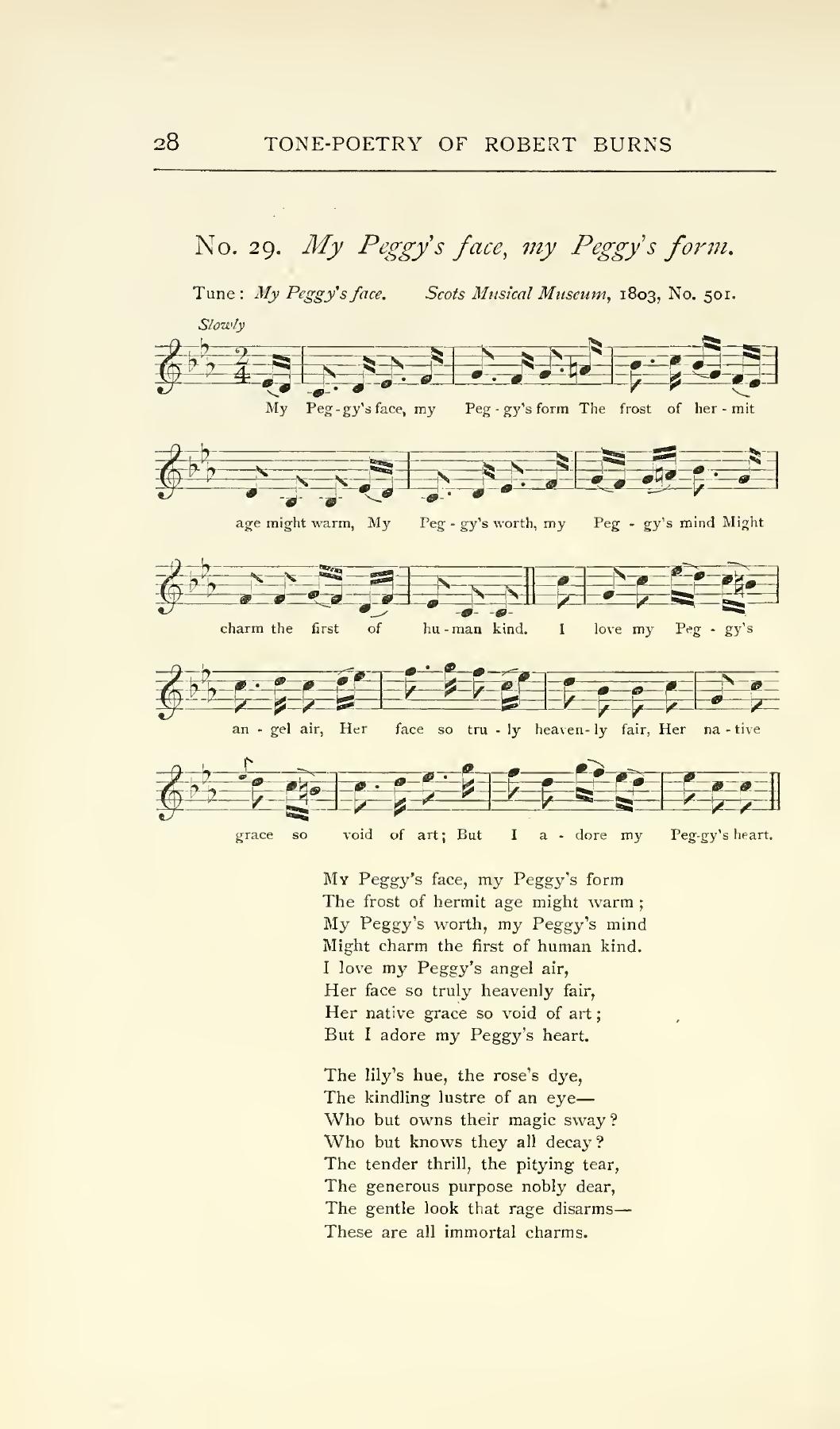 View score Dick’s Songs of Robert Burns (1903)
Lyrics
Choose an edition
Version notes
| Dick (1903) · no. 29 | Cunningham · 1855Ebook transcription |
|---|---|
| heavenly; generous | heav’nly; gen’rous |
| Who but knows they all decay? | Who but knows they all decay! |
| My Peggy's face, my Peggy's form | My Peggy's face, my Peggy's form, |
| My Peggy's worth, my Peggy's mind | My Peggy's worth, my Peggy's mind, |
More differences between these editions
| Dick (1903) · no. 29 | Cunningham · 1855Ebook transcription |
|---|---|
| The kindling lustre of an eye— | The kindling lustre of an eye; |
Dick (1903) · no. 29
My Peggy's face, my Peggy's form
The frost of hermit age might warm;
My Peggy's worth, my Peggy's mind
Might charm the first of human kind.
I love my Peggy's angel air,
Her face so truly heavenly fair,
Her native grace so void of art;
But I adore my Peggy's heart.

The lily's hue, the rose's dye,
The kindling lustre of an eye—
Who but owns their magic sway?
Who but knows they all decay?
The tender thrill, the pitying tear,
The generous purpose nobly dear,
The gentle look that rage disarms—
These are all immortal charms.
View the source edition · no. 29; p. 28
About this edition
Both editions retain two eight-line stanzas. Cunningham prints heav’nly and gen’rous where Dick spells heavenly and generous; Cunningham’s final question ends with an exclamation mark while Dick uses a question mark.
Scots Musical Museum, vol. VI (1839) · no. 501
View the source edition · p. 517
About this edition
Dick’s 1903 text and the Museum’s 1839 setting are separate versions.
Cunningham (1855)
My Peggy’s face, my Peggy’s form,
The frost of hermit age might warm;
My Peggy’s worth, my Peggy’s mind,
Might charm the first of human kind.
I love my Peggy’s angel air,
Her face so truly, heav’nly fair,
Her native grace so void of art,
But I adore my Peggy’s heart.

The lily’s hue, the rose’s dye,
The kindling lustre of an eye;
Who but owns their magic sway?
Who but knows they all decay!
The tender thrill, the pitying tear,
The gen’rous purpose, nobly dear,
The gentle look, that rage disarms—
These are all immortal charms.
Digital text from Project Gutenberg.
View the source edition · p. 271
About this edition
Both editions retain two eight-line stanzas. Cunningham prints heav’nly and gen’rous where Dick spells heavenly and generous; Cunningham’s final question ends with an exclamation mark while Dick uses a question mark.
Music
View historical scores
Dick’s Songs of Robert Burns (1903)
no. 29; p. 28
Credited to Burns in print
The printed score names Burns. How much he wrote or revised is uncertain.
Words Burns credited by the printed edition
Burns’s role Credited in print. The extent of his contribution is uncertain.