My Wife's a Wanton Wee Thing
Behind the song
The husband begins with a complaint he can scarcely stop repeating: his wife will not be guided by him. He calls her wanton, recalls her behaviour before marriage and predicts that she will carry on. The song turns his grievance into a refrain, then ends with his claim that beating her has made her obedient. Its comedy depends on a picture of marriage in which a wife’s independence becomes the husband’s public complaint. [1]
Read the fuller story
The repetitions are unusually insistent. The opening line comes three times before the admission that she resists his direction. The next stanza repeats her earlier misconduct three times, too. In Scots, “or” here means before: she played the loon before she married and, he says, will do so again before she dies. The repeated phrases give the singer plenty of room to perform the husband’s exasperation. They also make his wish to govern her impossible to miss. [1]
The third stanza supplies the most vivid incident. She sells her coat and drinks the proceeds, then wraps herself in a blanket. “Row’d” means wrapped. The practical consequence of her spending is folded into the husband’s returning complaint about control. The final stanza makes that control physical: when his prohibition fails, he takes a rung, a stick, and strikes her. His description of the result as a good child reduces his wife to someone he believes he can discipline. The closing joke is built around that assertion of authority. [1]
Dick’s edition makes a distinction between inherited and added words. It brackets the opening chorus and the following stanza, eight lines altogether. His note attributes those lines to a fragment in Herd’s Scottish Songs of 1776 and assigns the final eight lines to Burns. He also reports the description of the song as Burns’s “old words” in Law’s manuscript list. In Dick’s account, Burns extended the inherited complaint with the incidents of drinking and punishment. [1][2]
Dick prints a tune under the title “My wife’s a wanton wee thing”, with the chorus clearly marked and directions to return to it. He identifies his musical setting as coming from Stewart’s Reels of 1762. The repeated chorus carries the husband’s complaint back between the incidents, allowing the performance to turn on his increasingly forceful insistence. Read alongside the final stanza, its demand to be obeyed gives the song a harsher edge than the jaunty description of a “wee thing” initially suggests. [1][2]
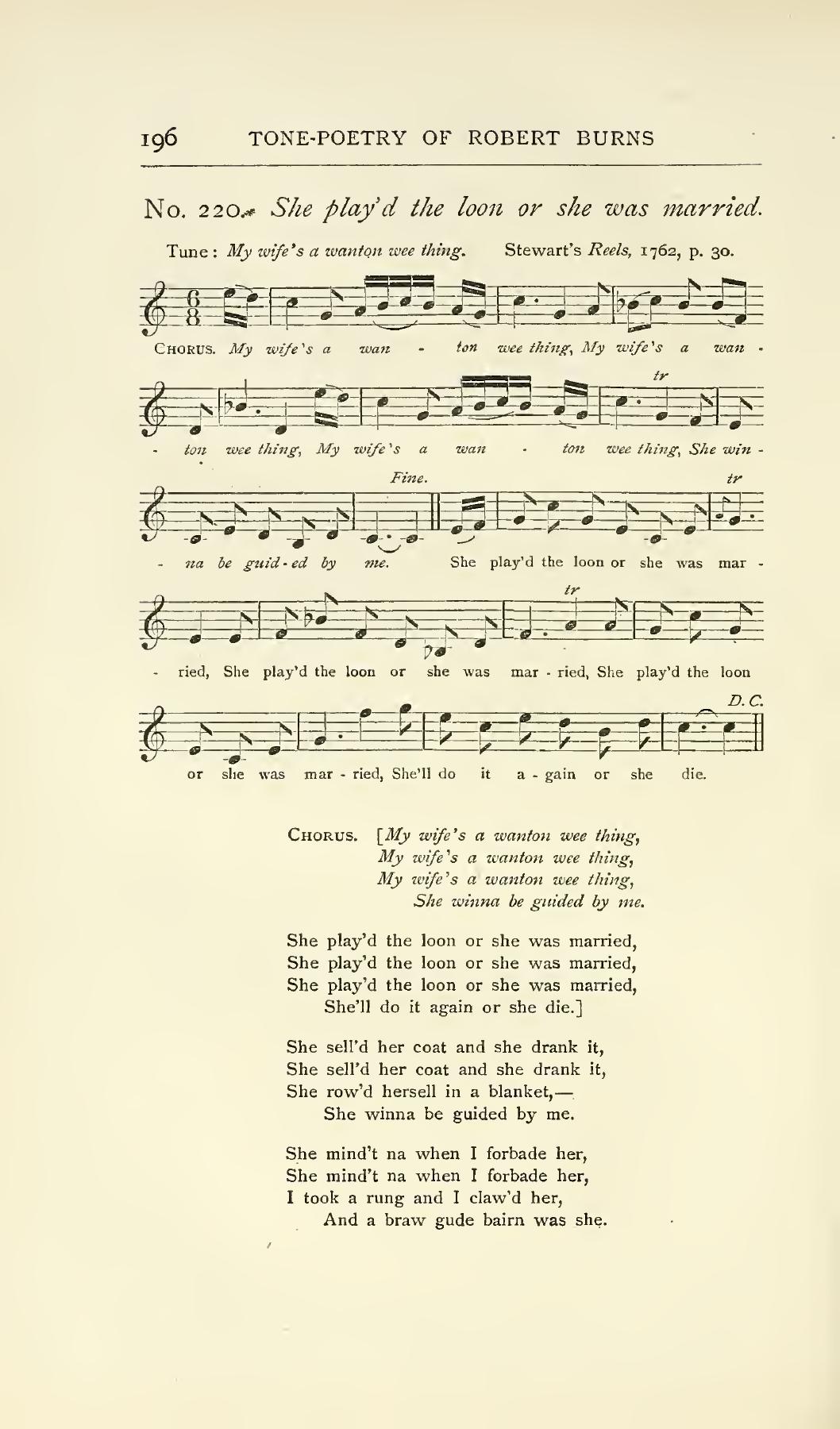 View score Dick’s Songs of Robert Burns (1903)
Lyrics
Dick (1903) · no. 220
CHORUS
[My wife's a wanton wee thing,
My wife's a wanton wee thing,
My wife's a wanton wee thing,
She winna be guided by me.

She play'd the loon or she was married,
She play'd the loon or she was married,
She play'd the loon or she was married,
She'll do it again or she die.]

She sell'd her coat and she drank it,
She sell'd her coat and she drank it,
She row'd hersell in a blanket,—
She winna be guided by me.

She mind't na when I forbade her,
She mind't na when I forbade her,
I took a rung and I claw'd her,
And a braw gude bairn was she.
Chorus and three stanzas from Dick’s 1903 edition.
View the source edition · no. 220; p. 196
About this edition
Syllables separated by the musical notation are joined into words in this reading.
Dick brackets the opening eight lines as a Herd fragment and attributes the final eight to Burns.
Music
View historical scores
Dick’s Songs of Robert Burns (1903)
no. 220; p. 196
Sources
- The Merry Muses of Caledonia (1911), p. 117