Can ye Labour Lea, Young Man?
Behind the song
The chorus asks a young man whether he can work the lea, or grassland. If he can, payment will not keep the pair apart. The verses begin with hiring a worker and end with kissing, caressing and making love. That movement makes the agricultural question increasingly suggestive: the singer wants a capable ploughman, and the words allow his abilities to carry another meaning. [1]
Read the fuller story
The first stanza remembers hiring a man at Martinmas with three earnest pennies. His one fault, the singer says, was that he could not labour the lea. The language of agreement and payment gives the complaint a practical surface. “Fee’d” means hired, while “airle pennies” are earnest money given to seal the engagement. In the chorus, “twine” means separate. The repeated question makes competence the test on which the relationship depends. [1]
The following stanza begins with seasonal pleasures: caressing is good in February and kissing sweet in May. It then singles out the ploughman lad as the singer’s delight. The last stanza turns to a lock and key, using those paired objects for kissing and caressing before praising a further intimacy. The song lets farm work, courtship and sexual suggestion reinforce one another through everyday words. Its humour grows from how easily the practical question accommodates desire. [1]
The printed title in Dick is the first verse’s “I fee’d a man at Martinmas”, while the tune and chorus carry the question by which the song is also known. His score labels the chorus and includes Fine and D.C. directions, returning the performance to that question. Each new stanza gives the returning words a little more context, so that their suggestiveness can become clearer as the song proceeds. [1]
Dick identifies the Museum appearance of 1792 as no. 394 and calls the text an amended version of an older rustic song found in the Merry Muses. He quotes Cromek describing it as long familiar and popular in Nithsdale and Galloway. These accounts place the song within a local singing tradition, while leaving the precise division between inherited and revised words unresolved in this note. [2]
The melody has another connection in Dick’s account. He says Thomson copied it from the Museum and printed it in 1799 for Burns’s “Auld lang syne”. That later use gives the air a place beyond the present courtship song. Here, its repeated chorus remains closely tied to the singer’s mischievous test of the young man. [2]
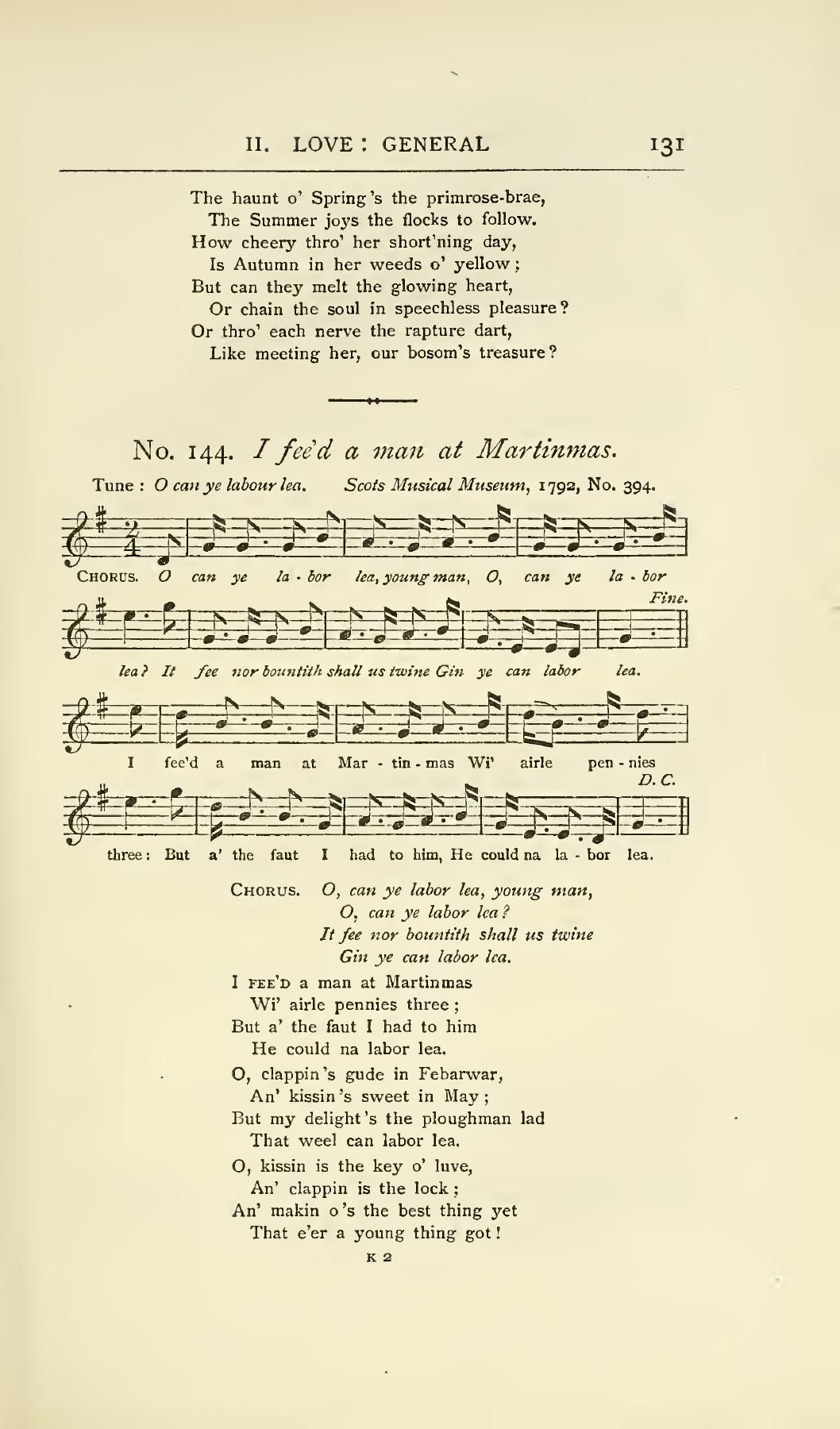 View score Dick’s Songs of Robert Burns (1903)
Lyrics
Choose an edition
Dick (1903) · no. 144
CHORUS
O, can ye labor lea, young man,
O, can ye labor lea?
It fee nor bountith shall us twine
Gin ye can labor lea.

I fee'd a man at Martinmas
Wi' airle pennies three;
But a' the faut I had to him
He could na labor lea.

O, clappin 's gude in Febarwar,
An' kissin 's sweet in May;
But my delight's the ploughman lad
That weel can labor lea.

O, kissin is the key o' luve,
An' clappin is the lock;
An' makin o's the best thing yet
That e'er a young thing got!
View the source edition · Dick1903 no. 144; p. 131
About this edition
Syllables separated by the musical notation are joined into words in this reading.
Scots Musical Museum, vol. IV (1792) · no. 394
View the source edition · Volume 4, no. 394; p. 407
Music
View historical scores
Dick’s Songs of Robert Burns (1903)
Dick1903 no. 144; p. 131
Sources
- The Merry Muses of Caledonia (1911), p. 86