As I came o'er the Cairney Mount
Behind the song
A journey across Cairney Mount leads the singer down among flowering heather and into shelter from a storm. The chorus reveals another kind of shelter: the warmth of a Highland lad’s tartan plaid. By the final stanza the sun is out, lambs are calling over the hillocks and the singer has agreed to be his at their next meeting. The small fragment moves from weather to affection with very little explanation between them. [1]
Read the fuller story
The milking-sheiling stands ready to protect the traveller. A sheiling is a hut or shelter associated with upland grazing, and the word places the encounter in a working rural landscape. Yet the chorus quickly makes the lad the centre of attention. He is handsome and winning, and his plaid makes wind and rain seem unimportant. “Row’d” means wrapped: the garment supplies both practical warmth and the image of closeness around which the song turns. [1]
The final stanza changes the light. Phoebus, the classical name used for the sun, shines on the rough grass, while lambs bleat on the “knowes”, or small hills. The movement out of the storm accompanies a new promise between the pair. The wording gives the singer’s consent explicitly, then looks forward to another meeting. [1]
Dick calls the piece a much-revised form of an older four-stanza song in the Merry Muses. He identifies its Museum appearance in 1796, signed Z, and quotes Burns’s note about the older song associated with the tune. The selected text here contains two stanzas and a chorus. Dick’s comparison places this compact form alongside a fuller stage of the song’s history. [2]
The tune is headed “The Highland lassie” and marked “Brisk”. Dick traces related titles through eighteenth-century music collections and says that the Museum editor copied the music from Aird’s Airs as Burns directed. His account also warns of the many tunes called “The Highland laddie”. The particular setting matters: a familiar Highland title alone is not enough to identify the melody. In this printed version, the brisk movement and returning praise of the lad keep the brief encounter light and expectant. [1][2]
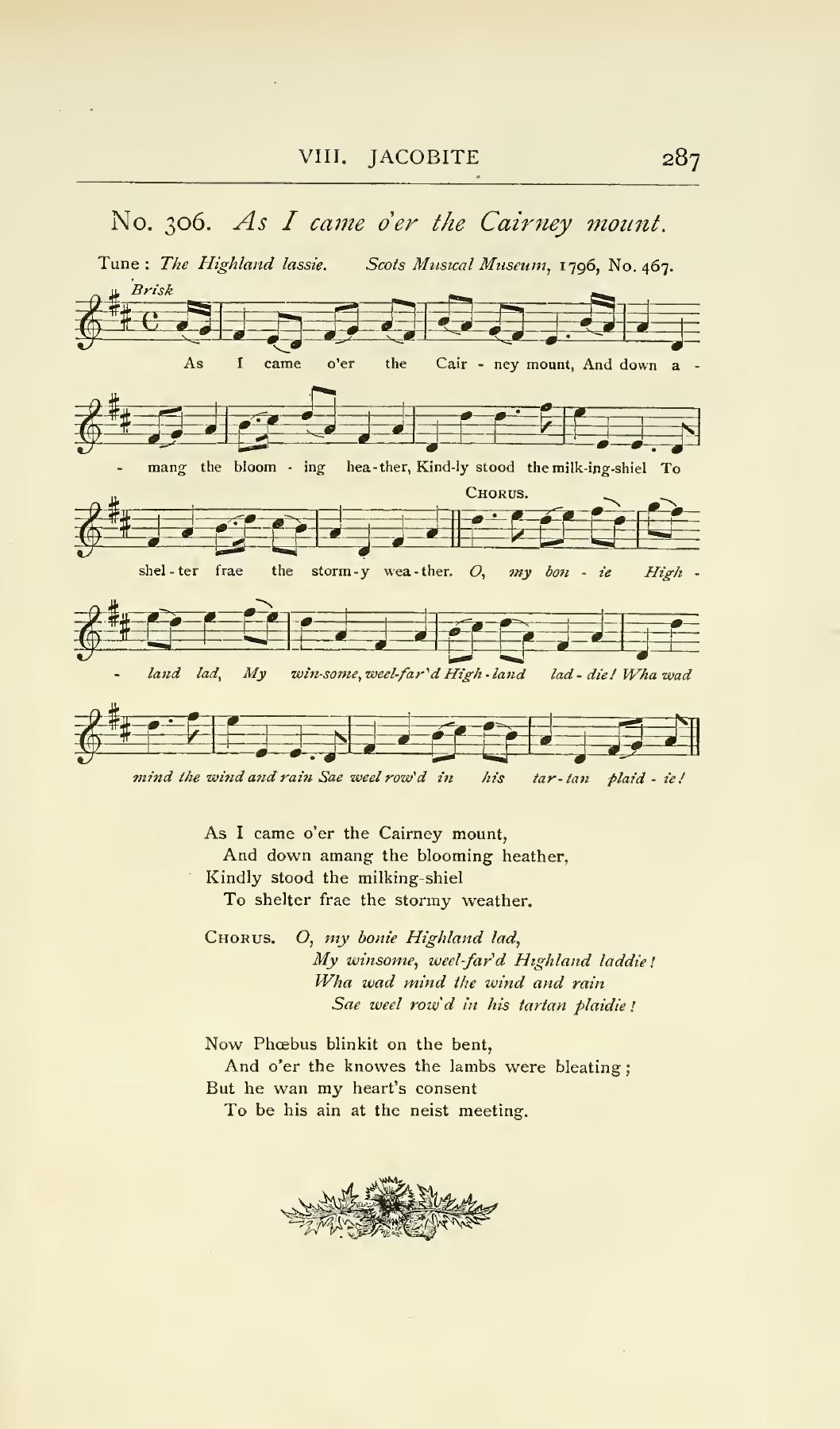 View score Dick’s Songs of Robert Burns (1903)
Lyrics
Dick (1903) · no. 306
As I came o'er the Cairney mount,
And down amang the blooming heather,
Kindly stood the milking-shiel
To shelter frae the stormy weather.
CHORUS
O, my bonie Highland lad,
My winsome, weel-far'd Highland laddie!
Wha wad mind the wind and rain
Sae weel row'd in his tartan plaidie!

Now Phœbus blinkit on the bent,
And o'er the knowes the lambs were bleating;
But he wan my heart's consent
To be his ain at the neist meeting.
View the source edition · Dick1903 no. 306; p. 287
About this edition
Syllables separated by the musical notation are joined into words in this reading.
Dick presents this text as a fragment: two verses and a chorus.
Scots Musical Museum, vol. V (catalogued 1796) · no. 467
View the source edition · Volume 5, no. 467; p. 480
Music
View historical scores
Dick’s Songs of Robert Burns (1903)
Dick1903 no. 306; p. 287
Sources
- The Merry Muses of Caledonia (1911), p. 64