From Thee, Eliza, I Must Go
Behind the song
A departing lover tells Eliza that the ocean can separate their lives while his affection remains hers. Burns gives the farewell two movements: the first faces the distance between them, and the second imagines a parting that may last until death. Each ends by turning the threat of separation into a promise of constancy.[1]
Read the fuller story
The 1786 Kilmarnock edition prints the song in two numbered eight-line stanzas under the tune heading “Gilderoy”. Its opening places departure from Eliza beside departure from a native shore. The singer is leaving both a beloved person and a familiar country. The words stay close to the farewell itself, speaking directly to her through the repeated “thee” and the prominently printed name ELIZA.[1][2]
The sea is first heard as a roar. Cruel fates throw it between the lovers, making distance feel like an obstacle imposed upon them. “Boundless” is repeated as a single ocean becomes oceans roaring wide. The expanding image gives the promise something powerful to answer. The speaker insists that they can never divide his heart and soul from Eliza; the repetition of “never” makes the assurance more emphatic.[1]
The second stanza begins with another repetition, “Farewell, farewell”. Now a foreboding voice tells the singer that they will never meet again. “Boding” means giving warning of what is to come. The voice expresses the fear within the farewell, intensifying the possible finality of the journey. The song then follows that fear to an imagined deathbed, where Death stands as a victorious figure beside the speaker.[1]
Even there, he reserves something for Eliza. The last beat of his heart and his final sigh will belong to her. Calling the heartbeat her “part” makes it a share which she alone can claim. The promise narrows from the boundless sea to the smallest remaining signs of life. The song’s two endings therefore meet: distance cannot divide the inner attachment, and the final breath is offered as its last expression.[1]
Story references
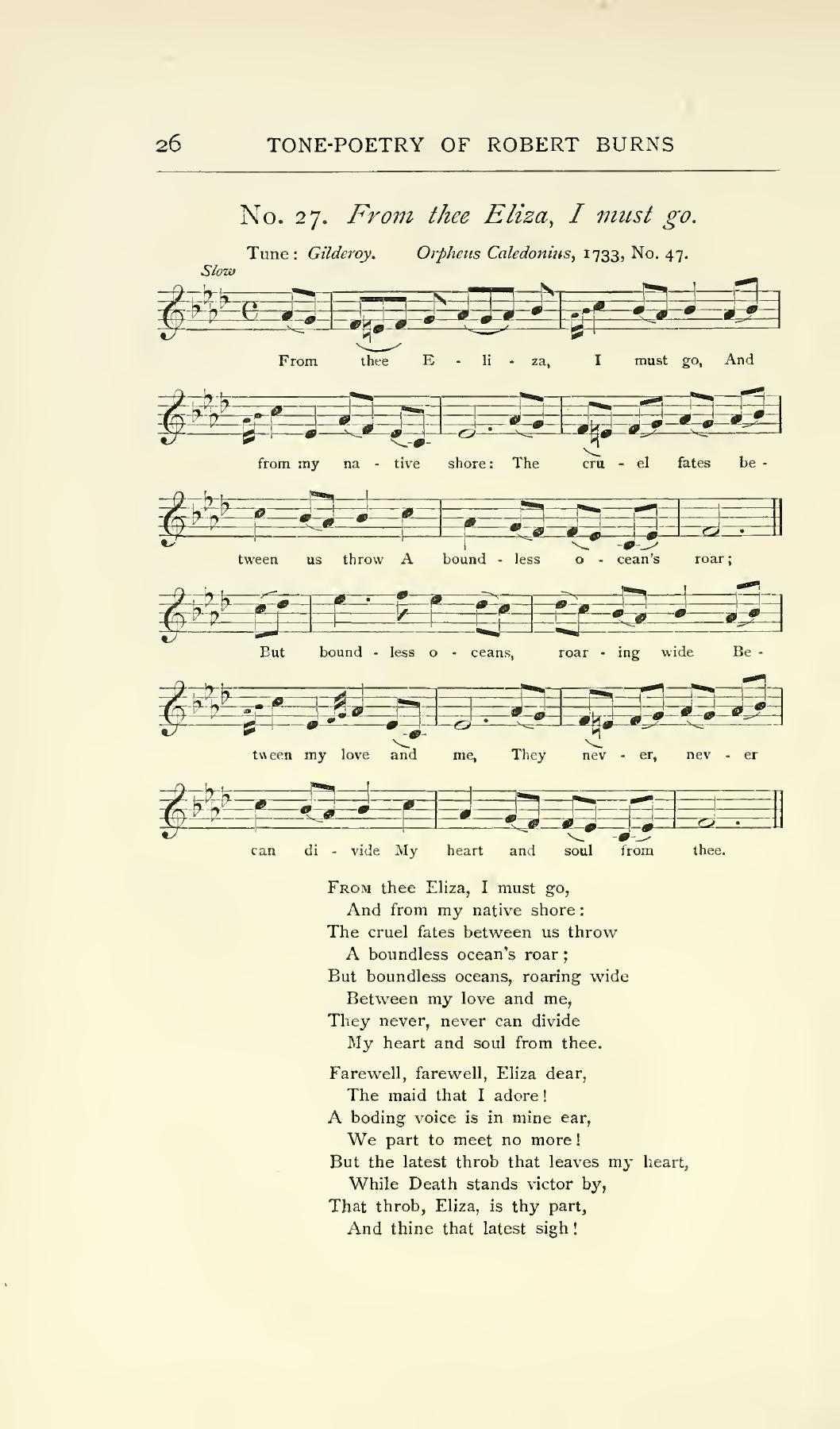 View score Dick’s Songs of Robert Burns (1903)
Lyrics
Choose an edition
Kilmarnock Poems (1786)
SONG.
I.
FROM thee, ELIZA, I must go,
    And from my native shore:
The cruel fates between us throw
    A boundless ocean’s roar;
But boundless oceans, roaring wide,
    Between my Love and me,
They never, never can divide
    My heart and soul from thee.

II.
Farewell, farewell, ELIZA dear,
    The maid that I adore!
A boding voice is in mine ear,
    We part to meet no more!
But the latest throb that leaves my heart,
    While Death stands victor by,
That throb, ELIZA, is thy part,
    And thine that latest sigh!
Complete selected song text compared with the printed page.
View the source edition · p. 227
About this edition
The sixteen verse lines, two stanza numbers and Gilderoy tune heading are retained.
Dick (1903) · no. 27
The words are on the score page.
View the source edition · no. 27; p. 26
Edinburgh Poems (1787)
View the source edition · p. 332
About this edition
Contents visually checked (1786 PDF14–15;1787 PDF55–56); short epitaphs additionally checked in1786 PDF237–240. Whole piece not newly read. Source-page range can include neighbouring text or notes.
Music
View historical scores
Dick’s Songs of Robert Burns (1903)
no. 27; p. 26
Words by Robert Burns
The farewell to Eliza appears in Burns’s Kilmarnock volume of 1786 as two numbered eight-line stanzas.
Words Robert Burns
Burns’s role Writer of the song words