The Gloomy Night Is Gathering Fast
Behind the song
The hunter has left the moor and the birds have gathered safely, while the singer still walks the lonely banks of Ayr. Wind and rain fill the opening, then autumn’s damaged corn leads his thoughts towards a dangerous sea crossing. Every return to the banks of Ayr tightens the connection between the landscape he sees and the place he expects to leave. [1]
The hardest part of departure is the breaking of attachments, figured as wounds that bleed afresh. The final farewell moves across hills, moors and valleys, then reaches both friends and enemies. The singer offers peace to his foes and love to his friends, before tears deliver the last goodbye. [1]
Read the fuller story
Dick quotes Burns’s letter to Dr Moore describing his chest on the road to Greenock and this as the last song he expected to compose in Scotland. Cunningham prints the same recollection above his text. Dick also recounts a later account by Dr Walker of the song taking shape after a farewell visit to Dr Lawrie. [2][3]
Both editions head the lyric Roslin Castle, and Dick marks the score Slow. Dick distinguishes this choice from the Masterton melody used in the Museum and the Druimionn dubh setting in Thomson’s collection. He links Druimionn dubh with the air used for Musing on the roaring ocean, giving the two separation songs a further musical connection. [1][3][2]
Story references
- James C. Dick, The Songs of Robert Burns (1903), No. 313; printed pp. 294–295; PDF pp. 350–351
- James C. Dick, The Songs of Robert Burns (1903), Dick note 313; printed 477,478; PDF 533,534
- Allan Cunningham, The Complete Works of Robert Burns (1855), printed 221; HTML #songsXXXI. Project Gutenberg transcription.
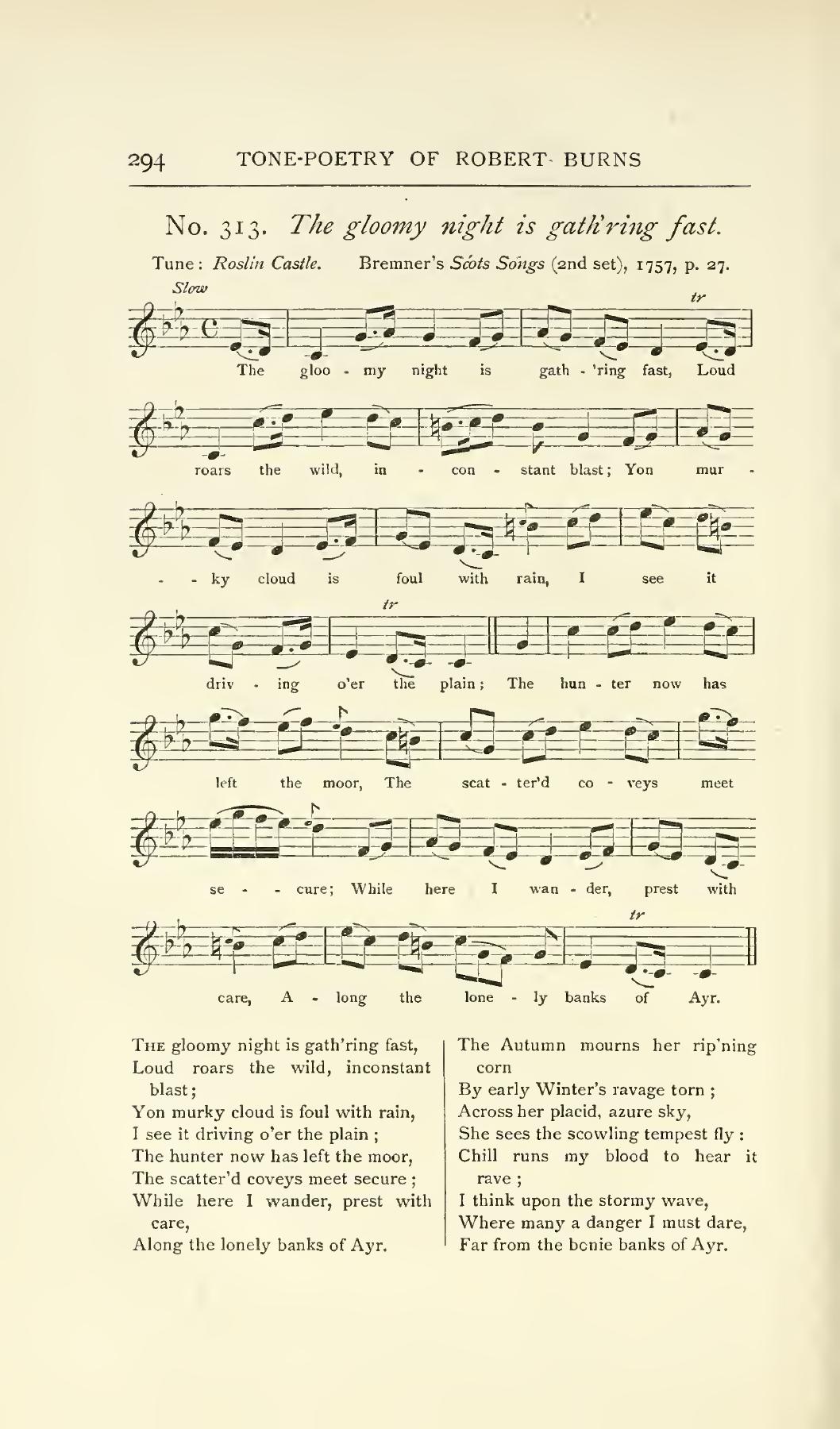 View score Dick’s Songs of Robert Burns (1903)
Lyrics
Choose an edition
Version notes
| Dick (1903) · no. 313 | Cunningham · 1855Ebook transcription |
|---|---|
| bonie | bonnie |
| surging billows roar | surging billow’s roar |
| wild, inconstant | wild inconstant |
Dick (1903) · no. 313
The gloomy night is gath'ring fast,
Loud roars the wild, inconstant blast;
Yon murky cloud is foul with rain,
I see it driving o'er the plain;
The hunter now has left the moor,
The scatter'd coveys meet secure;
While here I wander, prest with care,
Along the lonely banks of Ayr.

The Autumn mourns her rip'ning corn
By early Winter's ravage torn;
Across her placid, azure sky,
She sees the scowling tempest fly:
Chill runs my blood to hear it rave;
I think upon the stormy wave,
Where many a danger I must dare,
Far from the bonie banks of Ayr.

'Tis not the surging billows roar,
'Tis not that fatal, deadly shore;
Tho' death in ev'ry shape appear,
The wretched have no more to fear:
But round my heart the ties are bound,
That heart transpierc'd with many a wound;
These bleed afresh, those ties I tear,
To leave the bonie banks of Ayr.

Farewell, old Coila's hills and dales,
Her heathy moors and winding vales;
The scenes where wretched fancy roves,
Pursuing past unhappy loves!
Farewell my friends! farewell my foes!
My peace with these, my love with those:—
The bursting tears my heart declare
Farewell the bonie banks of Ayr!
View the source edition · no. 313; pp. 294–295
About this edition
Both readings contain four eight-line stanzas. Dick has bonie and the phrase surging billows roar, where Cunningham has bonnie and surging billow’s roar. Commas differ at wild, corn, old Coila, past unhappy loves and the final farewells. Dick places a semicolon after rave and a colon after fear; Cunningham uses an em dash and exclamation mark. Dick’s final declaration line has no semicolon.
Edinburgh Poems (1787)
View the source edition · pp. 330–331
About this edition
Contents visually checked (1786 PDF14–15;1787 PDF55–56); short epitaphs additionally checked in1786 PDF237–240. Whole piece not newly read. Source-page range can include neighbouring text or notes.
Cunningham (1855)
’The gloomy night is gathering fast.’”]

The gloomy night is gath’ring fast,
Loud roars the wild inconstant blast;
Yon murky cloud is foul with rain,
I see it driving o’er the plain;
The hunter now has left the moor,
The scatter’d coveys meet secure;
While here I wander, prest with care,
Along the lonely banks of Ayr.

The Autumn mourns her rip’ning corn,
By early Winter’s ravage torn;
Across her placid, azure sky,
She sees the scowling tempest fly:
Chill runs my blood to hear it rave—
I think upon the stormy wave,
Where many a danger I must dare,
Far from the bonnie banks of Ayr.

’Tis not the surging billow’s roar,
’Tis not that fatal deadly shore;
Tho’ death in ev’ry shape appear,
The wretched have no more to fear!
But round my heart the ties are bound,
That heart transpierc’d with many a wound;
These bleed afresh, those ties I tear,
To leave the bonnie banks of Ayr.

Farewell old Coila’s hills and dales,
Her heathy moors and winding vales;
The scenes where wretched fancy roves,
Pursuing past, unhappy loves!
Farewell, my friends! farewell, my foes!
My peace with these, my love with those—
The bursting tears my heart declare;
Farewell, the bonnie banks of Ayr!
Digital text from Project Gutenberg.
View the source edition · p. 221
About this edition
Both readings contain four eight-line stanzas. Dick has bonie and the phrase surging billows roar, where Cunningham has bonnie and surging billow’s roar. Commas differ at wild, corn, old Coila, past unhappy loves and the final farewells. Dick places a semicolon after rave and a colon after fear; Cunningham uses an em dash and exclamation mark. Dick’s final declaration line has no semicolon.
Scots Musical Museum, vol. III (1790) · no. 284
View the source edition · Volume 3, no. 284; p. 293
Music
View historical scores
Dick’s Songs of Robert Burns (1903)
no. 313; pp. 294–295