Again Rejoicing Nature Sees
Behind the song
Spring brings colour, birdsong and purposeful work to the countryside, while one lover remains unable to share its pleasure. Burns makes that separation grow through the song. The green world becomes almost unbearable to a speaker fixed on Menie’s scornful eye, until he calls for winter to make the landscape resemble his own sadness.[1]
Read the fuller story
The 1787 printing names “Jockey’s Gray Breeks” as the tune and sets out seven numbered stanzas with a recurring chorus. A footnote gives the chorus a separate origin: it is part of a song composed by a gentleman in Edinburgh, described as a particular friend of the author. The man remains unnamed there. A second note explains Menie as an abbreviation of Marianne. These notes make the song’s combination of voices unusually clear: Burns’s seasonal stanzas return to words credited to someone else.[1][2]
Nature first appears dressed for spring, her robe taking on fresh colours and her leafy hair moving in the breeze. The chorus interrupts that freshness with a question: must the singer still dote on Menie and endure her scorn? Her black eye is compared to a hawk’s, turning the gaze into something watchful and predatory. “Maun” means must; “winna” means will not. The repeated question makes affection sound like a condition from which the singer cannot free himself.[1]
The second stanza repeatedly says “In vain”. Cowslips and violets flower, and the thrush and linnet sing, but their beauty cannot reach him. The next stanza finds pleasure in labour: the ploughboy encourages his team and the attentive seedsman goes about his work with joy. Against their movement, the speaker describes life as a weary dream belonging to someone who never wakes. The people around him can act with purpose while he feels suspended.[1]
Waterbirds widen the scene. A coot skims, ducklings cry among reeds and a swan swims majestically; the singer makes his isolation explicit by declaring everything blessed except himself. Then a shepherd closes the gap in his fold and whistles across the moor. The lover’s own step is wild and uneven. By the time the lark rises singing in the half-light, he is gliding home like a grief-worn ghost. The landscape’s energetic movement measures the weakness of his own.[1]
The final stanza asks winter to come howling and bend the bare tree. Gloom would soothe him because the world would at last be sad in the same way. The wish reverses the opening welcome to spring: the singer seeks a season that agrees with his pain. The chorus returns in full after that appeal, bringing the listener back from the weather to Menie’s eye and the attachment which still holds him.[1]
Story references
- Robert Burns, Poems, chiefly in the Scottish dialect (Edinburgh, 1787), song beginning “Again rejoicing Nature sees”, pp.327–329 (physical PDF375–377): seven stanzas, chorus, tune heading and two footnotes.
- Burns, Poems, chiefly in the Scottish dialect (Edinburgh, 1787), title and imprint (physical PDF11).
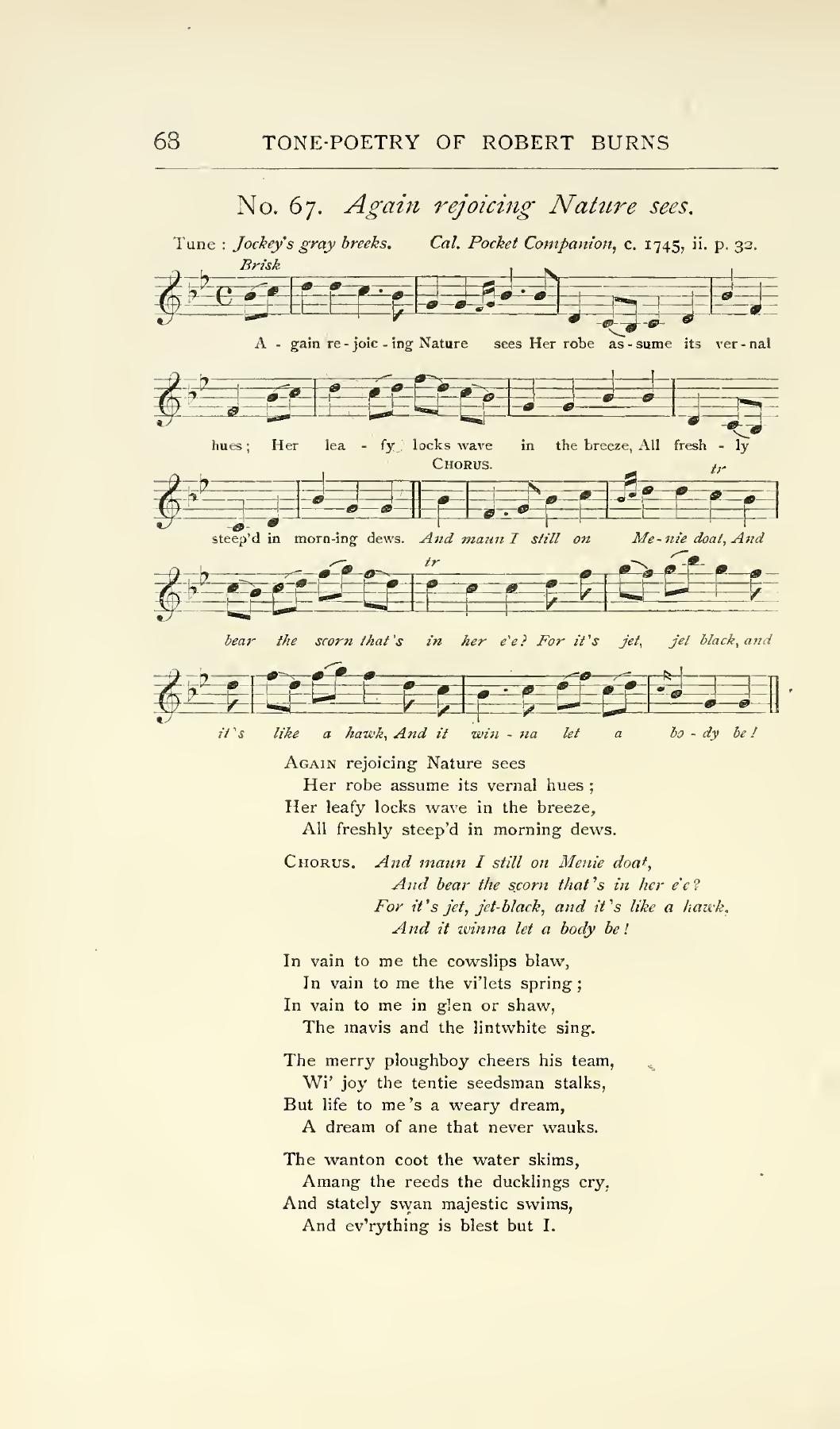 View score Dick’s Songs of Robert Burns (1903)
Lyrics
Choose an edition
Edinburgh Poems (1787)
SONG.
I.
AGAIN rejoicing Nature sees
    Her robe assume its vernal hues,
Her leafy locks wave in the breeze
    All freshly steep’d in morning dews.

CHORUS*.
And maun I still on Menie † doat,
    And bear the scorn that’s in her e’e !
For it’s jet, jet black, an’ it’s like a hawk,
    An’ it winna let a body be !

II.
In vain to me the cowslips blaw,
    In vain to me the vi’lets spring ;
In vain to me, in glen or shaw,
    The mavis and the lintwhite sing.
    And maun I still, &c.

III.
The merry Ploughboy cheers his team,
    Wi’ joy the tentie Seedsman stalks,
But life to me’s a weary dream,
    A dream of ane that never wauks.
    And maun I still, &c.

IV.
The wanton coot the water skims,
    Amang the reeds the ducklings cry,
The stately swan majestic swims,
    And ev’ry thing is blest but I.
    And maun I still, &c.

V.
The Sheep-herd steeks his faulding slap,
    And owre the moorlands whistles shill,
Wi’ wild, unequal, wand’ring step
    I meet him on the dewy hill.
    And maun I still, &c.

VI.
And when the lark, ’tween light and dark,
    Blythe waukens by the daisy’s side,
And mounts and sings on flittering wings,
    A woe-worn ghaist I hameward glide.
    And maun I still, &c.

VII.
Come Winter, with thine angry howl,
    And raging bend the naked tree ;
Thy gloom will soothe my chearless soul,
    When Nature all is sad like me !

And maun I still on Menie doat,
    And bear the scorn that’s in her e’e !
For it’s jet, jet black, an’ it’s like a hawk,
    An’ it winna let a body be.
Complete selected song text compared with the printed page.
View the source edition · pp. 327–329
About this edition
Seven numbered stanzas, the chorus printed twice in full and its repeat cues are retained. The source credits the chorus to an unnamed Edinburgh gentleman.
Edition footnotes
* This Chorus is part of a song composed by a gentleman in Edinburgh, a particular friend of the Author’s.
† Menie is the common abbreviation of Marianne.
Dick (1903) · no. 67
The words are on the score page.
View the source edition · no. 67; pp. 68–69
Music
View historical scores
Dick’s Songs of Robert Burns (1903)
no. 67; pp. 68–69
Verses by Burns; chorus separately credited
Burns’s 1787 volume prints seven song stanzas and credits the chorus to an unnamed gentleman in Edinburgh, described as a particular friend of the author.
Words Robert Burns; chorus credited to an unnamed Edinburgh gentleman
Burns’s role Writer of the song stanzas