Green Grow the Rashes
Behind the song
In 1794 George Thomson wanted to set ‘Green Grow the Rashes’ to ‘Cauld Kail’. Burns objected that the public already knew the words and the old tune together. James C. Dick recounts the dispute and prints the familiar air, marked ‘Lively’. [1][2]
Its singer has little patience with people who spend their lives chasing wealth. Give him a ‘cannie hour at e’en’ with his arms round his dearie and he will let worldly business go topsy-turvy. Dick traces the title and refrain to an older, bawdier song. He finds most of Burns’s lyric in the Commonplace Book under August 1784 and points to the complete song in the Edinburgh edition of 1787 and its setting in the first volume of the Scots Musical Museum. [1][2]
Read the fuller story
The verses become increasingly outspoken. The sober onlooker who sneers at the singer is answered with an insult and an appeal to the wisest man’s love of women. The final stanza imagines Nature learning her craft on man and perfecting it when she makes the lasses. Cunningham’s editorial paragraph draws a parallel with a passage in Cupid’s Whirlygig; he treats Burns’s knowledge of that book as unlikely. [1][3]
Dick’s score places the chorus above the verse, with a direction back to the beginning. [1]
The two reading editions retain five verses and the same chorus. Cunningham repeats the chorus at the end; Dick prints it once above the verses. Cunningham’s “canny” and Dick’s “cannie” preserve the same affectionate description of the evening hour. [1][3]
Story references
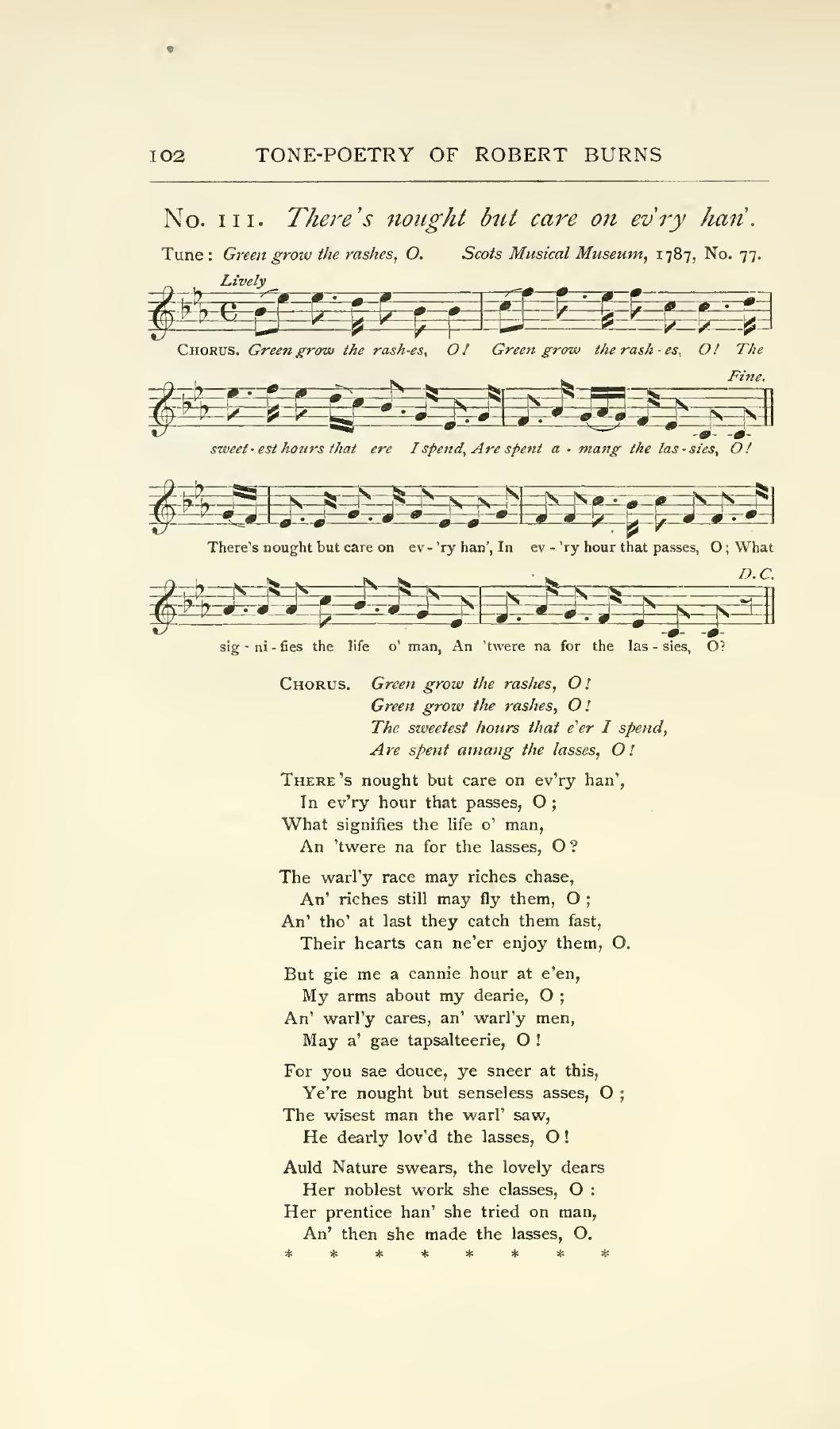 View score Dick’s Songs of Robert Burns (1903)
Lyrics
Choose an edition
Version notes
| Dick (1903) · no. 111 | Cunningham · 1855Ebook transcription |
|---|---|
| In ev’ry hour that passes, O; | In every hour that passes, O: |
| But gie me a cannie hour at e’en, | But gie me a canny hour at e’en, |
| Her prentice han’ she tried on man, | Her ‘prentice han’ she try’d on man, |
Dick (1903) · no. 111
Chorus. Green grow the rashes, O!
    Green grow the rashes, O!
The sweetest hours that e’er I spend,
    Are spent amang the lasses, O!

There’s nought but care on ev’ry han’,
    In ev’ry hour that passes, O;
What signifies the life o’ man,
    An ’twere na for the lasses, O?

The warl’y race may riches chase,
    An’ riches still may fly them, O;
An’ tho’ at last they catch them fast,
    Their hearts can ne’er enjoy them, O.

But gie me a cannie hour at e’en,
    My arms about my dearie, O;
An’ warl’y cares, an’ warl’y men,
    May a’ gae tapsalteerie, O!

For you sae douce, ye sneer at this,
    Ye’re nought but senseless asses, O;
The wisest man the warl’ saw,
    He dearly lov’d the lasses, O!

Auld Nature swears, the lovely dears
    Her noblest work she classes, O:
Her prentice han’ she tried on man,
    An’ then she made the lasses, O.
View the source edition · no. 111; p. 102
About this edition
Cunningham prints “canny”, “warly” and “try’d”; Dick has “cannie”, “warl’y” and “tried”. Cunningham’s fourth verse includes “the warl’ e’er saw”; Dick has “the warl’ saw”. Cunningham repeats the chorus after the last verse. The1787 witness retains its inherited screening status.
Edinburgh Poems (1787)
View the source edition · pp. 325–326
About this edition
Contents visually checked (1786 PDF 14–15;1787 PDF 55–56); short epitaphs additionally checked in 1786 PDF 237–240. Whole piece not newly read. Source-page range can include neighbouring text or notes.
Cunningham (1855)
Green grow the rashes, O!
  Green grow the rashes, O!
The sweetest hours that e’er I spend
  Are spent amang the lasses, O.

There’s nought but care on ev’ry han’,
  In every hour that passes, O:
What signifies the life o’ man,
  An’ ’twere na for the lasses, O.

The warly race may riches chase,
  An’ riches still may fly them, O;
An’ tho’ at last they catch them fast,
  Their hearts can ne’er enjoy them, O.

But gie me a canny hour at e’en,
  My arms about my dearie, O;
An’ warly cares, an’ warly men,
  May a’ gae tapsalteerie, O.

For you sae douce, ye sneer at this,
  Ye’re nought but senseless asses, O:
The wisest man the warl’ e’er saw,
  He dearly lov’d the lasses, O.

Auld Nature swears the lovely dears
  Her noblest work she classes, O:
Her ‘prentice han’ she try’d on man,
  An’ then she made the lasses, O.
    Green grow the rashes, O!
      Green grow the rashes, O!
    The sweetest hours that e’er I spend
      Are spent amang the lasses, O.
Digital text from Project Gutenberg.
View the source edition · p. 214
About this edition
Cunningham prints “canny”, “warly” and “try’d”; Dick has “cannie”, “warl’y” and “tried”. Cunningham’s fourth verse includes “the warl’ e’er saw”; Dick has “the warl’ saw”. Cunningham repeats the chorus after the last verse. The1787 witness retains its inherited screening status.
Scots Musical Museum, vol. I (1787) · no. 77
View the source edition · Volume 1, no. 77; p. 78
Music
View historical scores
Dick’s Songs of Robert Burns (1903)
no. 111; p. 102