Now Westlin Winds and Slaughtering Guns
Behind the song
Autumn brings grain for the farmer and danger for the birds. A moorcock rises from the heather; partridge, plover, woodcock and heron each have their own place in the landscape. The cushat keeps away from people. These separate lives give the song its breadth before the singer turns towards Peggy. [1]
The catalogue gathers force in the cry against “Tyrannic man's dominion”. The sportsman's pleasure becomes the wounded bird's fluttering wing. Then the singer invites Peggy to walk through the fields, among swallows, corn and fruiting thorn. The lovers share the pleasure of the creatures around them; the final promise measures her dearness against spring rain and the harvest. [1]
Read the fuller story
The Kilmarnock edition of 1786 calls it Song, composed in August and gives the tune as I had a horse, I had nae mair. The Edinburgh edition of 1787 repeats that designation. Both name Peggy in the fourth stanza and carry the complete movement from harvest through the protest against killing to the lovers' walk. [2][3]
Later editors attach different histories to Peggy. Dick reports a fragment associated by Burns's sister with Jean Armour, then says Burns changed the heroine to Peggy Thomson of Kirkoswald. Cunningham's introduction calls her “Montgomery's Peggy”. These competing identifications sit beside a lyric whose invitation is addressed simply to Peggy. [4][5]
Dick prints the song to Port Gordon. His note says Burns requested that air in manuscript lists and describes other settings used by Johnson and Thomson. Cunningham keeps I had a horse, I had nae mair above his text, titled Peggy. The contrasting headings show how the same five-stanza song could travel with different musical directions. [1][4][5]
Story references
- James C. Dick, The Songs of Robert Burns (1903), No. 11; printed pp. 10–11; PDF pp. 66–67
- Robert Burns, Poems, chiefly in the Scottish dialect (1786), printed 224–226; PDF 231–233
- Robert Burns, Poems, chiefly in the Scottish dialect (1787), printed 319–321; PDF 367–369
- James C. Dick, The Songs of Robert Burns (1903), Dick historical note 11; printed 354; PDF 410
- Allan Cunningham, The Complete Works of Robert Burns (1855), printed 212; HTML #songsXI. Project Gutenberg transcription.
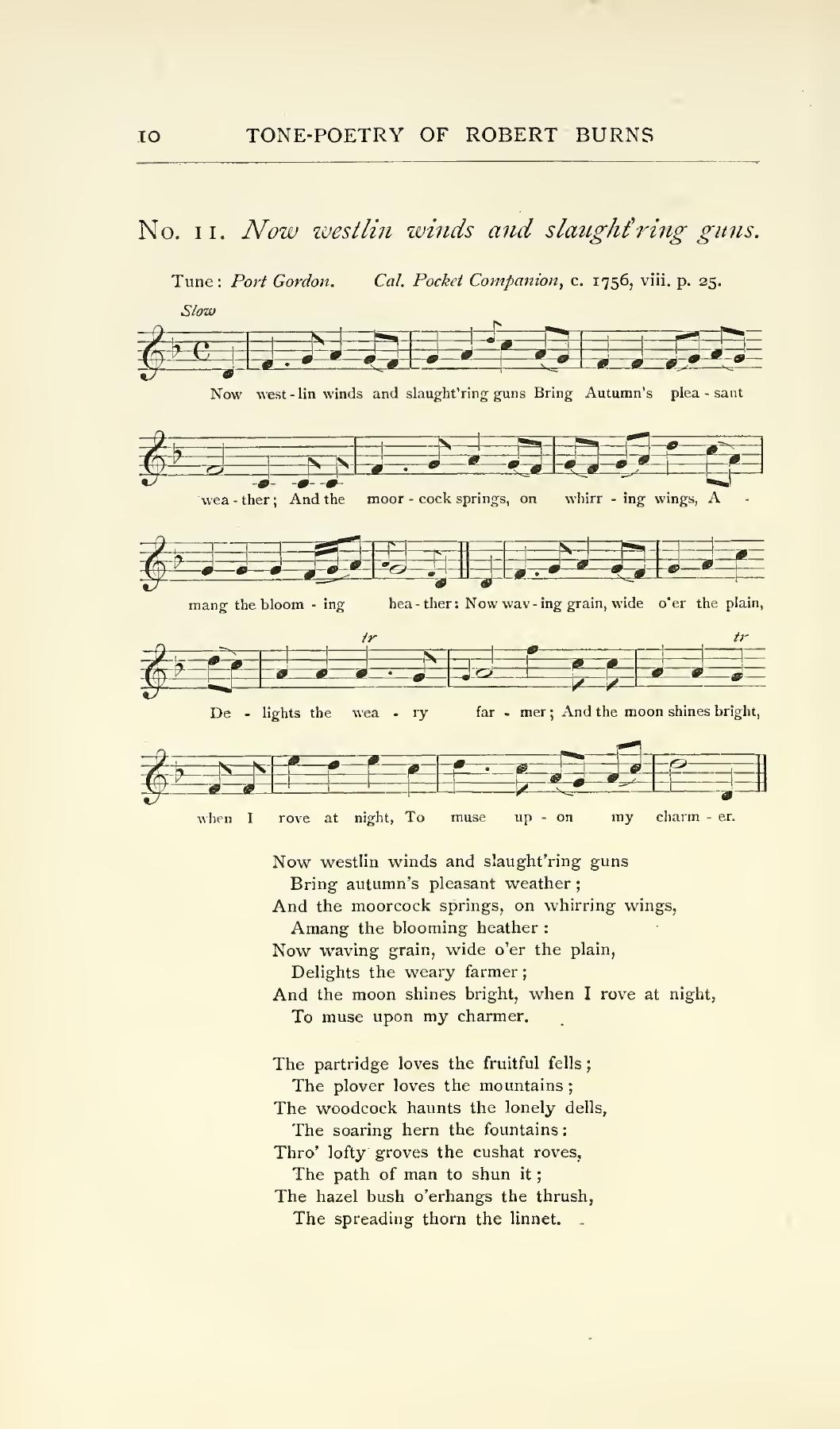 View score Dick’s Songs of Robert Burns (1903)
Lyrics
Choose an edition
Version notes
| Dick (1903) · no. 11 | Edinburgh Poems (1787) |
|---|---|
| And the moorcock | The moorcock |
| fluttering | flutt’ring |
| Port Gordon | I had a horse, I had nae mair |
| Dick (1903) · no. 11 | Kilmarnock Poems (1786) |
|---|---|
| fluttering | flutt’ring |
| Port Gordon | I had a horse, I had nae mair |
Dick (1903) · no. 11
Now westlin winds and slaught'ring guns
Bring autumn's pleasant weather;
And the moorcock springs, on whirring wings,
Amang the blooming heather:
Now waving grain, wide o'er the plain,
Delights the weary farmer;
And the moon shines bright, when I rove at night,
To muse upon my charmer.

The partridge loves the fruitful fells;
The plover loves the mountains;
The woodcock haunts the lonely dells,
The soaring hern the fountains:
Thro' lofty groves the cushat roves,
The path of man to shun it;
The hazel bush o'erhangs the thrush,
The spreading thorn the linnet.

Thus ev'ry kind their pleasure find,
The savage and the tender;
Some social join, and leagues combine;
Some solitary wander:
Avaunt, away! the cruel sway,
Tyrannic man's dominion;
The sportsman's joy, the murd'ring cry,
The fluttering, gory pinion!

But Peggy dear, the evening's clear,
Thick flies the skimming swallow;
The sky is blue, the fields in view,
All fading green and yellow:
Come let us stray our gladsome way,
And view the charms of Nature;
The rustling corn, the fruited thorn,
And ev'ry happy creature.

We'll gently walk, and sweetly talk,
Till the silent moon shine clearly;
I'll grasp thy waist, and fondly prest,
Swear how I love thee dearly:
Not vernal show'rs to budding flow'rs,
Not autumn to the farmer,
So dear can be, as thou to me,
My fair, my lovely charmer!
These are the words printed below the score.
View the source edition · no. 11; pp. 10–11
About this edition
All four inspected texts have five eight-line stanzas. The 1786 opening has “And the moorcock”; 1787 and Cunningham have “The moorcock”, against Dick’s “And the moorcock”. The 1786 and 1787 closing hunting line has “flutt’ring”, against Dick’s “fluttering”. Cunningham uses “every happy creature”, where Dick and the two early editions have “ev’ry happy creature”.
Kilmarnock Poems (1786)
View the source edition · pp. 224–226
About this edition
All four inspected texts have five eight-line stanzas. The 1786 opening has “And the moorcock”; 1787 and Cunningham have “The moorcock”, against Dick’s “And the moorcock”. The 1786 and 1787 closing hunting line has “flutt’ring”, against Dick’s “fluttering”. Cunningham uses “every happy creature”, where Dick and the two early editions have “ev’ry happy creature”.
Edinburgh Poems (1787)
View the source edition · pp. 319–321
About this edition
All four inspected texts have five eight-line stanzas. The 1786 opening has “And the moorcock”; 1787 and Cunningham have “The moorcock”, against Dick’s “And the moorcock”. The 1786 and 1787 closing hunting line has “flutt’ring”, against Dick’s “fluttering”. Cunningham uses “every happy creature”, where Dick and the two early editions have “ev’ry happy creature”.
Scots Musical Museum, vol. IV (1792) · no. 351
View the source edition · Volume 4, no. 351; p. 363
Music
View historical scores
Dick’s Songs of Robert Burns (1903)
no. 11; pp. 10–11