It Was upon a Lammas Night
Behind the song
Corn Rigs follows a remembered meeting with Annie through a moonlit field of barley. Time slips away, the pair sit among the growing crop, and the singer blesses the place that has held their embrace. The refrain turns that private recollection into the line everyone can join: he will always remember the night among the rigs. [1]
The landscape has the clarity of a few chosen details: blue sky, still wind and unclouded moonlight. The singer's account grows more emphatic as it proceeds. By the last stanza he is weighing the meeting against companionship, drink, money earned and the pleasures of thought. Even “three times doubled”, those other joys fall short of this one memory. [1]
Read the fuller story
Dick places the song about 1782 and points to its appearance in the Kilmarnock edition of 1786. He also quotes a short rustic predecessor about corn rigs and rye rigs. The shared field and refrain show the older material around which Burns built this sustained recollection. Dick transmits that fragment through Cromek's Reliques. [2]
Annie acquired several identities in later accounts. Cunningham names district traditions claiming Anne Ronald and Anne Blair. Dick says the identification remains unsettled and reports Scott-Douglas's claim for a farmer Rankine's daughter. Those competing traditions tell us how local readers attached the song to particular women; the lyric itself calls her Annie. [1][2][3]
Dick's separate lyric prints “tentless heed”; his footnote records “head” in the 1786 and 1787 editions. Cunningham also has “heed”, while placing the chorus after the four stanzas. Dick inserts it after the opening stanza and prints Corn rigs above the lively musical setting. The repeated refrain holds the changing verse arrangements together. [1][3]
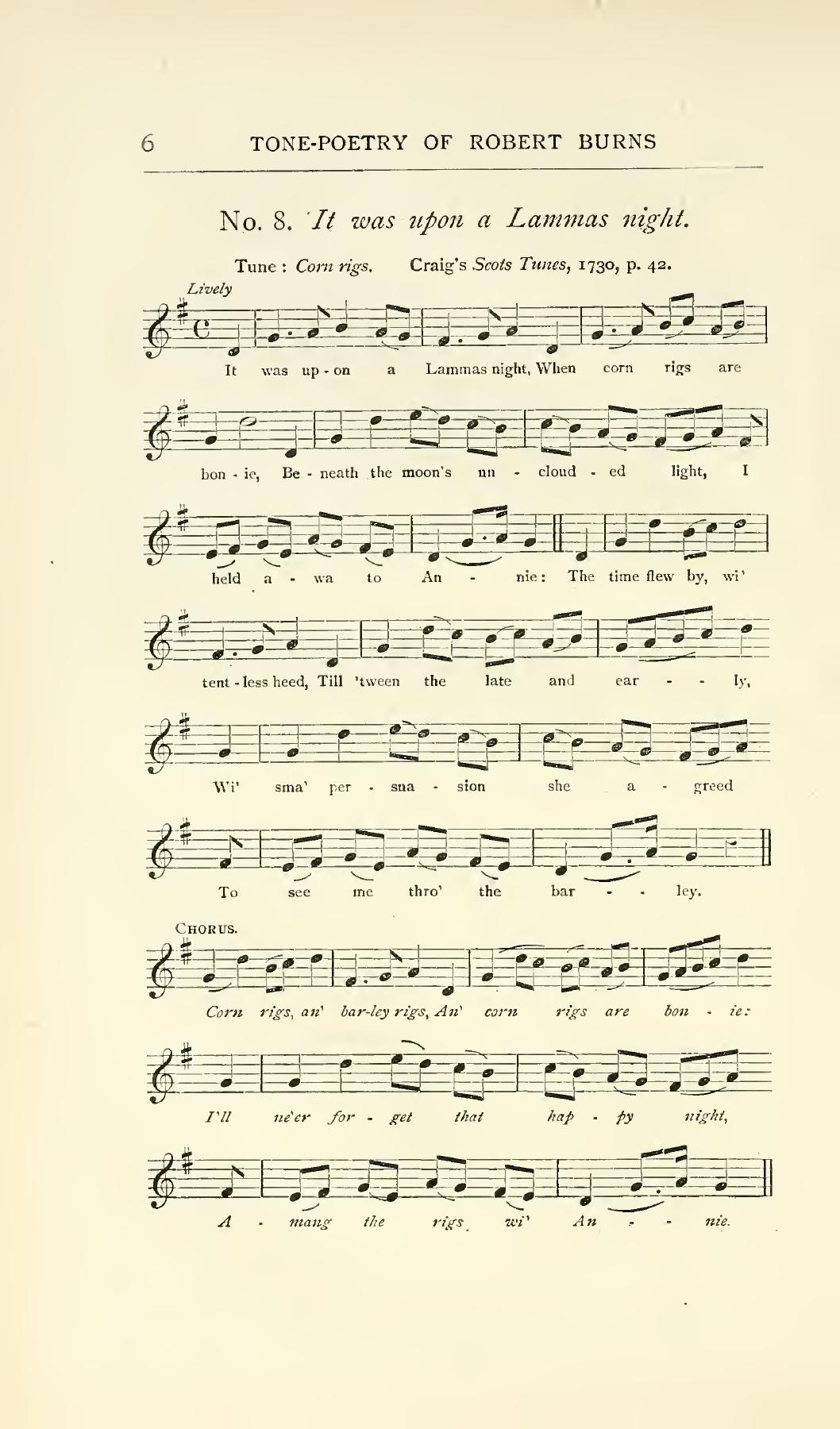 View score Dick’s Songs of Robert Burns (1903)
Lyrics
Version notes
The 1786 and 1787 editions give “tentless head”. Dick prints “tentless heed”. In the third stanza the moon shines “that night” in 1786 and “that hour” in 1787 and Dick. Kilmarnock Poems (1786) · Edinburgh Poems (1787) · Dick (1903) · no. 8
| Dick (1903) · no. 8 | Cunningham · 1855Ebook transcription |
|---|---|
| after stanza I | after stanza IV |
| clearly! | clearly? |
| Dick (1903) · no. 8 | Kilmarnock Poems (1786) |
|---|---|
| tentless heed | tentless head |
| kent; doubled; third-stanza happy night without comma | ken’t; doubl’d; third-stanza happy night followed by comma |
| Dick (1903) · no. 8 | Edinburgh Poems (1787) |
|---|---|
| tentless heed | tentless head |
| chorus after I; kent; doubled | chorus after IV; ken’t; doubl’d |
| Edinburgh Poems (1787) | Kilmarnock Poems (1786) |
|---|---|
| That shone that hour so clearly | That shone that night so clearly |
Dick (1903) · no. 8
It was upon a Lammas night,
When corn rigs are bonie,
Beneath the moon's unclouded light,
I held awa to Annie:
The time flew by, wi' tentless heed,
Till, 'tween the late and early,
Wi' sma' persuasion she agreed
To see me thro' the barley.

Chorus. Corn rigs, an' barley rigs,
An' corn rigs are bonie:
I'll ne'er forget that happy night,
Amang the rigs wi' Annie.

The sky was blue, the wind was still,
The moon was shining clearly;
I set her down, wi' right good will,
Amang the rigs o' barley:
I kent her heart was a' my ain;
I lov'd her most sincerely;
I kiss'd her owre and owre again,
Amang the rigs o' barley.

I lock'd her in my fond embrace;
Her heart was beating rarely:
My blessings on that happy place,
Amang the rigs o' barley!
But by the moon and stars so bright,
That shone that hour so clearly!
She ay shall bless that happy night
Amang the rigs o' barley.

I hae been blythe wi' comrades dear;
I hae been merry drinking;
I hae been joyfu' gath'rin gear;
I hae been happy thinking:
But a' the pleasures e'er I saw,
Tho' three times doubled fairly,
That happy night was worth them a',
Amang the rigs o' barley.
These are the words printed below the score.
View the source edition · no. 8; pp. 6–7
About this edition
Cunningham places the chorus after stanza IV; Dick places it after stanza I. Cunningham’s third stanza prints a question mark after “clearly”; Dick prints an exclamation mark. Dick’s footnote records head/heed in earlier editions.
Kilmarnock Poems (1786)
View the source edition · pp. 222–224
About this edition
Both early editions print “tentless head”, against Dick’s “tentless heed”. The 1786 third stanza has “That shone that night so clearly”; the 1787 edition and Dick have “That shone that hour so clearly”. Long s is typographical.
Edinburgh Poems (1787)
View the source edition · pp. 316–318
About this edition
Both early editions print “tentless head”, against Dick’s “tentless heed”. The 1786 third stanza has “That shone that night so clearly”; the 1787 edition and Dick have “That shone that hour so clearly”. Long s is typographical.
Cunningham (1855)
It was upon a Lammas night,
  When corn rigs are bonnie,
Beneath the moon’s unclouded light,
  I held awa to Annie:
The time flew by wi’ tentless heed,
  ’Till ’tween the late and early,
Wi’ sma’ persuasion she agreed,
  To see me through the barley.

The sky was blue, the wind was still,
  The moon was shining clearly;
I set her down wi’ right good will,
  Amang the rigs o’ barley:
I ken’t her heart was a’ my ain;
  I lov’d her most sincerely;
I kiss’d her owre and owre again,
  Amang the rigs o’ barley.

I lock’d her in my fond embrace!
  Her heart was beating rarely:
My blessings on that happy place.
  Amang the rigs o’ barley!
But by the moon and stars so bright.
  That shone that hour so clearly?
She ay shall bless that happy night,
  Amang the rigs o’ barley!

I hae been blithe wi’ comrades dear;
  I hae been merry drinkin’;
I hae been joyfu’ gath’rin’ gear;
  I hae been happy thinkin’:
But a’ the pleasures e’er I saw,
  Tho’ three times doubled fairly,
That happy night was worth them a’,
  Amang the rigs o’ barley.

Corn rigs, an’ barley rigs,
  An’ corn rigs are bonnie:
I’ll ne’er forget that happy night,
  Amang the rigs wi’ Annie.
Digital text from Project Gutenberg.
View the source edition · p. 210
About this edition
Cunningham places the chorus after stanza IV; Dick places it after stanza I. Cunningham’s third stanza prints a question mark after “clearly”; Dick prints an exclamation mark. Dick’s footnote records head/heed in earlier editions.
Music
View historical scores
Dick’s Songs of Robert Burns (1903)
no. 8; pp. 6–7