John Barleycorn
Behind the song
Three kings swear that John Barleycorn must die. They bury him under clods, only to see him rise again with the spring rain. The victim is barley, and the ballad turns the work of growing and processing grain into a succession of assaults on a living body. Its mock solemnity lets ordinary agricultural operations become a story of persecution and survival. [1]
The seasons shape the first part. Summer arms John’s head with spears; autumn bends his joints and makes him pale. Harvesting cuts him at the knee. The cart, the beating, the water, the heat and the millstones carry him through the later stages of processing. When his enemies drink his blood, the violence becomes convivial pleasure. The final toast asks that his descendants flourish in Scotland. [1]
Read the fuller story
Burns worked within an older ballad tradition. Dick quotes his Commonplace Book account of remembering three opening verses and scattered fragments of a song he had heard. Cunningham likewise describes the poem as composed on the plan of an older song. Dick surveys Scottish and English relatives, including poems about Allan o’ Maut and other versions of John Barleycorn. [2][3]
The tune requires its own distinction. Dick prints Lull me beyond thee from Playford’s Dancing Master of 1670, while his note leaves open whether Burns intended that melody or Cold and raw. The score therefore presents Dick’s chosen setting, a useful part of the song’s editorial history. [1][2]
Dick and Cunningham both print fifteen quatrains. Cunningham opens “There were three kings”; Dick has “There was three kings”. Their miller verses also differ: Cunningham ends “He crush’d him ’tween the stones”, while Dick gives “For he crush’d him ’tween two stones”. Those small changes sit within the same sustained transformation of grain into a resilient hero. [1][3]
Story references
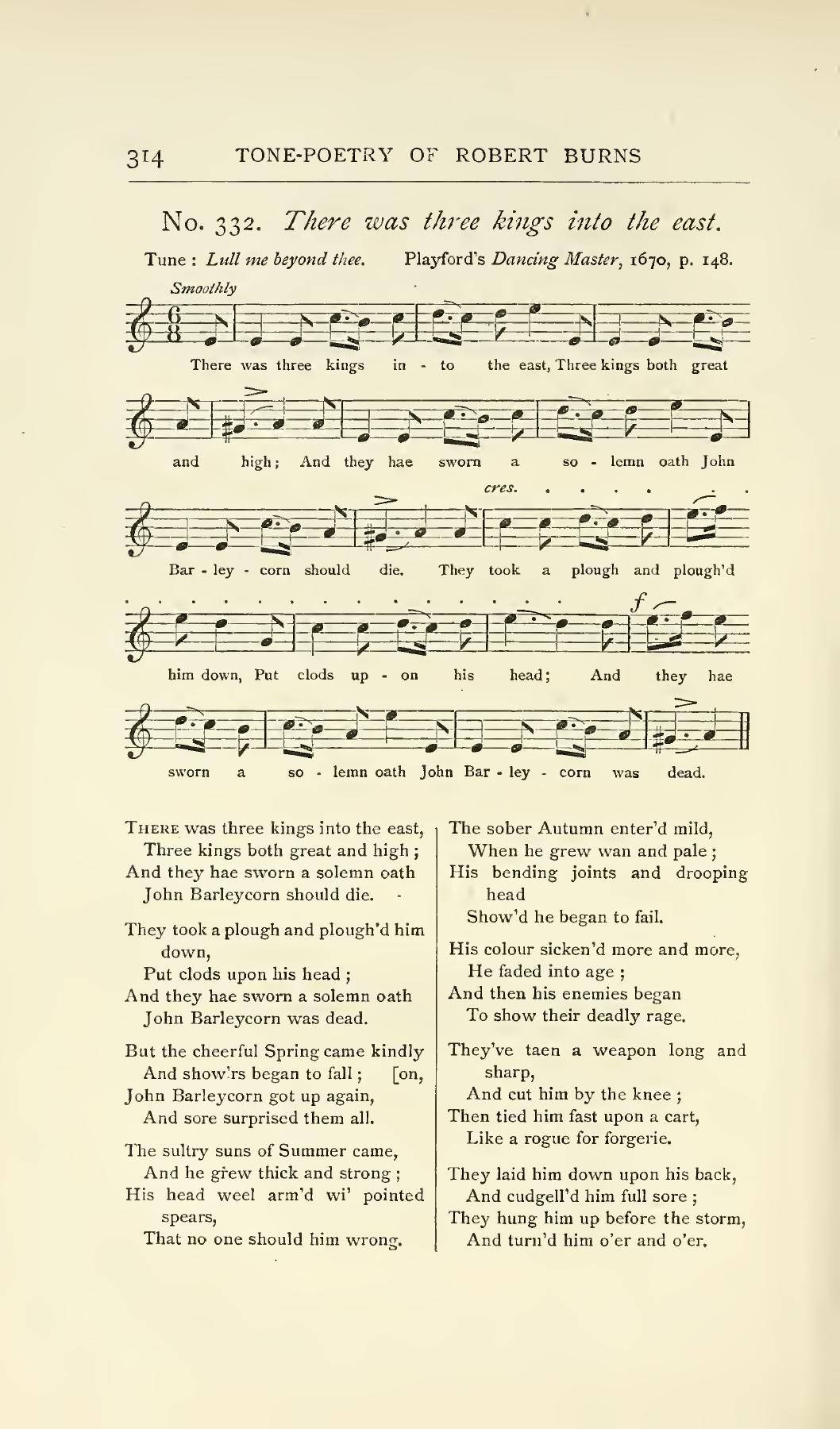 View score Dick’s Songs of Robert Burns (1903)
Lyrics
Choose an edition
Version notes
| Dick (1903) · no. 332 | Cunningham · 1855Ebook transcription |
|---|---|
| There was three kings into the east, | There were three kings into the east, |
| And they hae sworn a solemn oath | And they ha’e sworn a solemn oath |
| But the cheerful Spring came kindly on, | But the cheerful spring came kindly on, |
| His head weel arm’d wi’ pointed spears, | His head weel arm’d wi’ pointed spears |
More differences between these editions
| Dick (1903) · no. 332 | Cunningham · 1855Ebook transcription |
|---|---|
| The sober Autumn enter’d mild, | The sober autumn enter’d mild, |
| His bending joints and drooping head | His beading joints and drooping head |
| They’ve taen a weapon long and sharp, | They’ve ta’en a weapon, long and sharp, |
| Then tied him fast upon a cart, | Then ty’d him fast upon a cart, |
| They hung him up before the storm, | They hung him up before the storm. |
| And still, as signs of life appear’d | And still, as signs of life appear’d, |
| Then let us toast John Barleycorn | Then let us toast John Barleycorn, |
Dick (1903) · no. 332
There was three kings into the east,
    Three kings both great and high;
And they hae sworn a solemn oath
    John Barleycorn should die.

They took a plough and plough’d him down,
    Put clods upon his head;
And they hae sworn a solemn oath
    John Barleycorn was dead.

But the cheerful Spring came kindly on,
    And show’rs began to fall;
John Barleycorn got up again,
    And sore surprised them all.

The sultry suns of Summer came,
    And he grew thick and strong;
His head weel arm’d wi’ pointed spears,
    That no one should him wrong.

The sober Autumn enter’d mild,
    When he grew wan and pale;
His bending joints and drooping head
    Show’d he began to fail.

His colour sicken’d more and more,
    He faded into age;
And then his enemies began
    To show their deadly rage.

They’ve taen a weapon long and sharp,
    And cut him by the knee;
Then tied him fast upon a cart,
    Like a rogue for forgerie.

They laid him down upon his back,
    And cudgell’d him full sore;
They hung him up before the storm,
    And turn’d him o’er and o’er.

They filled up a darksome pit
    With water to the brim;
They heaved in John Barleycorn,—
    There, let him sink or swim!

They laid him out upon the floor,
    To work him farther woe;
And still, as signs of life appear’d
    They toss’d him to and fro.

They wasted o’er a scorching flame
    The marrow of his bones;
But a miller used him worst of all,
    For he crush’d him ’tween two stones.

And they hae taen his very heart’s blood,
    And drank it round and round;
And still the more and more they drank,
    Their joy did more abound.

John Barleycorn was a hero bold,
    Of noble enterprise;
For if you do but taste his blood,
    ’Twill make your courage rise.

’Twill make a man forget his woe;
    ’Twill heighten all his joy:
’Twill make the widow’s heart to sing,
    Tho’ the tear were in her eye.

Then let us toast John Barleycorn
    Each man a glass in hand;
And may his great posterity
    Ne’er fail in old Scotland!
View the source edition · no. 332; pp. 314–315
About this edition
Cunningham opens “There were”; Dick prints “There was”. Cunningham’s miller “crush’d him ’tween the stones”; Dick’s “crush’d him ’tween two stones”. The held ebook has “beading joints”, where Dick’s page clearly reads “bending joints”; that ebook reading is retained as a witness difference awaiting facsimile correction. The1787 witness retains its inherited status.
Edinburgh Poems (1787)
View the source edition · pp. 306–310
About this edition
Contents visually checked (1786 PDF 14–15;1787 PDF 55–56); short epitaphs additionally checked in 1786 PDF 237–240. Whole piece not newly read. Source-page range can include neighbouring text or notes.
Cunningham (1855)
There were three kings into the east,
  Three kings both great and high;
And they hae sworn a solemn oath
  John Barleycorn should die.

They took a plough and plough’d him down,
  Put clods upon his head;
And they ha’e sworn a solemn oath
  John Barleycorn was dead.

But the cheerful spring came kindly on,
  And show’rs began to fall;
John Barleycorn got up again,
  And sore surpris’d them all.

The sultry suns of summer came,
  And he grew thick and strong;
His head weel arm’d wi’ pointed spears
  That no one should him wrong.

The sober autumn enter’d mild,
  When he grew wan and pale;
His beading joints and drooping head
  Show’d he began to fail.

His colour sicken’d more and more,
  He faded into age;
And then his enemies began
  To show their deadly rage.

They’ve ta’en a weapon, long and sharp,
  And cut him by the knee;
Then ty’d him fast upon a cart,
  Like a rogue for forgerie.

They laid him down upon his back,
  And cudgell’d him full sore;
They hung him up before the storm.
  And turn’d him o’er and o’er.

They filled up a darksome pit
  With water to the brim;
They heaved in John Barleycorn,
  There let him sink or swim.

They laid him out upon the floor,
  To work him farther woe;
And still, as signs of life appear’d,
  They toss’d him to and fro.

They wasted o’er a scorching flame
  The marrow of his bones;
But a miller us’d him worst of all—
  He crush’d him ’tween the stones.

And they ha’e ta’en his very heart’s blood,
  And drank it round and round;
And still the more and more they drank,
  Their joy did more abound.

John Barleycorn was a hero bold,
  Of noble enterprise;
For if you do but taste his blood,
  ’Twill make your courage rise.

’Twill make a man forget his woe;
  ’Twill heighten all his joy:
’Twill make the widow’s heart to sing,
  Tho’ the tear were in her eye.

Then let us toast John Barleycorn,
  Each man a glass in hand;
And may his great posterity
  Ne’er fail in old Scotland!
Digital text from Project Gutenberg.
View the source edition · p. 210
About this edition
Cunningham opens “There were”; Dick prints “There was”. Cunningham’s miller “crush’d him ’tween the stones”; Dick’s “crush’d him ’tween two stones”. The held ebook has “beading joints”, where Dick’s page clearly reads “bending joints”; that ebook reading is retained as a witness difference awaiting facsimile correction. The1787 witness retains its inherited status.
Music
View historical scores
Dick’s Songs of Robert Burns (1903)
no. 332; pp. 314–315
Reworked or extended by Burns
Dick quotes Burns recalling three old verses and fragments interwoven into his song.
Words Robert Burns and an earlier ballad tradition
Burns’s role Reworking of remembered older verses