Man Was Made to Mourn
Behind the poem
An old man meets a younger wanderer beside the river in November and offers him a bleak account of human life. Years, care and poverty have worn him down. The poem’s most searching questions concern the suffering people cause one another, especially the power of the wealthy to deny the poor a livelihood.[1]
Read the fuller story
The 1786 Kilmarnock edition calls the poem “A Dirge”. Its eleven numbered eight-line stanzas begin in a landscape stripped bare by a cold wind. The old man enters this bleak landscape with a worn face and weary step. He asks whether the stranger is pursuing wealth or pleasure, or has already begun to share his sorrow. The conversation makes the poem an encounter between youth and experience, with the elder voice steadily taking possession of the scene.[1][2]
Looking across the moors, the old man sees hundreds labouring to support a lordling’s pride. He has watched eighty winters pass, each adding evidence for the refrain that humanity was made to mourn. His survey includes wasted youth, unruly passions and the painful conjunction of age with want. The repeated return to mourning gives the poem its slow, insistent movement, while each stanza adds another cause for the judgement.[1]
A decisive distinction appears between afflictions woven into human nature and injuries of our own making. Regret, remorse and shame sharpen suffering; cruelty extends it to others. The phrase “Man’s inhumanity to Man” follows an image of a face capable of expressing love. That proximity makes the failure of sympathy especially severe. People possess the capacity for tenderness and still make multitudes miserable.[1]
The next example brings the argument to a household in distress. An exhausted labourer asks another human being for permission to work, and his request is rejected despite the needs of his wife and children. The powerful man is called a “fellow-worm”, a phrase that cuts his pretensions down to the shared condition of mortality. The old man then asks why he has an independent wish if nature intended him for servitude. If it did not, what justifies another person’s cruelty and scorn?[1]
The closing movement offers consolation without resolving that challenge. The old man hopes that this partial view of human life cannot be the last, and that honest people who suffer oppression must have some recompense. He finally welcomes death as the poor man’s friend and rest for his aged limbs. The wealthy fear losing their pleasures; the burdened look towards relief. The dirge ends with that unequal experience of a common fate, leaving its protest against avoidable suffering as forceful as its lament for human frailty.[1]
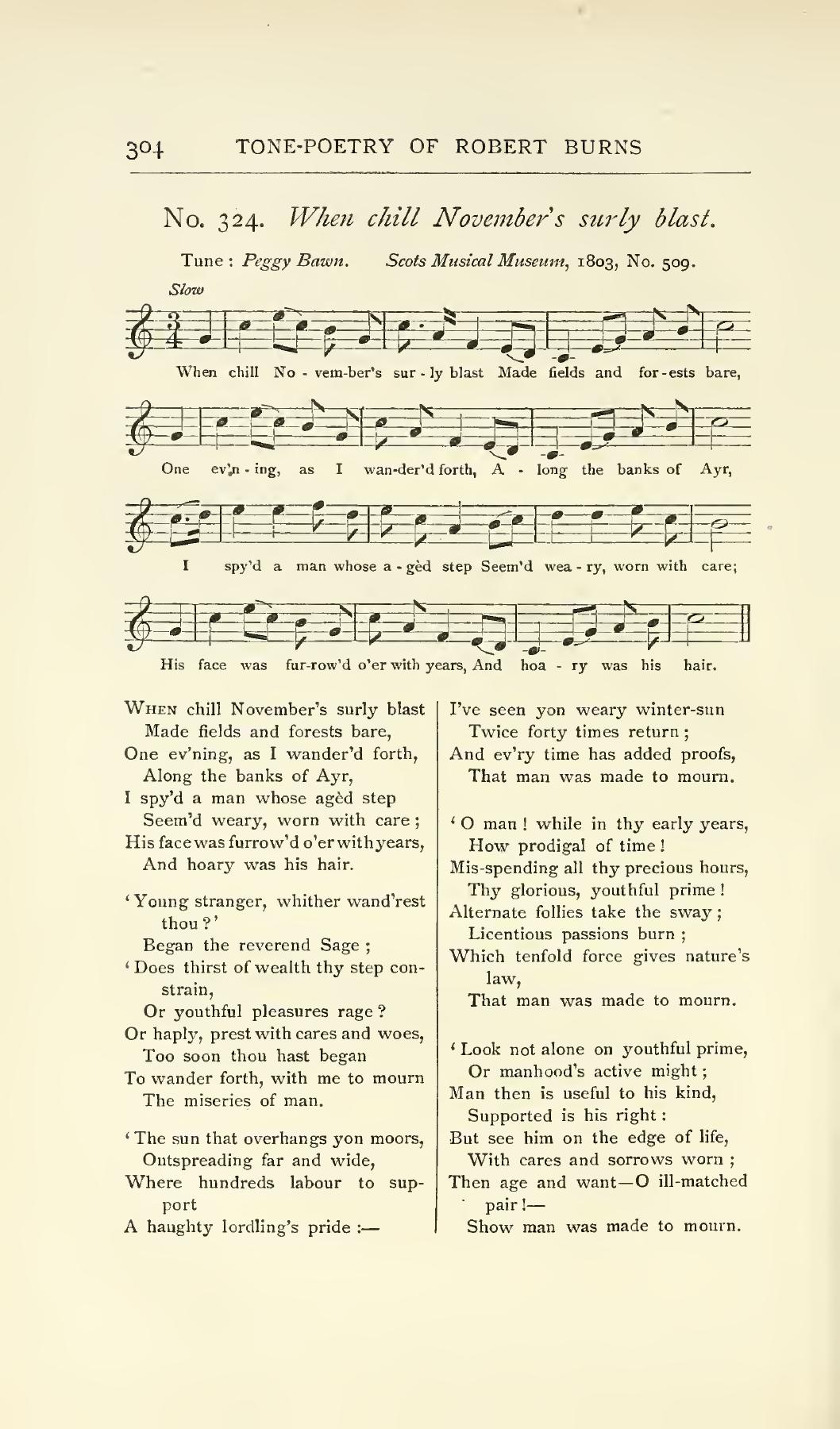 View score Dick’s Songs of Robert Burns (1903)
Poem
Choose an edition
Kilmarnock Poems (1786)
MAN WAS MADE TO MOURN,
A DIRGE.
I.
WHEN chill November’s surly blast
    Made fields and forests bare,
One ev’ning, as I wand’red forth,
    Along the banks of AIRE,
I spy’d a man, whose aged step
    Seem’d weary, worn with care;
His face was furrow’d o’er with years,
    And hoary was his hair.

II.
Young stranger, whither wand’rest thou?
    Began the rev’rend Sage;
Does thirst of wealth thy step constrain,
    Or youthful Pleasure’s rage?
Or haply, prest with cares and woes,
    Too soon thou hast began,
To wander forth, with me, to mourn
    The miseries of Man.

III.
The Sun that overhangs yon moors,
    Out-spreading far and wide,
Where hundreds labour to support
    A haughty lordling’s pride;
I’ve seen yon weary winter-sun
    Twice forty times return;
And ev’ry time has added proofs,
    That Man was made to mourn.

IV.
O Man! while in thy early years,
    How prodigal of time!
Mispending all thy precious hours,
    Thy glorious, youthful prime!
Alternate Follies take the sway;
    Licentious Passions burn;
Which tenfold force gives Nature’s law,
    That Man was made to mourn.

V.
Look not alone on youthful Prime,
    Or Manhood’s active might;
Man then is useful to his kind,
    Supported is his right:
But see him on the edge of life,
    With Cares and Sorrows worn,
Then Age and Want, Oh! ill-match’d pair!
    Show Man was made to mourn.

VI.
A few seem favourites of Fate,
    In Pleasure’s lap carest;
Yet, think not all the Rich and Great,
    Are likewise truly blest.
But Oh! what crouds in ev’ry land,
    All wretched and forlorn,
Thro’ weary life this lesson learn,
    That Man was made to mourn!

VII.
Many and sharp the num’rous Ills
    Inwoven with our frame!
More pointed still we make ourselves,
    Regret, Remorse and Shame!
And Man, whose heav’n-erected face,
    The smiles of love adorn,
Man’s inhumanity to Man
    Makes countless thousands mourn!

VIII.
See, yonder poor, o’erlabour’d wight,
    So abject, mean and vile,
Who begs a brother of the earth
    To give him leave to toil;
And see his lordly fellow-worm,
    The poor petition spurn,
Unmindful, tho’ a weeping wife,
    And helpless offspring mourn.

IX.
If I’m design’d yon lordling’s slave,
    By Nature’s law design’d,
Why was an independent wish
    E’er planted in my mind?
If not, why am I subject to
    His cruelty, or scorn?
Or why has Man the will and pow’r
    To make his fellow mourn?

X.
Yet, let not this too much, my Son,
    Disturb thy youthful breast:
This partial view of human-kind
    Is surely not the last!
The poor, oppressed, honest man
    Had never, sure, been born,
Had there not been some recompence
    To comfort those that mourn!

XI.
O Death! the poor man’s dearest friend,
    The kindest and the best!
Welcome the hour, my aged limbs
    Are laid with thee at rest!
The Great, the Wealthy fear thy blow,
    From pomp and pleasure torn;
But Oh! a blest relief for those
    That weary-laden mourn!
Complete 1786 poem compared with the original page images.
View the source edition · pp. 160–165
About this edition
The reading follows the Kilmarnock edition of 1786, printed pages 160–165. Long s is shown as s; apostrophes and quotation marks use modern typographic forms. Original words, spelling and capitals are retained. Wrapped verse lines are rejoined, stanza divisions and indentation are preserved, and italic type is rendered in roman. Page numbers, signatures and ornaments are omitted. Printed stanza numbering is retained. The title’s description “A DIRGE” is retained.
Dick (1903) · no. 324
The words are on the score page.
View the source edition · no. 324; pp. 304–305
Edinburgh Poems (1787)
View the source edition · pp. 224–229
About this edition
Contents visually checked (1786 PDF14–15;1787 PDF55–56); short epitaphs additionally checked in1786 PDF237–240. Whole piece not newly read. Source-page range can include neighbouring text or notes.
Cunningham (1855)
When chill November’s surly blast
  Made fields and forests bare,
One ev’ning as I wandered forth
  Along the banks of Ayr,
I spy’d a man whose aged step
  Seem’d weary, worn with care;
His face was furrow’d o’er with years,
  And hoary was his hair.

“Young stranger, whither wand’rest thou?”
  Began the rev’rend sage;
“Does thirst of wealth thy step constrain,
  Or youthful pleasure’s rage?
Or haply, prest with cares and woes,
  Too soon thou hast began
To wander forth, with me to mourn
  The miseries of man.

“The sun that overhangs yon moors,
  Out-spreading far and wide,
Where hundreds labour to support
  A haughty lordling’s pride:
I’ve seen yon weary winter-sun
  Twice forty times return,
And ev’ry time had added proofs
  That man was made to mourn.

“O man! while in thy early years,
  How prodigal of time!
Misspending all thy precious hours,
  Thy glorious youthful prime!
Alternate follies take the sway;
  Licentious passions burn;
Which tenfold force gives nature’s law,
  That man was made to mourn.

“Look not alone on youthful prime,
  Or manhood’s active might;
Man then is useful to his kind,
  Supported in his right:
But see him on the edge of life,
  With cares and sorrows worn;
Then age and want—oh! ill-match’d pair!—
  Show man was made to mourn.

“A few seem favorites of fate,
  In pleasure’s lap carest:
Yet, think not all the rich and great
  Are likewise truly blest.
But, oh! what crowds in every land,
  All wretched and forlorn!
Thro’ weary life this lesson learn—
  That man was made to mourn.

“Many and sharp the num’rous ills
  Inwoven with our frame!
More pointed still we make ourselves,
  Regret, remorse, and shame!
And man, whose heaven-erected face
  The smiles of love adorn,
Man’s inhumanity to man
  Makes countless thousands mourn!

“See yonder poor, o’erlabour’d wight,
  So abject, mean, and vile,
Who begs a brother of the earth
  To give him leave to toil;
And see his lordly fellow-worm
  The poor petition spurn,
Unmindful, though a weeping wife
  And helpless offspring mourn.

“If I’m design’d yon lordling’s slave—
  By Nature’s law design’d—
Why was an independent wish
  E’er planted in my mind?
If not, why am I subject to
  His cruelty or scorn?
Or why has man the will and power
  To make his fellow mourn?

“Yet, let not this too much, my son,
  Disturb thy youthful breast;
This partial view of human-kind
  Is surely not the best!
The poor, oppressed, honest man
  Had never, sure, been born,
Had there not been some recompense
  To comfort those that mourn!

“O Death! the poor man’s dearest friend—
  The kindest and the best!
Welcome the hour, my aged limbs
  Are laid with thee at rest!
The great, the wealthy, fear thy blow,
  From pomp and pleasure torn!
But, oh! a blest relief to those
  That weary-laden mourn.”
Digital text from Project Gutenberg.
View the source edition · p. 95
About this edition
Cunningham’s preface discusses several poems he left out of the collection.
Music
View historical scores
Dick’s Songs of Robert Burns (1903)
no. 324; pp. 304–305
Burns’s own writing
The poem appears in Burns’s Kilmarnock volume of 1786 under the description “A Dirge”.
Words Robert Burns
Burns’s role Author of the poem