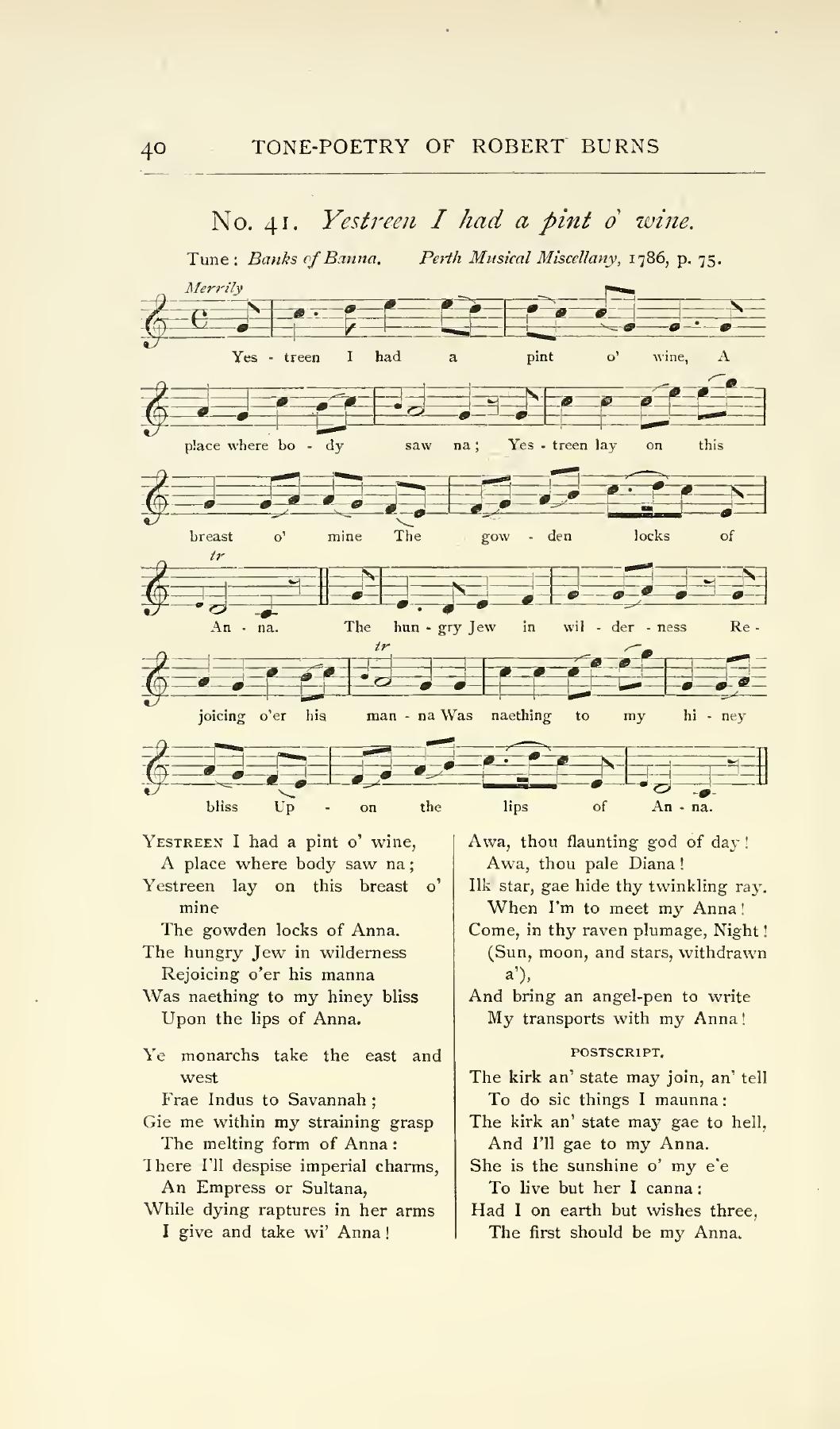
 Open full image
James C. Dick - 1903 - NLS · Licence · Source
Allan Cunningham’s 1855 introduction to The Gowden Locks of Anna rejected the idea that Robert Burns could have called the song one of his finest love songs. Cunningham thought such praise showed bad taste. His judgement formed part of the editorial commentary through which readers encountered Burns’s bawdy writing.
A fuller letter printed later by William Scott Douglas complicated that judgement. Dated 7 April 1793, it records Burns praising a song, sending its original form for Andrew Erskine and an altered copy for George Thomson’s proposed publication. Douglas identified the song as Anna.
The disagreement concerns both the surviving text and an editor’s willingness to accept Burns’s own assessment. Later Merry Muses editions added further questions about a concluding stanza and the tune. Cunningham’s headnote shows how an editor’s view of Burns’s reputation could affect what he accepted as Burns’s own words.
Sources
- The Complete Works of Robert Burns: poems, songs and correspondence · songCLXXVII
- The Works of Robert Burns, volume sixth: Prose · Scott Douglas VI (1895), pp.239–243,7 April1793 letter and editorial note
- The Merry Muses of Caledonia · Merry Muses1911, pp.38–39, postscript and tune headings