 Open full image
Rare Print Collection · 1900 · Cornell/IA · Licence · Source
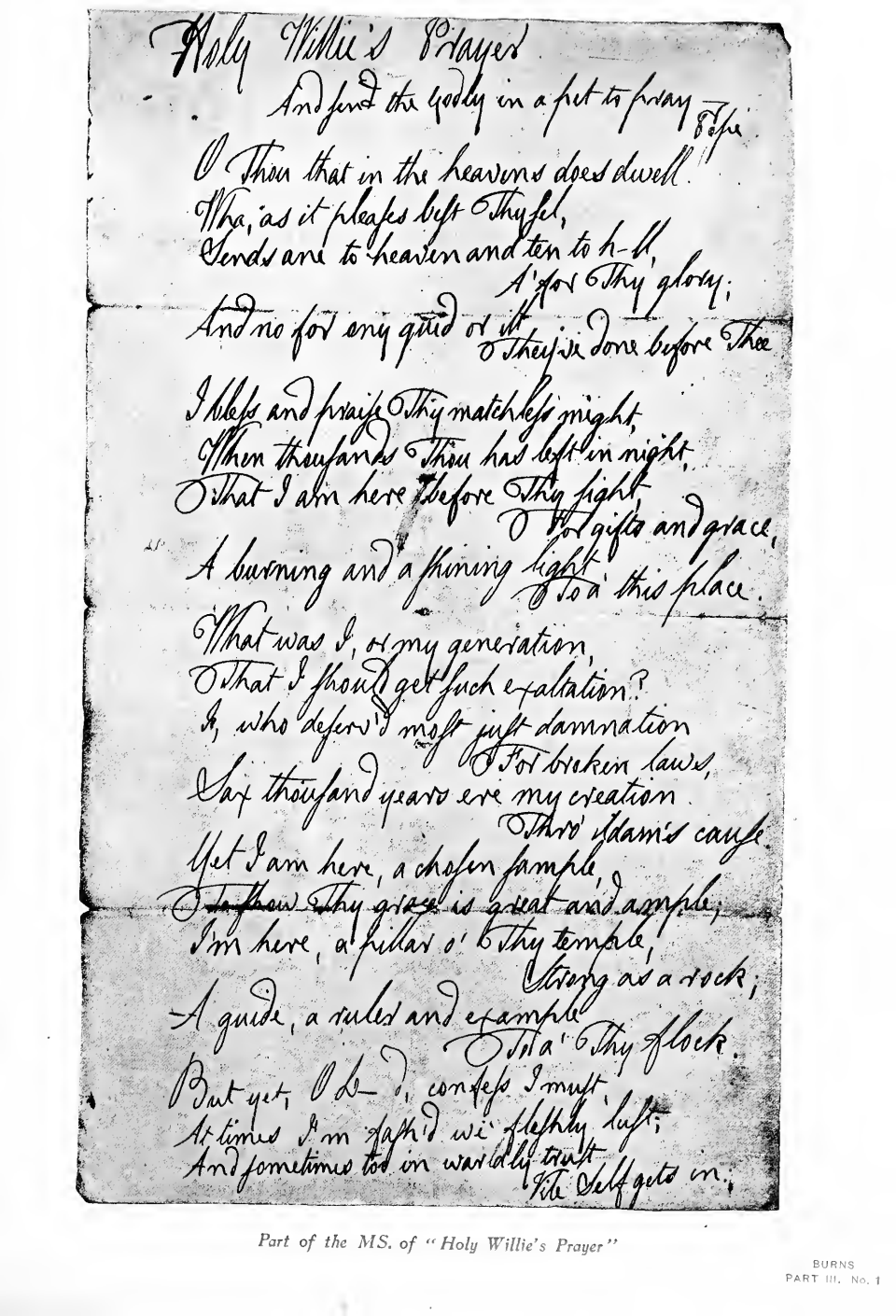
Robert Burns wrote Holy Willie's Prayer amid the religious quarrels of Mauchline in 1785. His friend and landlord Gavin Hamilton had been in dispute with the local church authorities. William Fisher, an elder on the opposing side, supplied the historical figure behind the poem's speaker.
The poem gives Willie a prayer in which he praises his own privileged standing before God. He confesses drunkenness and sexual misconduct while finding excuses for himself, then calls for punishment against his enemies. Hamilton, the Ayr presbytery (the district church court) and the advocate Robert Aiken become targets of his anger.
Burns lets the speaker expose himself through his own reasoning. The local dispute becomes a comic demonstration of the different standards Willie applies to himself and other people. Burns later told John Moore that the poem had alarmed the parish church court. It circulated in manuscript before reaching print in a small Kilmarnock chapbook in 1789, carrying the Mauchline quarrel to readers beyond the parish.
Sources
- The Complete Works of Robert Burns: poems, songs and correspondence · Letter LXXIV, p.356
- NLS Glenriddell Manuscripts · Glenriddell manuscript account, HolyWillie discussion
- A Bibliography of Robert Burns for the 21st Century:1786–1802 · Lamont bibliography entry15 p29
- The Complete Works of Robert Burns: poems, songs and correspondence · Cunningham1855 poemXVII pp79–80