Earning a living
Burns worked on family farms, tried flax-dressing and published his poems before finding a regular salary in the Excise. Writing continued through each change of occupation. [1][2][3][4][5][2]
The family economy
William worked as a gardener and Agnes managed a small dairy at Alloway. The move to Mount Oliphant brought the children into the work of farming. In his letter to John Moore, Robert remembered himself as a practised ploughman and Gilbert as able to drive the plough and help with threshing. [6][7][8][9][1]
His recollection of beginning to make verse also comes from a harvest field, where a fellow worker’s singing encouraged him. Read A harvest partner and the beginning of verse. He continued farming at Lochlea and Mossgiel. [1][2]
Attempts at independence
At Irvine, Burns learnt flax-dressing, preparing fibres for linen. He later recalled that a fire during New Year celebrations ended the venture. [3] His letter home just before New Year and Gilbert’s account explain the hopes and difficulties surrounding it. Read The flax shop and the New Year fire.
At Irvine, Burns also formed a friendship with Richard Brown. Years later he credited Brown’s response to his verses with encouraging his poetic ambition. Read The friend who heard a poet.
Publication offered another possibility. John Wilson printed the Kilmarnock poems in 1786; Burns later connected the proceeds with his proposed departure for Jamaica, where the contemplated employment involved supervising enslaved labour. His account then describes the encouragement that helped redirect his plans towards Edinburgh. [4][5]
Farming and the excise
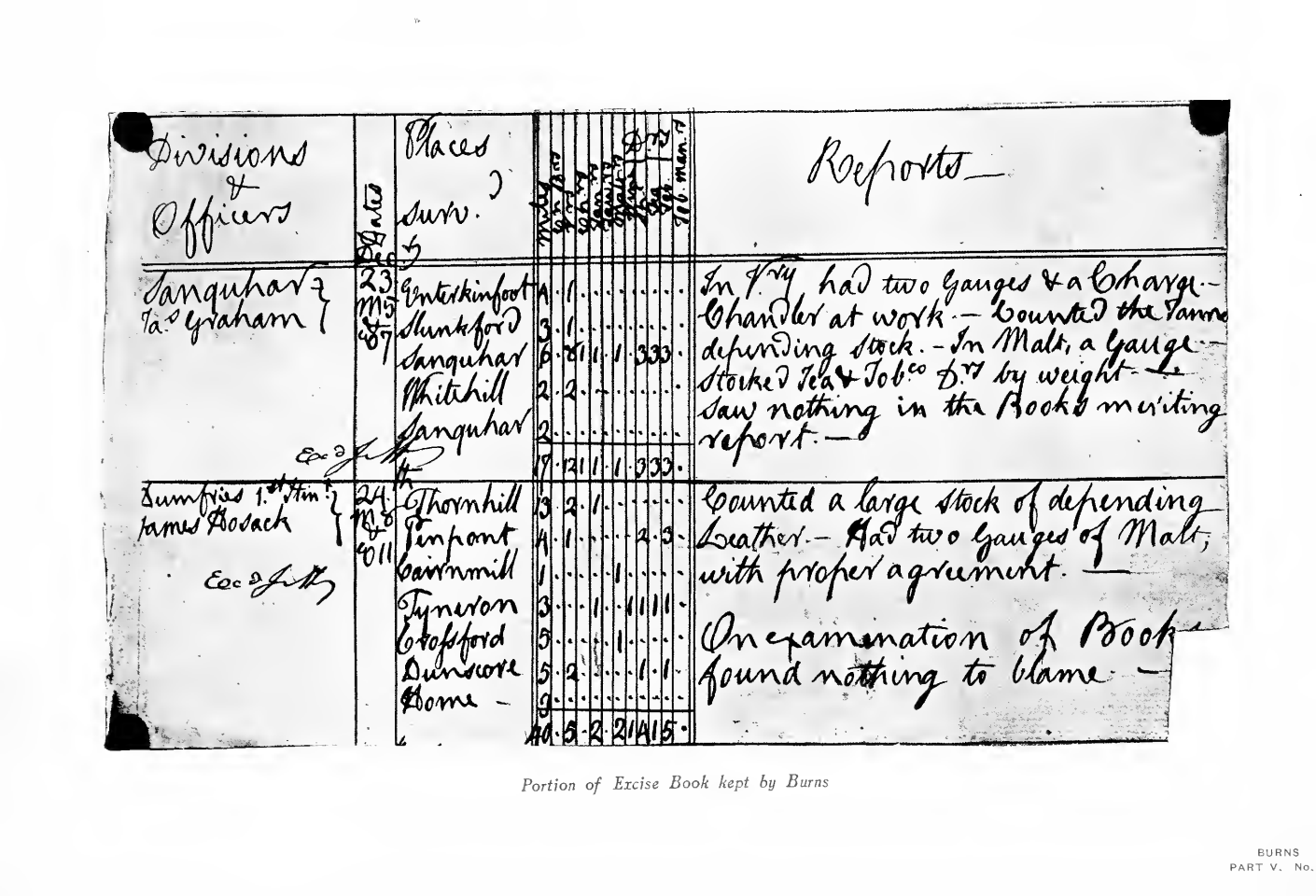
Burns moved to Ellisland in 1788, began excise work in 1789 and moved to Dumfries in 1791, when excise employment became his full-time occupation. [2]
Read Ellisland: a farm, a family and a living.
The seizure of a smuggling vessel in the Solway in February 1792 brings that work into sharp focus. Burns led one of the parties approaching the armed ship. An account largely in his handwriting records the expenses of guarding and repairing her before sale. Read Burns, the smugglers and the four cannon.
Alongside employment, he continued working with James Johnson and George Thomson on Scottish songs. The Works collection follows those contributions individually, linking the songs to their printed versions and music. [10]
References
- The works of Robert Burns; with an account of his life, volume I · I pp40-42; PDF78-80
- University of Glasgow Burns booklet, including timeline · pp4-5; PDF4
- The works of Robert Burns; with an account of his life, volume I · I p50; PDF88
- Kilmarnock Poems, 1786; Glasgow digitisation · title; PDF8
- The works of Robert Burns; with an account of his life, volume I · I pp54-56; PDF92-94
- The works of Robert Burns; with an account of his life, volume I · I pp36-37; PDF74-75
- The works of Robert Burns; with an account of his life, volume I · I pp58-60; PDF96-98
- The works of Robert Burns; with an account of his life, volume I · I p60; PDF98
- The works of Robert Burns; with an account of his life, volume I · I p62; PDF100
- Scottish Poetry Library: Robert Burns · Biography, final two substantive paragraphs