William Burnes and the winter evening lessons
When John Murdoch left the district, William Burnes took on the teaching himself. The family was living at Mount Oliphant, the children were useful on the farm, and there was no school close at hand. Gilbert Burns remembered his father teaching arithmetic on winter evenings by candlelight. He added that his two elder sisters received all their education in this way.[1]
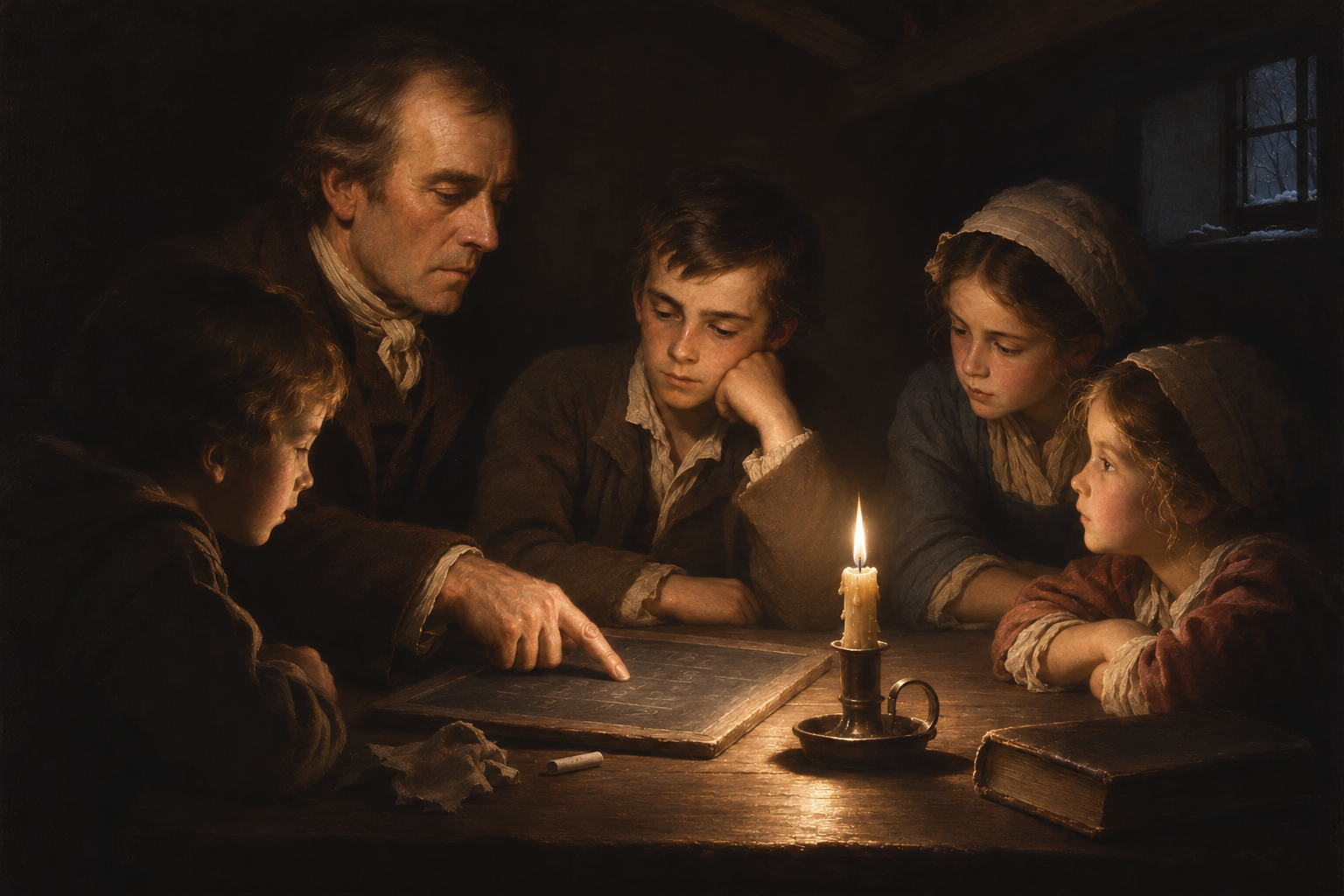
Later in the same account, Gilbert mentions an uncle who had lived with them and learned some arithmetic by their winter candle. William’s household teaching reached an adult learner too.[1]
Making time for learning
William had already helped to organise a school. Murdoch recalled being engaged by him and four neighbours to teach at Alloway. The five employers took turns boarding the young teacher and undertook to make up an agreed salary if the pupils’ quarterly payments fell short. After the family moved to Mount Oliphant, the distance made regular attendance difficult. Murdoch’s departure left William with a practical problem: how to keep the children learning while their work was needed at home.[1][2]
The arithmetic lessons were one answer. Conversation was another. Gilbert remembered a quiet, isolated life, with few visitors and no nearby boys of their own age. For a time, their father was almost their only companion. He spoke to them “as if we had been men”, using their hours together on the farm to explain things and encourage habits he considered virtuous.[1]
Books about the wider world
William borrowed Salmon’s Geographical Grammar to teach them about the situation and history of countries. Through a book society in Ayr, he obtained access to Derham’s works on physical and astronomical theology and Ray’s Wisdom of God in the Creation. Gilbert described these as introductions to astronomy and natural history. Books concerned with God’s creation were also ways of learning about the natural world.[1]
William had subscribed to Stackhouse’s History of the Bible, which Gilbert credited with giving Robert knowledge of ancient history. Robert read these substantial books eagerly. Gilbert remembered that their length and age did little to discourage him.[1]
Read about the borrowed books that sent Burns to Leglen Wood →
One book arrived by accident. The uncle who had learned arithmetic went to an Ayr bookseller for a ready reckoner and a guide to writing letters. Instead of the letter-writing manual he intended to buy, he came away with a small collection of letters by distinguished writers, accompanied by advice on style. Gilbert remembered this as especially valuable to Robert: it supplied examples and stirred a wish to become a good letter-writer himself.[1]
A learner becomes a teacher
Murdoch remembered that he and William both insisted on understanding the words children learned by heart. In his own lessons, Murdoch had the boys put verse into ordinary prose order, find alternative expressions and supply words left understood. These exercises tested meaning while developing their command of language.[2]
William continued to seek outside teaching when he could. Concerned about the boys’ handwriting, he sent Robert and Gilbert to Dalrymple parish school in alternate weeks during a summer quarter. Gilbert placed this when Robert was about thirteen or fourteen.[1]
In 1773, Robert returned to Murdoch in Ayr to revise English grammar. Murdoch gave a family purpose for that visit: Robert was to become better able to teach his brothers and sisters at home.[2]
References
[1] Gilbert Burns’s account to Mrs Dunlop, in James Currie, ed., The Works of Robert Burns; with an Account of His Life, vol. I (Liverpool: J. M’Creery, 1800), pp. 62, 64–66. Gilbert’s later recollections supply the evening lessons, family learners, conversations, books and Dalrymple schooling. Read the scanned volume ↗.
[2] John Murdoch’s account, in James Currie, ed., The Works of Robert Burns, vol. I (1800), pp. 89–92. His recollections describe the school’s support, teaching methods, distance from Mount Oliphant and Robert’s return to study in 1773. Read the scanned volume ↗.