Nine at the cottage
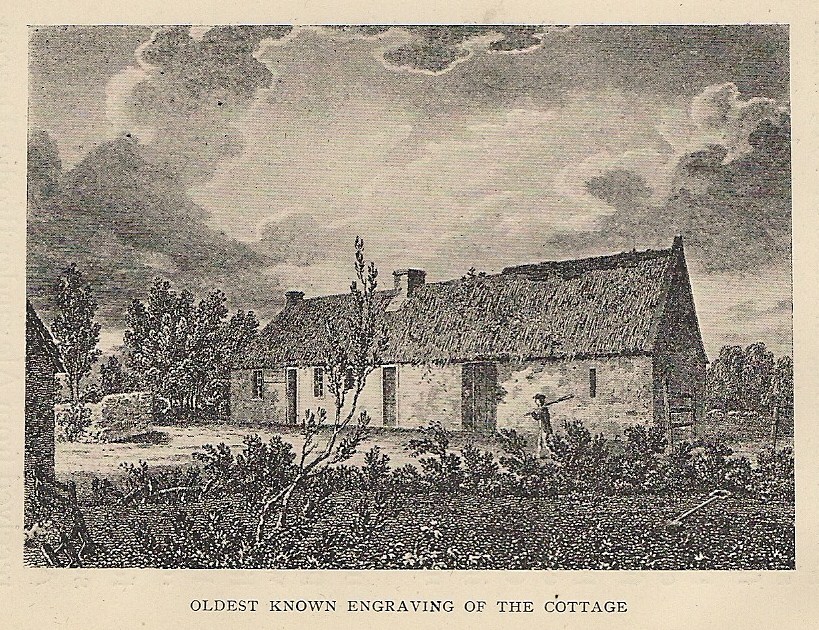
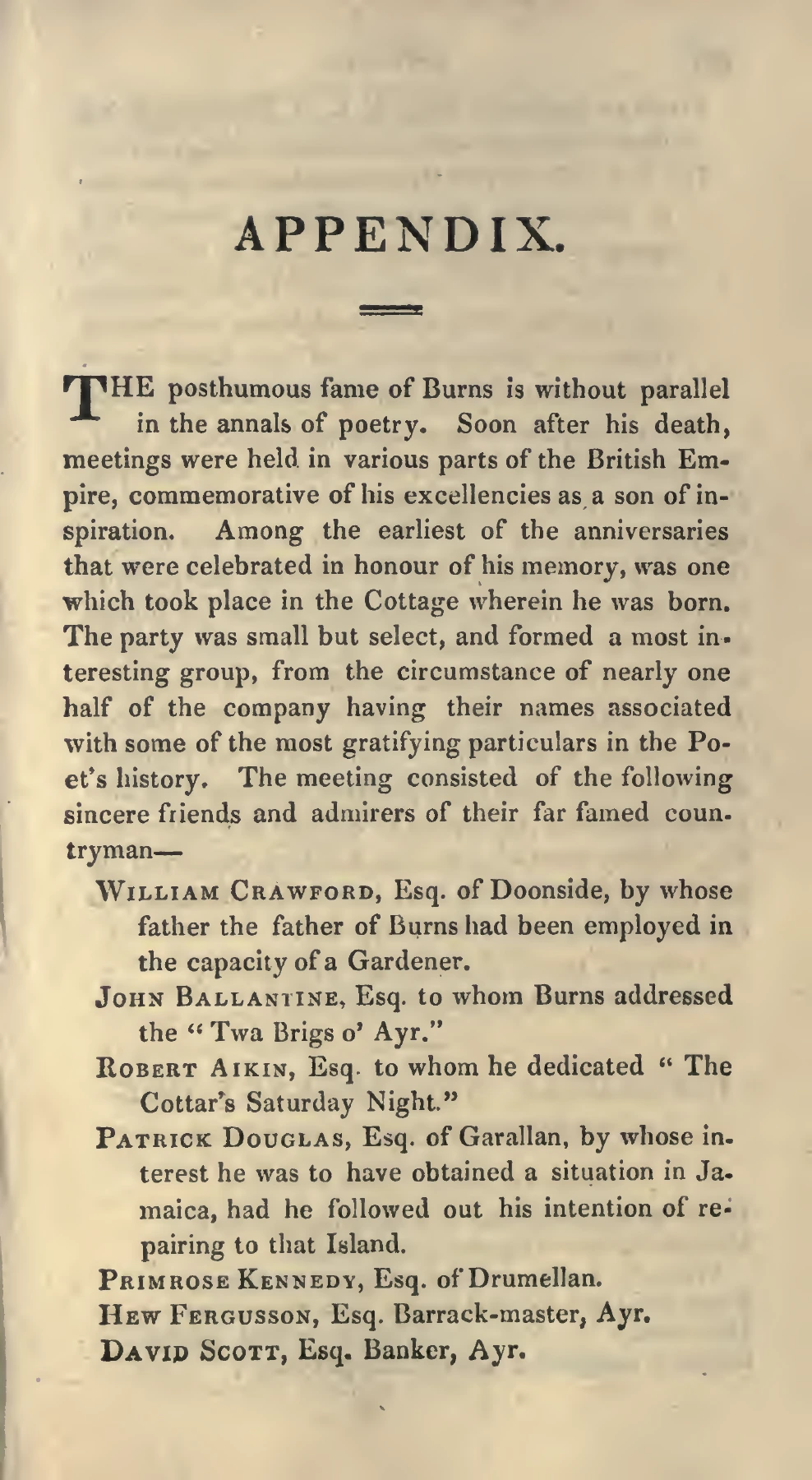
In the summer of 1801 nine men sat down to dinner in the cottage at Alloway where Robert Burns had been born. Several had known him. They chose his birthplace, Hamilton Paul wrote, to offer “a tribute to the memory of departed genius”. John Ballantine, to whom Burns had addressed The Twa Brigs, wanted a poem for the occasion. Two of the guests, Primrose Kennedy and Hew Fergusson, carried his request to Paul.[1][5]
The poet from Dailly
Paul was twenty-eight. Born in the parish of Dailly in 1773, he was the son of John Paul, who managed the collieries on the Bargany estate. From the parish school he went to Glasgow University. There he made friends with the poet Thomas Campbell and acquired a reputation for making up comic verses. By the time Ballantine asked him for his poem, Paul had published a book of verse and served as an assistant minister at Coylton.[6]
One guest read Paul’s ode before dinner. Years later Paul told William Chambers how Robert Aiken, to whom Burns had dedicated The Cotter’s Saturday Night, asked to see it as the two men walked towards Alloway Kirk. Aiken read a verse or two, then walked a few paces in silence. He had two ways of telling when a poem had moved him, he said. His eyes watered and “the button of my waistcoat skelps”. Paul remembered the white waistcoat bursting open.[7]
At the table with them was William Crawford, whose father had employed Burns’s father as a gardener. Patrick Douglas had helped Burns find the post he once intended to take in Jamaica. Eighteen years later Paul named the whole company in print, down to David Scott, an Ayr banker, and Thomas Jackson, who taught natural philosophy at St Andrews.[1]
Paul dated the gathering to 1801. The National Trust for Scotland places it on 21 July, five years to the day after Burns died, and names Paul as the man who led it. In that account the men ate haggis and sheep’s head, recited Burns’s address to the haggis and sang his songs.[1][2]
A birthday dinner
When the Alloway company met again, they chose the poet’s birthday. They kept it on 29 January in 1802. The following year they met four days earlier, on 25 January, the date Burns’s family had entered for his birth.[2][3]
In Greenock another group had begun meeting on alternate Saturdays at Mrs Cottar’s tavern. Her name gave the members a joke of their own. They called the meetings Cottar’s Saturday nights. The club’s centenary historian, A. Kerr Bruce, saw its first minute book and described a dinner at the White Hart Hotel on 29 January 1802. About forty members sat down with John Wright in the chair. Wright was an excise officer who had known Burns. Two inscribed leaves survive from the book Bruce handled.[4]
Paul went on writing for the Alloway gatherings. By 1819 he had written eighteen anniversary odes. Different guests took turns reading them. In 1805 the reader was Sir Frederick Adam, then stationed with his regiment at Ayr. A room had been added to the end of the cottage. Even with the extra space, Paul recalled, they could scarcely fit everyone in.[1]
References
- Hamilton Paul, appendix to The Poems & Songs of Robert Burns (1819), pp. 295–296, the company at the cottage and the anniversary odes.
- National Trust for Scotland, The first Burns Supper (20 January 2021), including the account from the Robert Burns Birthplace Museum.
- Burns family register, first entry, reproduced in the Robert Burns Rare Print Collection (1900).
- Greenock Burns Club, History, including A. Kerr Bruce’s account of the White Hart dinner and the minute book.
- Hamilton Paul, Anniversaries of Burns, opening of his manuscript account, McKie Collection IX, no. 35, EADO172a–d.
- Hamilton Paul in the Oxford Dictionary of National Biography; Ayrshire Notes 26 (2003), pp. 8–9, on the Bargany collieries and his licence to preach. The earlier Dictionary of National Biography describes his verse at Glasgow and his first publication.
- Paul’s recollection to William Chambers, transcribed by Clark McGinn in “Robert Aiken – Orator Bob” (2015), in the account of their walk before dinner.