My Nanie O: original Scots and explanation
Robert Burns, Poems, chiefly in the Scottish dialect, Edinburgh, 1787, pp. 322–324. The heading reads “SONG. Tune, My Nanie, O.”
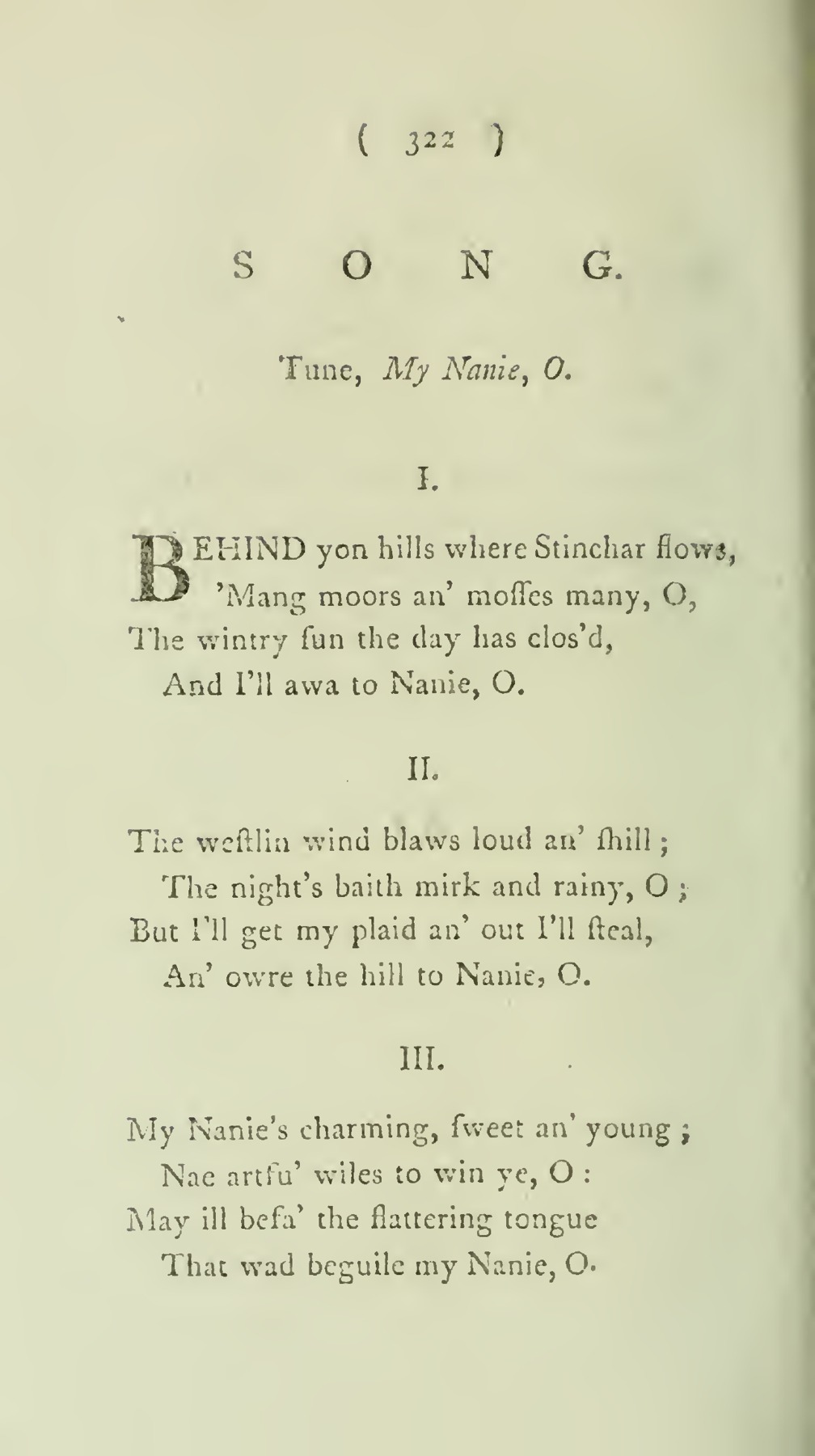
Reading transcription: long s is rendered as modern s; the opening display capital is normalised; typographic apostrophes are regularised. Words, contractions, stanza order and line breaks follow the inspected pages.
I.
Behind yon hills where Stinchar flows,
’Mang moors an’ mosses many, O,
The wintry sun the day has clos’d,
And I’ll awa to Nanie, O.
II.
The westlin wind blaws loud an’ shill;
The night’s baith mirk and rainy, O;
But I’ll get my plaid an’ out I’ll steal,
An’ owre the hill to Nanie, O.
III.
My Nanie’s charming, sweet an’ young;
Nae artfu’ wiles to win ye, O:
May ill befa’ the flattering tongue
That wad beguile my Nanie, O.
IV.
Her face is fair, her heart is true,
As spotless as she’s bonie, O,
The op’ning gowan, wat wi’ dew,
Nae purer is than Nanie, O.
V.
A country lad is my degree,
An’ few there be that ken me, O;
But what care I how few they be,
I’m welcome ay to Nanie, O.
VI.
My riches a’s my penny-fee,
An’ I maun guide it cannie, O;
But warl’s gear ne’er troubles me,
My thoughts are a’, my Nanie, O.
VII.
Our auld Guidman delights to view
His sheep an’ kye thrive bonie, O;
But I’m as blythe that hauds his pleugh,
An’ has nae care but Nanie, O.
VIII.
Come weel come woe, I care na by,
I’ll tak what Heav’n will sen’ me, O;
Nae ither care in life have I,
But live, an’ love my Nanie, O.
Words that help
Mosses: boggy ground or peat mosses. Westlin: westerly. Shill: shrill. Baith mirk: both dark. Plaid: the cloth or outer covering he takes with him. Owre: over. Gowan: daisy. Ken: know. Ay: always. Penny-fee: his cash wages. Maun guide it cannie: must manage it carefully. Warl’s gear: worldly possessions. Guidman: the master or farmer in this stanza. Kye: cattle. Hauds his pleugh: holds his plough. Weel: good fortune; woe: misfortune.
What the song is saying
The speaker means to set out for Nanie at the end of a winter day, despite the wind and rain. He praises her beauty and honesty and resents the thought of anyone deceiving her. He calls himself a country lad with little public standing and only his wages. His wages need careful management, but being welcome with Nanie matters more to him than possessions or recognition. The farmer takes pleasure in thriving stock; the man holding his plough takes pleasure in love. The final stanza accepts whatever fortune brings and returns to Nanie.
Burns later proposed changing Stinchar to Lugar. Read about that revision and his choice of river names.
References
Source: 1787 edition, pp. 322–324 (scan pp. 370–372).
Glossary checks: Dictionaries of the Scots Language, penny, gowan and guidman and shill, consulted 15 October 2026. The farm-master sense of guidman follows this stanza’s context.