A ploughman on his way to Nanie
The young man in Burns’s “My Nanie, O” works at the plough and has a journey in mind. A winter day is ending. There are hills between him and Nanie, and the weather is against him. He means to take his plaid and go anyway.[1]
Behind yon hills where Stinchar flows,
’Mang moors an’ mosses many, O,
The wintry sun the day has clos’d,
And I’ll awa to Nanie, O.[1]
Those are the opening lines in the Edinburgh edition of Burns’s poems published in 1787. The song begins on page 322, beneath a heading giving its tune as “My Nanie, O”. Stinchar, the moors and the mosses give the opening its setting. The next stanza makes the journey harder: a westerly wind, darkness and rain. The repeated return to Nanie keeps the song moving towards her.[1]
“My Nanie, O” in Burns’s 1787 Edinburgh edition, p. 322.
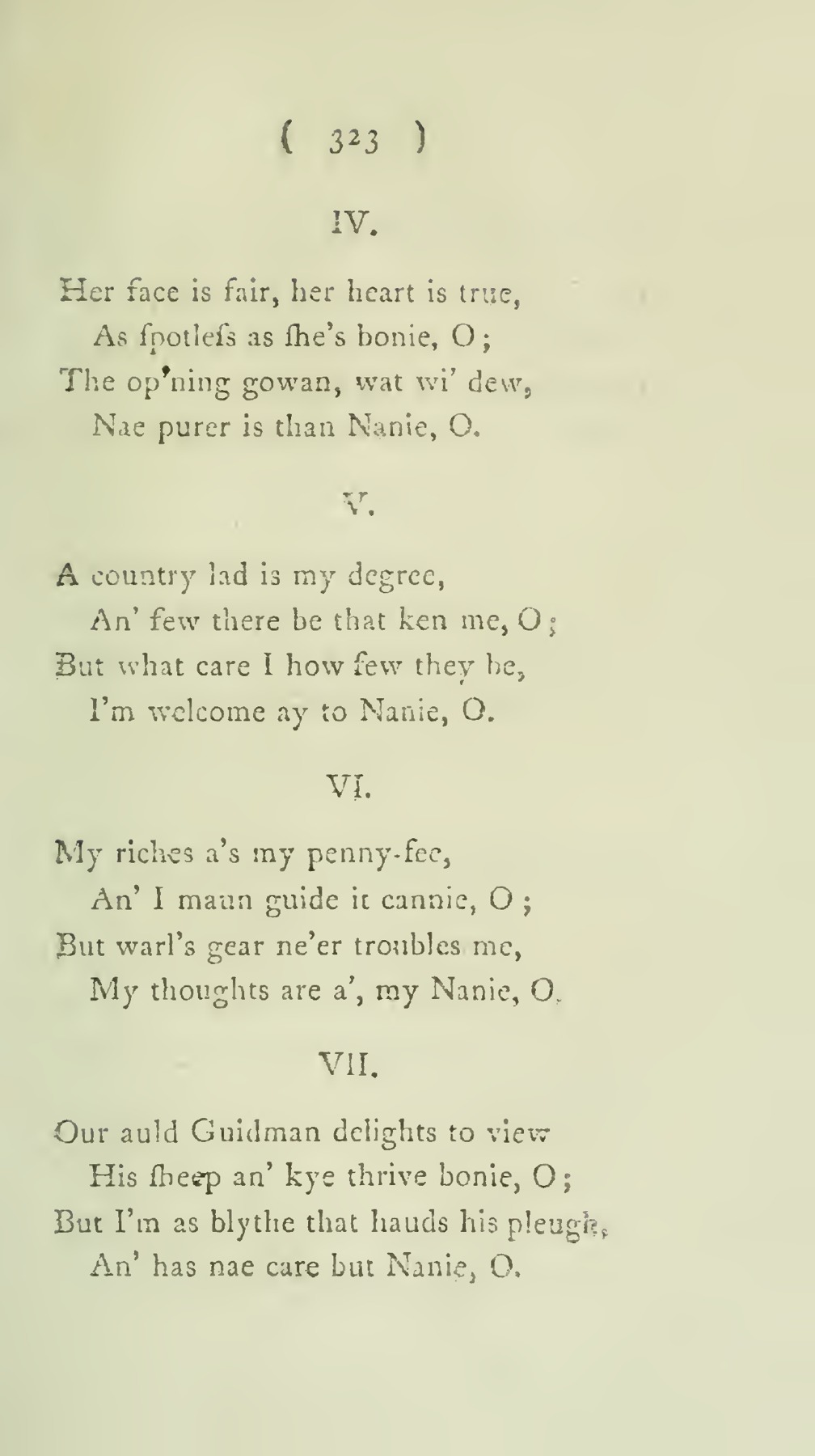
Nanie is young and beautiful, but the speaker dwells just as much on her honesty. She has no tricks to win him. He wishes ill on the flattering tongue that would deceive her, then compares her purity to a daisy wet with dew. [1]
Halfway through the song, he tells us something about himself. “A country lad is my degree” is his account of his standing. Few people know him. He is welcome with Nanie, and that welcome answers his lack of recognition elsewhere. The refrain now carries more than the prospect of reaching her: it gives him a place where he matters.[1]
His money occupies four plain lines. His riches amount to his “penny-fee”, his cash wages, and he must “guide it cannie”—manage it carefully.[2] The need to manage his pay sits beside his declaration that worldly possessions do not trouble him. He gives the practical problem its due before his thoughts return to Nanie.[1]
The following stanza places him at work. The farmer delights in seeing his sheep and cattle thrive. The speaker holds the farmer’s plough and declares himself just as happy. The two men have different reasons for contentment: one looks at his stock; the other thinks of the woman he loves. Burns gives the farm worker his own measure of a good life.[1]
Across eight short stanzas, the song moves from a journey through bad weather to a statement about how its speaker wants to live. He ends by accepting good fortune or bad. The last line returns to the name that has closed every stanza: “But live, an’ love my Nanie, O.”[1]
Words and context
Here, mosses means boggy ground; mirk means dark; gowan is a daisy; and kye means cattle. The “auld Guidman” is the farmer whose plough the speaker holds. [1][2]
References
[1] Robert Burns, Poems, chiefly in the Scottish dialect ↗, Edinburgh, 1787, title page and pp. 322–324. Long s and display capitals are normalised in quotations.
[2] Dictionaries of the Scots Language, “penny”, compound14 ↗, “gowan” ↗, and “guidman” ↗.
Image credit
Robert Burns, Poems, chiefly in the Scottish dialect, 1787, p. 322; digitised copy via Internet Archive.