Burns and the making of songs
Songs reached Burns through friends, singers, books and letters. He gathered words, tried them against tunes and wrote new verses for familiar airs. His work with James Johnson and George Thomson brought that daily exchange into print.
A collection to sing from
The Scots Musical Museum was a series of songbooks published in Edinburgh by James Johnson. The first volume appeared in 1787; the sixth and last followed in 1803. Its pages brought together song words, their melodies and a bass line for accompaniment. A reader could follow the tune and sing the verses from the same book.[10]
The title expressed an ambition to gather Scotland's songs into a lasting collection. Here a museum took the form of books that people could buy and use. Older songs stood beside recent compositions. Material passed through singers' memories, handwritten copies and earlier printed collections before finding a place on Johnson's pages. Scottish musical life also drew on tunes and words circulating across Britain, and the collection carried that exchange into print.[10]
Johnson's undertaking depended on several kinds of work. Songs had to be found and selected, words matched to airs, and music prepared for the engraved pages. The musician Stephen Clarke helped with the musical settings. Burns contributed as a writer, collector and reviser, and used his friendships and correspondence to bring other people's songs into the collection.[10]
For readers opening a volume, the connection between words and music was visible. The opening verse was fitted beneath the melody, with further verses printed below. An index helped them find a song, and sometimes named the writer or the composer of its air.[4]
The collection gave Burns a continuing practical task alongside the publication of his poetry. In November 1788 he sent Johnson two songs from Mauchline. He wanted something back on the return journey: tunes, or anything that needed correcting, sent by the carrier. Between the poet and the publisher, the books grew through these small consignments of words and music. Burns urged Johnson to take care over them: “Be not in a hurry; let us go on correctly.”[1]
A song might arrive with words by one person and an air associated with another. Working out what to print meant asking questions, comparing versions and deciding how the words would sound when sung. Burns supplied new writing while helping Johnson draw on people whose memories, papers and musical knowledge could enlarge the collection.
Finding songs and their writers
Before leaving Edinburgh in 1787, Burns sent Johnson a song he had received from Thomas Blacklock. He identified the air with McGibbon and said that he did not know who had written the words. He also asked Johnson to keep the original until they met again.[2]
Burns pursued living writers as well as songs already passing from hand to hand. In February 1788 he wrote to the Reverend John Skinner, author of Tullochgorum. Burns had heard the song attributed to several people, particularly James Beattie, and welcomed the chance to put Skinner's name before readers. He sent Skinner the newly published second volume of the Museum and told him that his songs would appear in the third, with his name in the index.[3]
There was more to ask for. Skinner's brother had promised verses to the Marquis of Huntley's reel. Burns also wanted copies of a song to Dumbarton Drums and another written by a ploughman. His letter moved easily between thanks, literary conversation and requests for further songs. Each correspondent could open another route into the repertoire.
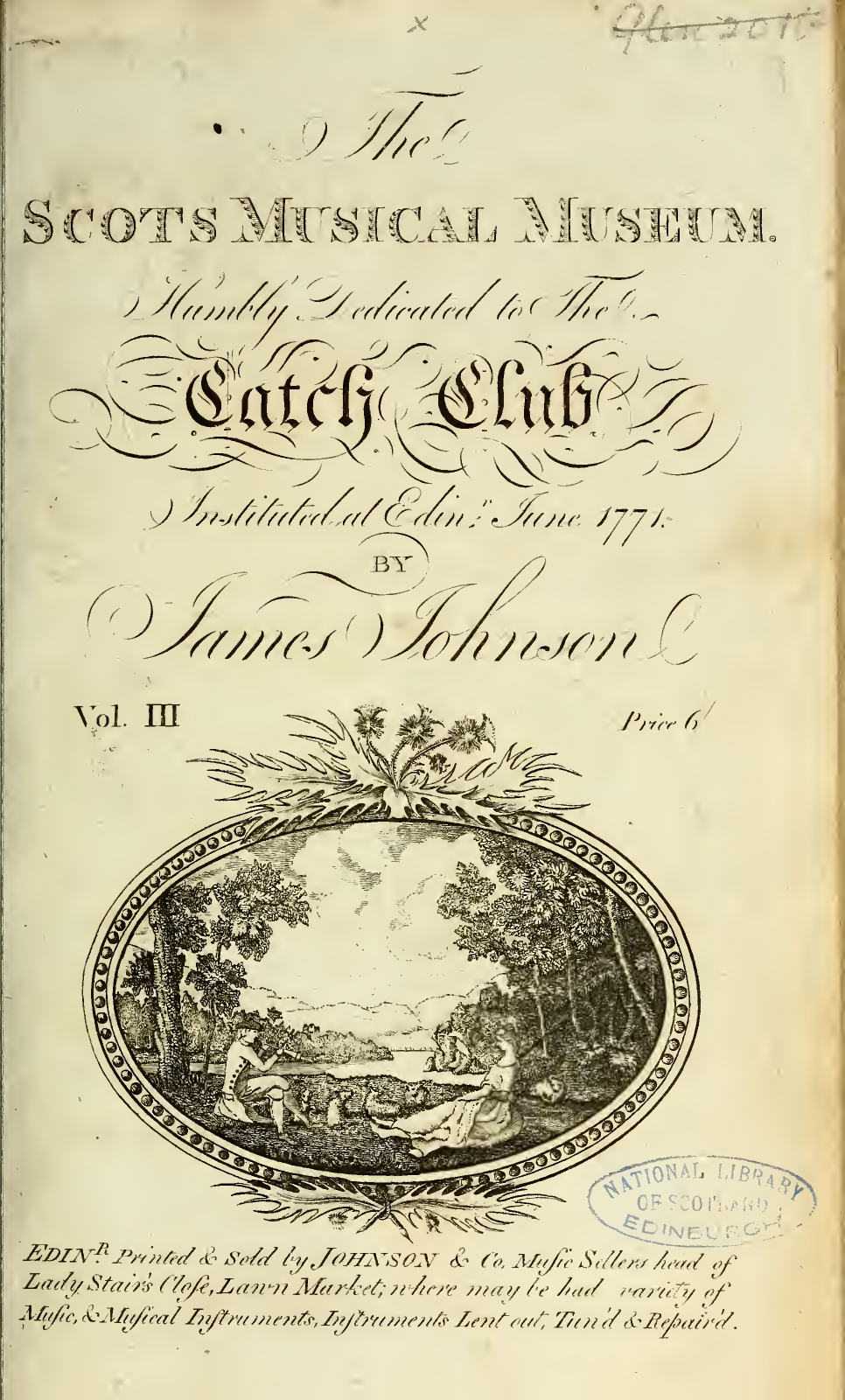
The Museum gave this gathering work a place in print. Its third volume carried Johnson's name on the engraved title page. The preface, dated 2 February 1790, appealed to affection for Scottish music and for the productions of Scotland itself. Burns's requests for songs and his insistence on careful correction served that undertaking.[4]
A new set of airs
In September 1792 George Thomson invited Burns into another song collection. Burns accepted eagerly and asked for a list of the airs, together with the opening lines of the verses Thomson intended to use. That would let him see where alterations or new words could help. He wanted a proof of every song he composed or amended.[5]
The language mattered to him. He argued for a place for the native tongue in the collection and defended the fit between Scottish airs and Scottish speech. In their correspondence, a proposal to change a line could lead into a discussion of pronunciation, feeling or the character of an old song. Burns expected Thomson to exercise judgement over what went into the book, and asked for frank criticism of his own contributions.
He also had strong preferences about what a song should retain. Sending Will ye go to the Indies, my Mary?, he described his early love songs as the expression of ardent feeling and resisted polishing away their simplicity. The work of revision required an ear for what gave a song its life.[6]
Singing before writing
Burns explained his method to Thomson in September 1793. Asked about Laddie, lie near me, he said that he could write nothing for it until he had mastered the air in his own singing.[7]
He began by considering the feeling expressed by the music, then chose a theme and attempted a first stanza. That opening stanza was the hardest part. He described walking out, sitting down, looking for natural objects in keeping with his thoughts, and humming the air with the verses he had made. When he tired of that, he returned to the fireside and committed the lines to paper. He then rocked in his chair while criticising his own work.
In an earlier letter he had named the practical difficulty. The peculiar rhythm of an air demanded syllables fitted to its emphatic “feature-notes”. He described My wife's a winsome wee thing as following the tune's “light-horse gallop”. A tender air could call for more time and a different kind of concentration.[8]
The river in My Nanie, O changed as Burns revised the song. In the 1787 Edinburgh edition, it begins “Behind yon hills where Stinchar flows”.[11] Writing later to Thomson, Burns called the printed river name “horribly prosaic” and proposed “Behind yon hills where Lugar flows”. Girvan suited the idea of the stanza best, he explained, but Lugar offered the more agreeable modulation of syllables.[6]
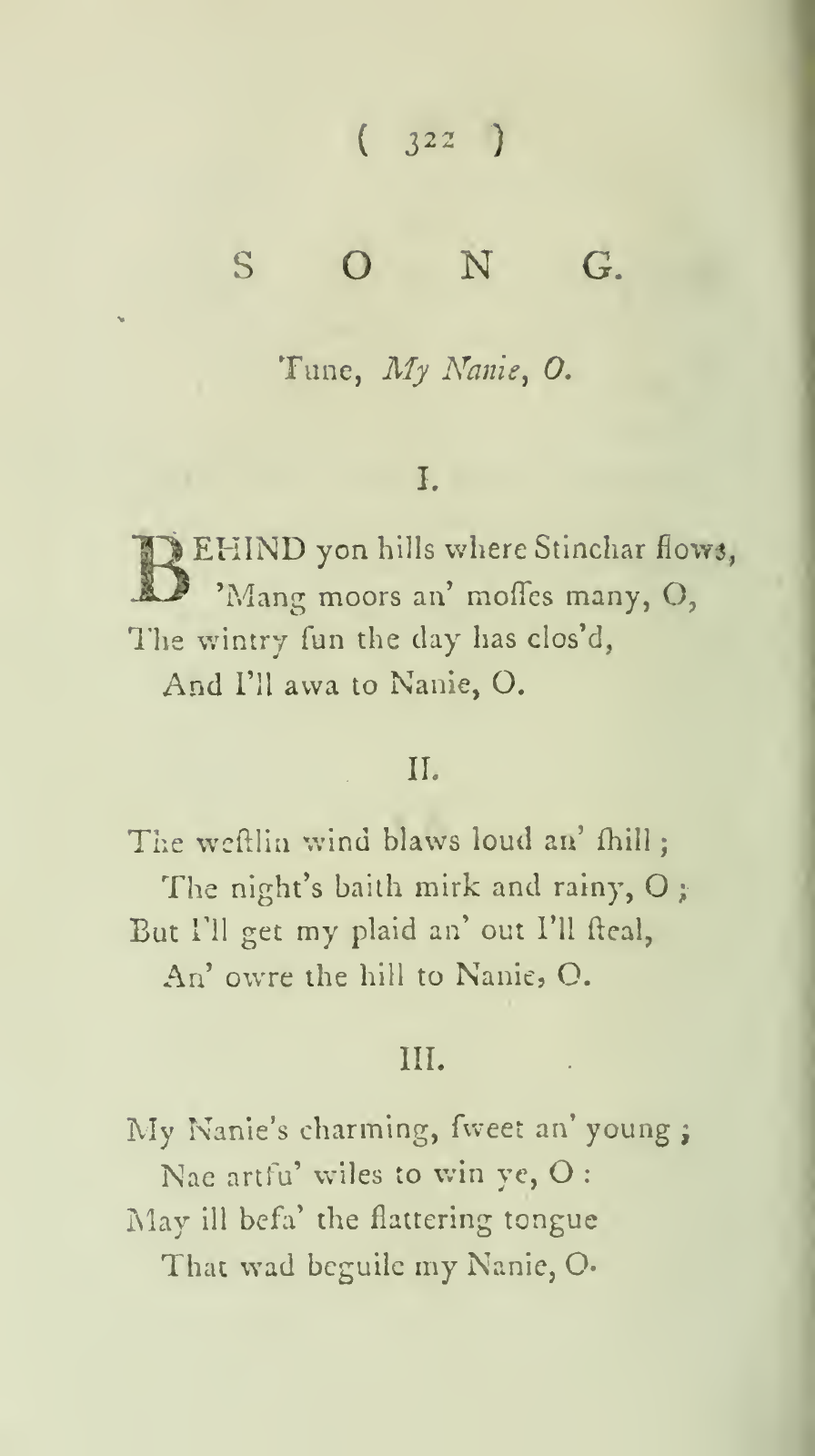
These names belong to different river valleys. The Lugar runs by Cumnock, inland from the Carrick country of the Girvan and Stinchar.[12] Burns's letter makes the choice turn on the sound of the line. Stinchar supplied the published opening; Girvan suited his imagined scene; Lugar gave him the syllables he preferred to sing.[6]
The argument over a line
Thomson's suggestions sometimes persuaded him. In December 1792 Burns accepted alterations to Nanie and My wife's a winsome wee thing as improvements. He held to the Alexander line in Bonny Lesley, however, because he liked the thought, despite the difficulty of its rhythm. He weighed another proposed change against the phrasing “For nature made her what she is, / And never made anither”.[9]
The exchanges could reach beyond individual words. In September 1793 Burns discussed shortening Down the burn, Davie, the suitability of repeated high passages for singing, and where a chorus should fall in Dainty Davie. He proposed joining two stanzas before the chorus.[7]
Performers could change his understanding of an air. He described Frazer's slow playing of Fee him, father as giving it the language of despair. Burns wanted words that would answer that pathos. His choices drew on the way someone performed, as well as on the notes and words available to him.[7]
Carrying an old song forward
In the same September letter Burns sent Thomson Auld Lang Syne. He introduced it as an old song and said that he had taken it down from an old man's singing. The letter places a singer's remembered words within the continuing traffic of airs, manuscripts and proposed verses.[7]
Burns could be a collector in one passage of a letter and a maker in the next. He compared airs, recommended another writer's song, changed the shape of a stanza and sent work of his own. These were connected activities, each requiring him to listen and choose. An old song could prompt a search for better words; an unfamiliar tune had to become something he could sing before he attempted a line.
One Friday night Burns wrote to Thomson about songs and revisions, knowing that he had a free means of sending the letter. On Saturday morning, with the conveyance still to leave, he added Nanie in full. He closed by asking Thomson to speak frankly about his verses so that they could carry the work forward together.[6]
Read and explore
References
The letters listed below are printed in Allan Cunningham's edition of The Complete Works of Robert Burns (1855).
[1] To James Johnson, 15 November 1788, letter CXL, pp. 393–394 ↗.
[2] To James Johnson, 1787, letter LX, p. 345 ↗.
[3] To John Skinner, 14 February 1788, letter C, pp. 370–371 ↗.
[4] The Scots Musical Museum, volume III (1790), title page, preface, index and song layout ↗.
[5] To George Thomson, 16 September 1792, letter CCXXXIV, pp. 447–448 ↗.
[6] To George Thomson, Friday night and Saturday morning, letter CCXXXVII, pp. 449–450 ↗.
[7] To George Thomson, September 1793, letter CCLXXIII, pp. 468–470 ↗.
[8] To George Thomson, 8 November 1792, letter CCXXXVIII, p. 450 ↗.
[9] To George Thomson, 1 December 1792, letter CCXL, p. 451 ↗.
[10] Murray Pittock, “Who Wrote the Scots Musical Museum?” ↗, Studies in Scottish Literature 42 (2016), pp. 3–5.
[11] Robert Burns, Poems, Chiefly in the Scottish Dialect, Edinburgh (1787), p. 322 ↗, “Song. Tune, My Nanie, O.”
[12] Historic Environment Scotland, Cumnock, Bank Viaduct over Lugar Water ↗; Ayrshire Rivers Trust, River Girvan ↗ and River Stinchar ↗.