Geometry and a wider world at Kirkoswald
Robert Burns went to Kirkoswald to learn surveying. His brother Gilbert remembered a summer quarter at the parish school, with Robert lodging with one of their mother’s brothers. It was a further stage in an education that had already taken him through lessons at home, Dalrymple school and John Murdoch’s teaching in Ayr.[1]
Burns’s own account, written to John Moore in 1787, gives the summer a different emphasis. He remembered good progress in mathematics and an even greater advance in his understanding of people. The school stood in a district he described as a smuggling coast, and its social life drew him into company he had scarcely known before.[2]
Mathematics with a practical use
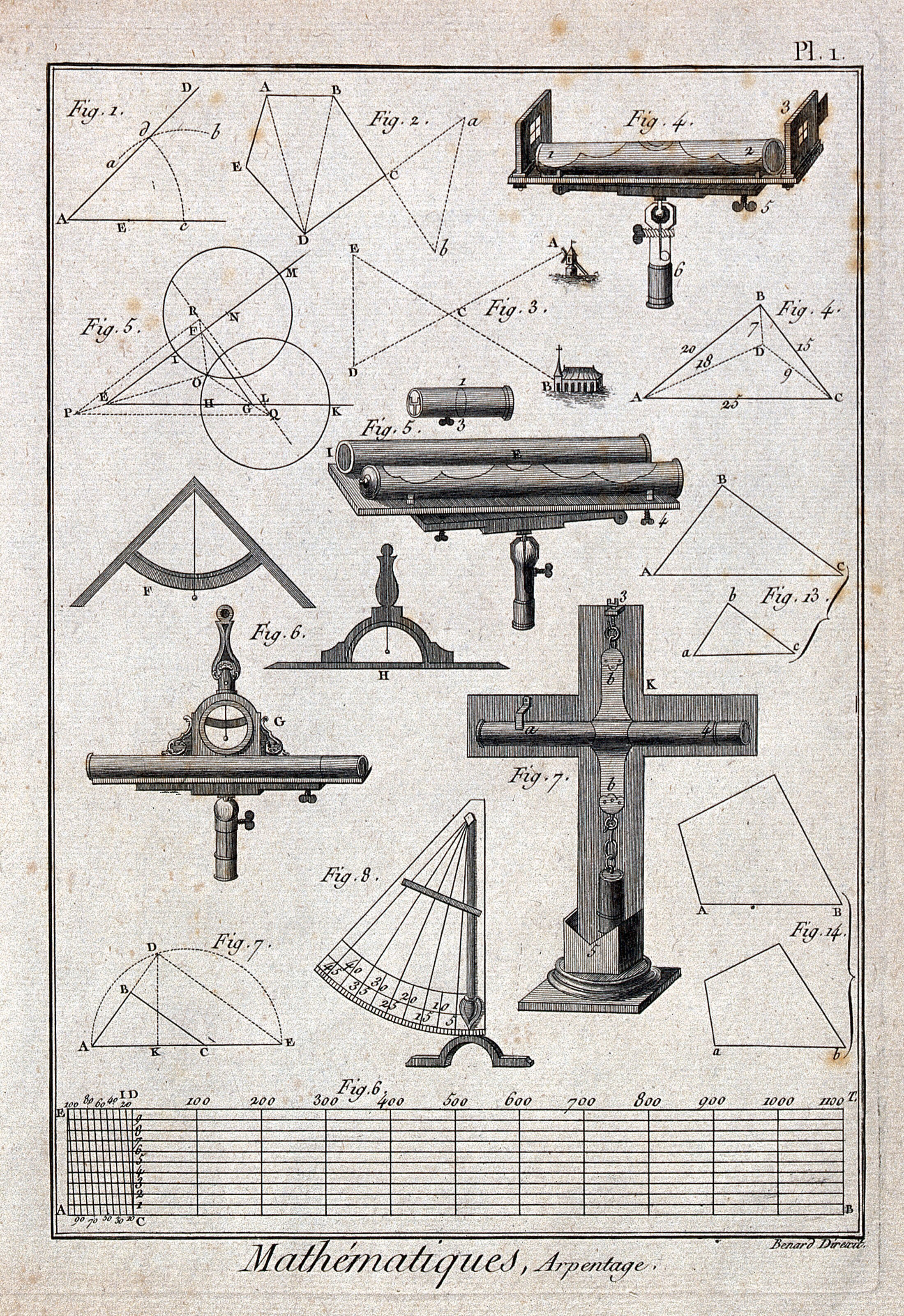
The subjects Burns named were mensuration, surveying and dialling. Mensuration concerns measurement and the calculation of quantities such as areas and volumes; surveying applies measurement to land. Dialling was concerned with designing and constructing sundials. These were practical uses of geometry, connecting calculations with the ground and the sun.[2][3]
His recollection becomes quite specific about the work. He mentions trigonometry, sines and cosines, and going into a garden at noon to measure the sun’s altitude—its angle above the horizon.[2]
That education had grown from the opportunities his family could arrange. In the evening lessons story, William Burnes taught arithmetic and found books for the household. Gilbert’s account of Kirkoswald adds another family connection: a maternal uncle providing somewhere for Robert to stay while he attended school.[1]
Company on a smuggling coast
Burns recalled that the contraband trade was thriving and that he sometimes met the people engaged in it. Their drinking and noisy disputes were new experiences for him. In the letter, he presents himself as learning to drink and to hold his own in a drunken quarrel while continuing to make progress in geometry.[2]
Years later, Burns took part in the Solway seizure, carrying out his duties as an exciseman. At Kirkoswald, he describes the encounters through the eyes of a student enjoying unfamiliar company.[2]
A distraction next door
The interruption to his studies came, in his telling, from a girl who lived beside the school. He made the mathematics part of the joke: she “overset my trigonometry”. He struggled on with his calculations for a few more days, then met her in the garden when he had gone out to observe the sun.[2]
Burns remembered spending his remaining week thinking about her and finding opportunities to meet. He told Moore that thoughts of her kept him awake during his last two nights. The girl is unnamed in this passage; the account dwells on his own excitement and loss of concentration.[2]
What came home with him
Burns nevertheless considered himself improved by the summer. His reading had widened, and he had persuaded several schoolfellows to continue a literary correspondence after he returned home. He credited this exchange of letters with improving his composition.[2]
He studied a collection of letters by writers of Queen Anne’s reign, kept copies of his own letters when they pleased him, and compared them with those his correspondents sent. He admitted enjoying the comparison. With very little business to conduct, he joked that his post had become as busy as a merchant’s.[2]
References
[1] Gilbert Burns’s account to Mrs Dunlop, in James Currie, ed., The Works of Robert Burns; with an Account of His Life, vol. I (Liverpool: J. M’Creery, 1800), pp. 62, 65–67. Read the scanned volume ↗.
[2] Robert Burns to John Moore, 2 August 1787, in Currie, Works, vol. I (1800), pp. 47–48. Burns recalls the summer in this autobiographical letter. Read the scanned volume ↗.
[3] British Sundial Society, The BSS Sundial Glossary, entry “dial”, explaining dialling as the design and construction of dials. Read the glossary ↗.