Three shillings for a poet
On 14 April 1786, a printed sheet offered readers a book that was still waiting to be made. Its heading announced proposals for publishing Scotch Poems by Robert Burns. The price was three shillings for a stitched copy. Printing would begin when enough subscribers had come forward to cover the necessary expense. At the foot of the surviving sheet, people put their names beside the number of copies they undertook to buy.[1]
The arrangement gave a first-time author a practical way into print. A subscriber promised a purchase on the stated terms; gathering those promises established an audience before the printer committed the work to paper. Some entries on the surviving sheet are for one copy, others for several.[1]
Getting the book made
Burns enlisted friends to help circulate the proposals. In a letter to John Ballantyne of Ayr, he enclosed half a sheet so that Ballantyne could begin helping him. By 9 July he was asking John Richmond in Edinburgh to return any subscriptions he had gathered, adding that the book should be ready in a fortnight. Proposals had to reach people, and their answers had to find their way back.[2]
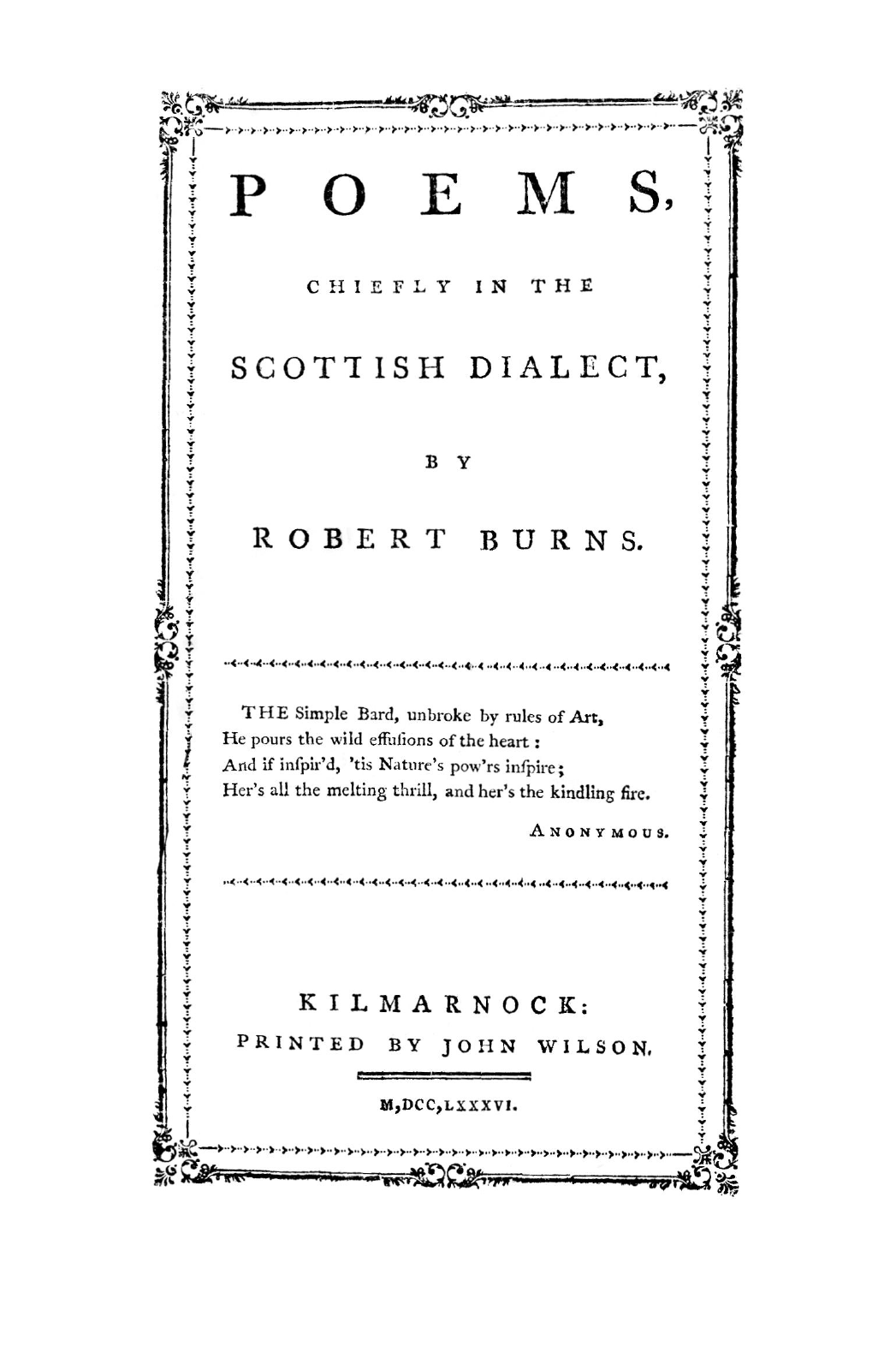
John Wilson of Kilmarnock was the printer. The finished title page names him beneath Poems, chiefly in the Scottish dialect, the title under which the collection appeared. Glasgow’s Mitchell Library dates publication to 31 July 1786 and records an edition of 612 copies.[3][4]
Burns later remembered obtaining subscriptions for about 350 copies. He described the whole printing in round numbers as six hundred. Promises to buy already covered a substantial part of the edition, leaving further copies to find readers after publication.[5]
The proposal had advertised a stitched volume. Its three-shilling price bought the sheets held together by stitching, a modest form in which a reader could acquire the poems. On the sheet itself, the promise of elegant printing sits above the condition about meeting expenses.[1]
What Burns offered his readers
The preface introduces a writer making poems amid the labour and feelings of ordinary life. Burns describes friendship’s applause encouraging him to think his work worth showing. He acknowledges his debt to Allan Ramsay and Robert Fergusson, and thanks the subscribers whose support has helped him seek recognition.[3]
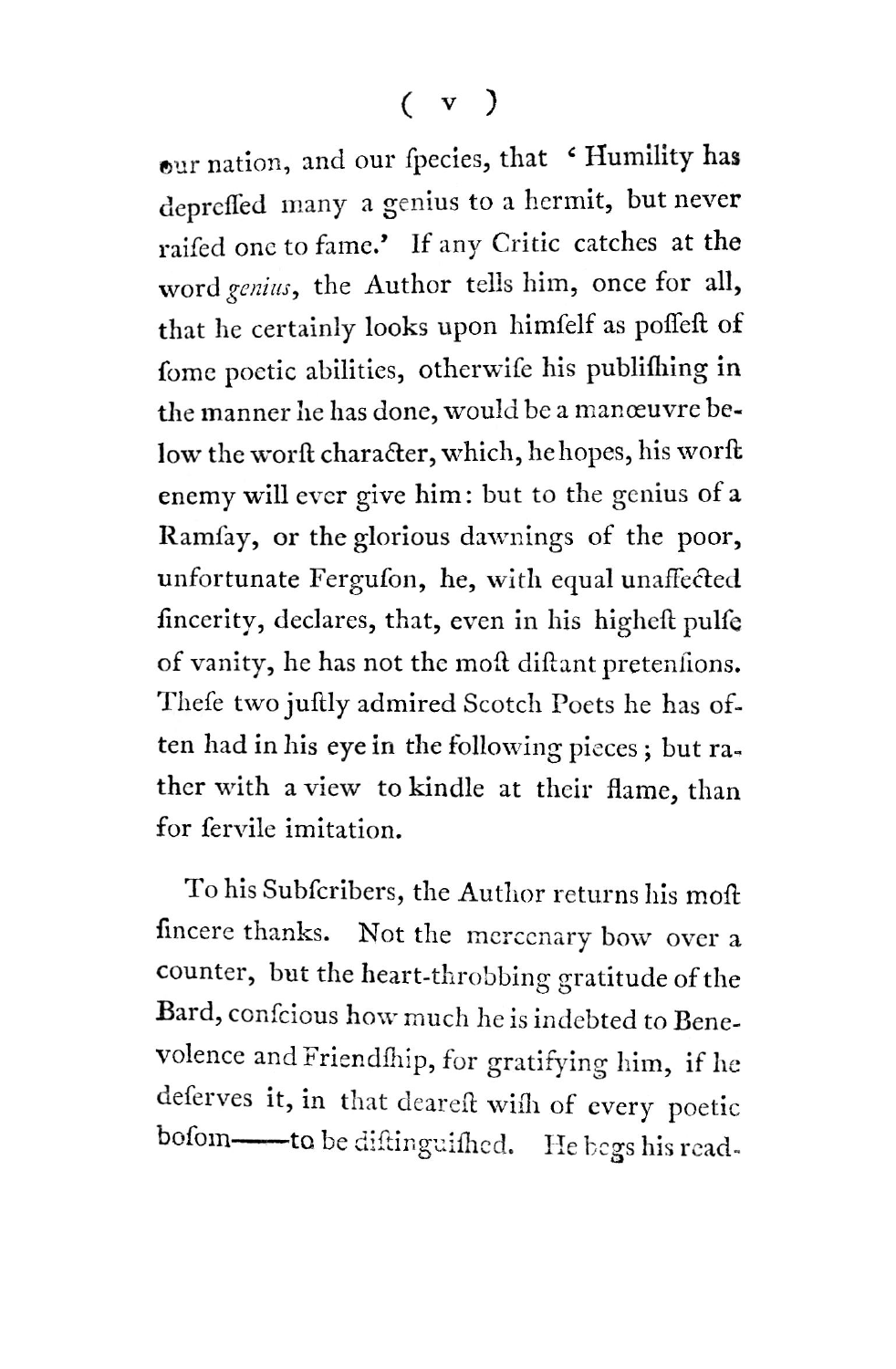
He also describes entering the public character of an author with “fear and trembling”. Readers were being asked to judge work that had previously found encouragement among friends. The subscribers’ promises had helped put the poems into a form that strangers could buy and assess for themselves.[3]
Money mattered to the venture. In his later account to John Moore, Burns connected publication with preparations to leave Scotland for Jamaica, where the contemplated employment involved supervising enslaved labour. He said the book left him nearly twenty pounds after expenses. Gilbert’s account also links the subscription scheme with raising money for the proposed journey.[5]
The cost of doing it again
The first book’s reception brought the prospect of another edition, and another financial problem. In a letter to Robert Aiken, Burns reported settling his account with Wilson and asking the printer to undertake a second edition, to be paid from its first proceeds. Wilson declined that arrangement. Paper for a thousand copies would cost about £27, Burns wrote, with printing another £15 or £16. Wilson would print if Burns advanced the paper money. Burns could not afford it.[2]
That exchange explains why a successful first book did not make the next one straightforward. The money from sales and the money needed to begin another printing arrived at different stages. Burns had found readers; he still needed a workable arrangement for producing their books. In his later recollection, encouragement from Thomas Blacklock helped turn his attention towards an Edinburgh edition.[2][5]
References
[1] Proposals for publishing by subscription, Scotch Poems, by Robert Burns, 14 April 1786, surviving printed sheet with manuscript subscriptions, NTS/02/25/BRN/04/537. View the document and collection record ↗.
[2] Robert Burns, letters to Robert Aiken, John Richmond (9 July 1786) and John Ballantyne, in Allan Cunningham’s The Complete Works of Robert Burns (1855), correspondence XXI–XXIII, pp. 326–328. Read the edition’s ebook transcription ↗.
[3] Robert Burns, Poems, chiefly in the Scottish dialect (Kilmarnock: John Wilson, 1786), title page and preface, pp. iii–vi. Read the digitised first edition ↗.
[4] Glasgow Libraries, Mitchell Library Robert Burns Collection, “Editions of collected poems”. Read the collection guide ↗.
[5] Robert Burns’s autobiographical letter to John Moore and Gilbert Burns’s account, in James Currie, The Works of Robert Burns (1800), volume I, pp. 54–56 and 78–79. Read the scanned volume ↗.