Jean Armour: marriage, music and family
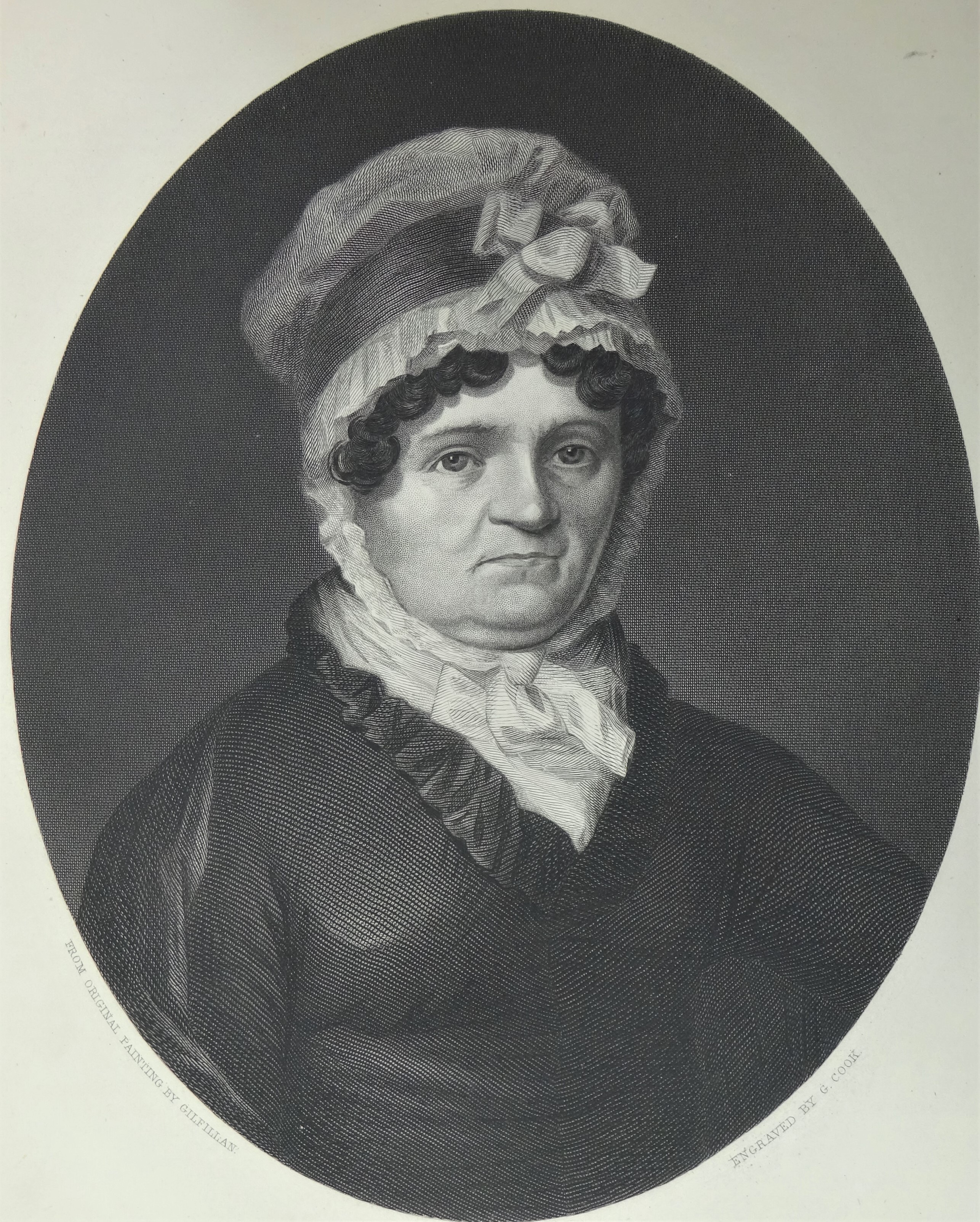
In 1804 Jean Burns wrote from Dumfries to an old family acquaintance, Maria Riddell. Robert Burns had died in 1796. Jean was still living in the house they had shared, and she had news of sons studying in Glasgow and London, of a son who had died before a planned departure for the East Indies, and of William, still at school and still at home. She signed the letter “Jean Burns”. The family whose future she described had begun in Mauchline, through a relationship that brought pregnancy, parental opposition and a disputed marriage pledge.[1][2]
A marriage in Mauchline
Jean was the daughter of James Armour, a master mason in Mauchline, Ayrshire. Robert was farming nearby at Mossgiel when their relationship began. By 1786 she was pregnant. He gave her a written pledge of marriage, which her father subsequently had mutilated. James Armour opposed the relationship.[2][3]
During the next two years Burns’s circumstances changed. His first book of poems appeared at Kilmarnock in 1786, followed by an enlarged Edinburgh edition in 1787. Literary success brought him new friendships and opportunities beyond Ayrshire. Jean remained in the Mauchline family circle. By the time they established their married household in 1788, she had borne four children in two sets of twins.[3][4]
Burns returned to Ayrshire in February 1788, and the couple resumed their relationship. In April he wrote to his friend James Smith that he had privately married Jean. Smith had moved away from Mauchline and worked in textile printing. Burns asked him to obtain a printed shawl for her, choosing a good pattern and the best quality.[2][5]
In August Robert and Jean appeared before the Mauchline kirk session, the parish church court. They acknowledged that they had been irregularly married some years earlier. That acknowledgement brought their earlier union before the church authorities.[2]
Preparing a home
Their new home would be at Ellisland, beside the River Nith, north of Dumfries. Burns had taken on the farm and was preparing to build a house. The move carried Jean away from the town where her father worked and the family among whom she had grown up. For a time, husband and wife remained in different parts of the country.[6][3]
On 13 June 1788 Burns wrote to Frances Dunlop from Ellisland. It was his second day there, and he was living alone in an old smoky room. Jean was learning dairy work and other rural work from his mother and sisters during his absence. She was preparing for work on the farm: cows, milk and dairy produce would form part of the farm’s livelihood. His family in Ayrshire was helping prepare her for it.[7]
Burns praised Jean’s quickness in learning household work and her readiness to carry it out. In the same letter he placed the concerns of his wife and family first among his occupations. His description joins affection to the practical demands of establishing a home. The farm needed work, the house needed building, and the couple had children to support.[7]
By February 1789 he could tell his cousin James Burness that he was settled with a wife and a farm. The profits from his poetry had helped him begin. An excise commission offered another means of earning a living, and he would soon combine farming with travelling duties in the revenue service. Jean’s work in the household and dairy formed part of that changing family economy.[8]
Jean’s voice at home
Singing was part of their life together. In June 1789 Burns described family worship to Mr M’Auley. He occasionally led the household in devotion and particularly enjoyed singing the psalms. Jean joined him in “Lo, children are God’s heritage”. He praised her “wood-note wild” in both old songs and psalmody, the singing of psalms.[9]
One of his best-known songs addresses Jean through the experience of separation. In Of a’ the airts the wind can blaw, the speaker’s thoughts turn towards the west, where the woman he loves is living. “Airts” means directions or quarters of the compass. Burns wrote the song while he was beginning life at Ellisland and Jean was still in Ayrshire.[10]
Burns left a specific account of the song’s origin: “the song I composed out of compliment to Mrs. Burns.” He added that it was written during the honeymoon. The tune was by William Marshall, known as Miss Admiral Gordon’s Strathspey. Burns supplied words for an existing melody; the song appeared in James Johnson’s Scots Musical Museum as I love my Jean. The Museum was a printed collection of Scottish songs with their music, through which a song written for Jean reached singers far beyond the household.[10]
The song-making story follows Burns’s work with Johnson and other musical collaborators. Here the connection is close to home: a husband writing about his absent wife, and a woman whose own singing he valued.
Children and the move to Dumfries
The household changed as children were born and Burns’s work changed. Jean and Robert had nine children together; three lived to adulthood. Their family also included Elizabeth, known as Betty, Burns’s daughter with Anna Park. Jean brought her up alongside her own children.[3][4]
In 1791 the family left Ellisland for Dumfries, where Burns continued his excise employment. The move ended their attempt to make a living from the farm. Town life put his paid work, correspondence and writing in a different setting. The Ellisland story follows the decisions behind that move.[6]
In July 1796 Jean was expecting another child while Burns was seriously ill. Away at Brow, on the Solway coast, he wrote to her father asking him to send Mrs Armour to help. On 10 July he thought the birth might be a fortnight away.[11]
A letter to Jean from Brow carried news in both directions. Their friend Jess Lewars had told him that Jean and the children were well. He sent his warmest greetings to Jess and to the children, and said he would see Jean on Sunday. Back in Dumfries on 18 July, he again asked James Armour to send her mother immediately. Burns died on 21 July. Jean’s youngest son, Maxwell, was born later that month.[11][3]
Jean’s letter
Jean remained in Dumfries after her husband’s death. In 1804 Maria Riddell asked for news of the family. Maria was a writer and a friend of Burns from his Dumfries years. Her inquiry reached Jean through Mrs Scot, who had called on her. Jean’s reply picked up that conversation and explained where the children were.[1][3]
“We still live in the same house that you left us in,” she wrote. William was the only child at home. Robert, the eldest son, had spent two winters at Glasgow College after one in Edinburgh. Jean had heard that a position would be found for him in London through the assistance of Mr Shaw, the sheriff of London. She believed the report and passed on the prospect.[1]
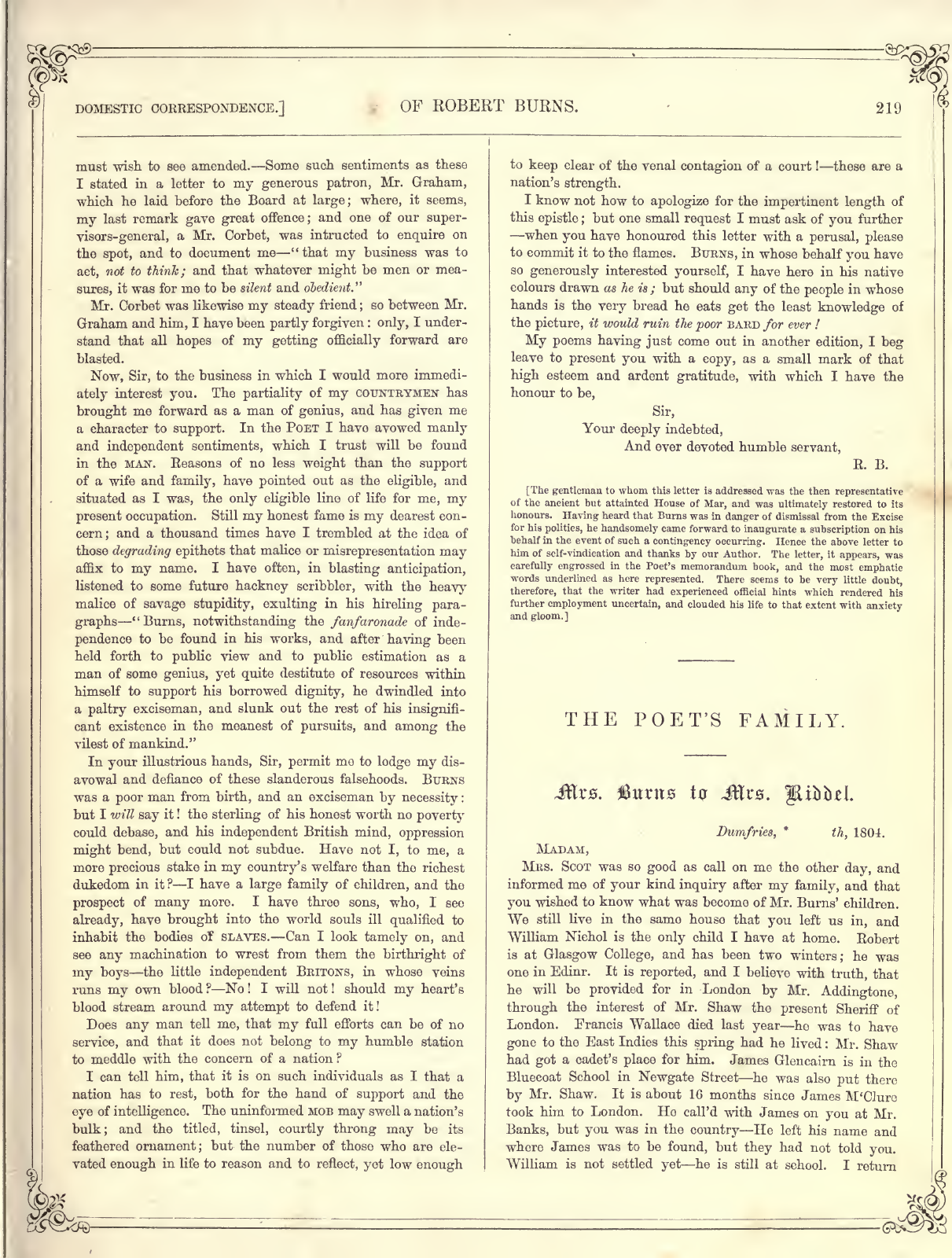
Shaw had also helped James Glencairn, who was at the Bluecoat School in Newgate Street, London. Jean told Maria that James McClure had taken the boy south about sixteen months earlier. McClure had called with James at Mr Banks's while Maria was away in the country. He left his name and details of where James could be found.[1]
There was news of a lost opportunity too. Francis Wallace had died the previous year. Shaw had obtained a cadet’s place for him, and he was to have gone to the East Indies that spring. In a postscript she added that Maxwell had died two years and nine months after his father.[1]
Jean thanked Maria for her good wishes and signed herself her “obliged and sincere well-wisher”. Her letter follows the children out from the family house into colleges, a London school and hoped-for employment. William’s future remained open: “William is not settled yet—he is still at school.”[1]
References
[1] Jean Burns, letter to Mrs Riddell, Dumfries, 1804 ↗, in P. Hately Waddell (ed.), Life and Works of Robert Burns, vol. II, pp. 219–220. Recipient identified as Maria Riddell in the National Library of Scotland catalogue, Acc.13120. See also Erin Allen, Note from a Muse: Folklorist Discovers Robert Burns-Related Letter ↗, Library of Congress, March 2010.
[2] Tristram Clarke, Robert Burns, the Poet ↗, National Records of Scotland, 10 August 2017; discussion of the marriage and Mauchline parish record, OPR 604/2.
[3] Leslie Stephen, Burns, Robert (1759–1796) ↗, Dictionary of National Biography (1886), sections on Mauchline, the family at Dumfries and Burns’s final illness.
[4] National Trust for Scotland, Relationships ↗, Jean Armour section, and Relationship Explorer ↗, entry on Elizabeth “Betty” Burns; Dumfries and Galloway Council, Jean Armour’s gold ring ↗, Future Museum, objects BCBN012a, BCBN013n and DUMFM:0198.257, family biography.
[5] Robert Burns, letter to James Smith, 28 April 1788 ↗, National Trust for Scotland, NTS/02/25/BRN/01/44; letter transcription and collection description.
[6] Ellisland: a farm, a family and a living, particularly “Building a household” and the move to Dumfries, with linked correspondence and museum sources.
[7] Burns, letter to Frances Dunlop, 13 June 1788 ↗, in Allan Cunningham, The Complete Works of Robert Burns (1855), letter CXXII, pp. 380–381.
[8] Burns, letter to James Burness, 9 February 1789 ↗, Cunningham (1855), letter CL, pp. 399–400.
[9] Burns, letter to Mr M’Auley, 4 June 1789 ↗, Cunningham (1855), letter CLXIV, pp. 406–407.
[10] James C. Dick, The Songs of Robert Burns ↗ (1903), note 69, pp. 375–376, including Burns’s note on Of a’ the airts and the tune’s authorship and title. Read the song.
[11] Burns, letters to Jean Burns, “Brow, Thursday”, and James Armour, 10 and 18 July 1796 ↗, Waddell, vol. II, p. 218. For Jess Lewars’s friendship with Jean and Robert, see Lewars, Jessy (1778–1855) ↗, Robert Burns Encyclopedia.