A harvest partner and the beginning of verse
Burns remembered his first attempt at verse beginning with a fellow worker’s singing. They had been paired for the harvest, following what he described as the country custom of setting a man and a woman to work together. In his letter to John Moore, written in 1787, he placed the episode in his “fifteenth autumn”. His partner was a year younger.[1]
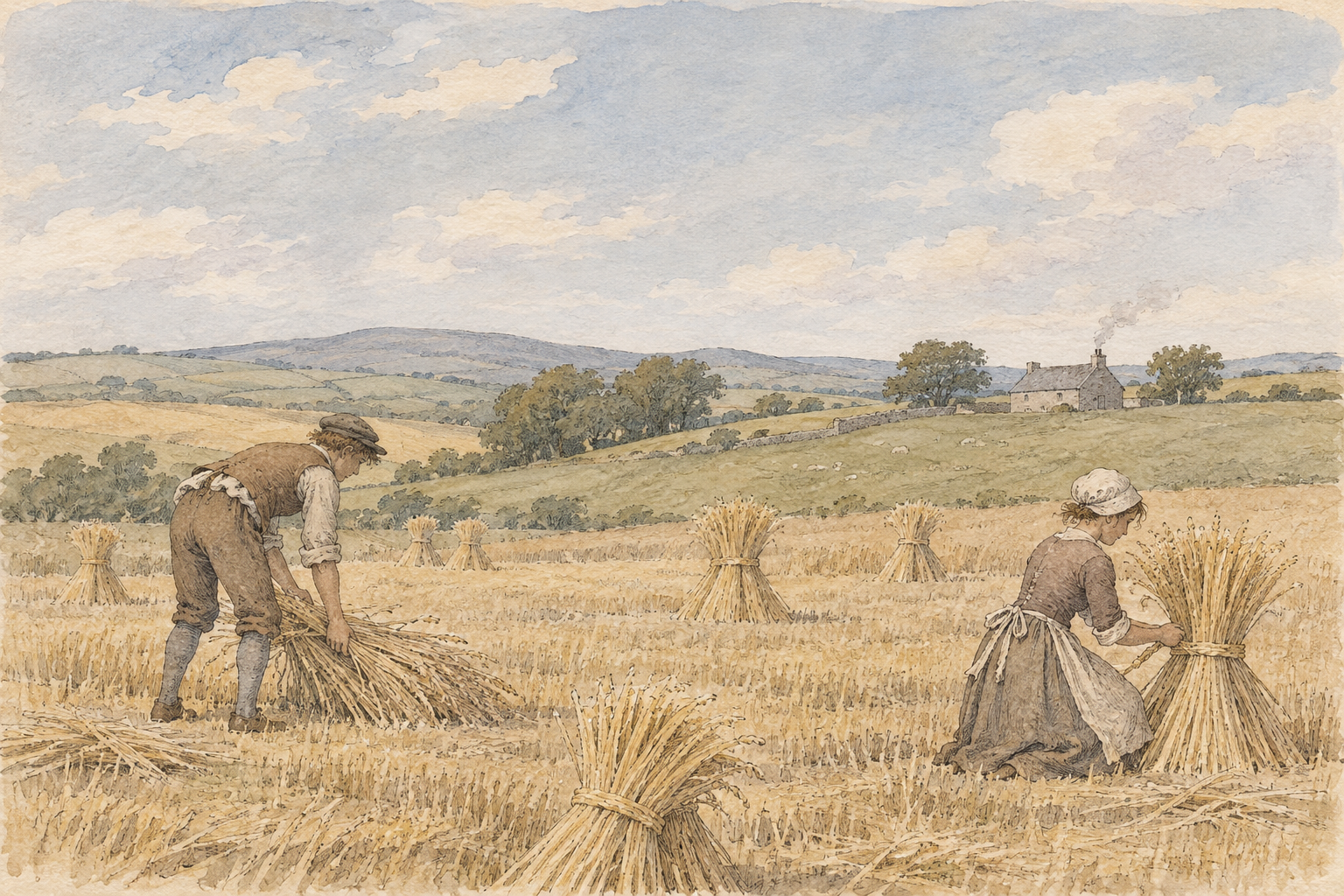
He introduced the memory after describing the family’s hard agricultural life. Robert worked the plough, Gilbert drove it, and the brothers threshed corn together. Their father’s struggle to keep the farm going formed the background to the affection Robert remembered discovering in the harvest field.[1]
The details he chose were intimate. He liked lingering behind with his partner when they returned from work in the evening. Her voice stirred him, and he remembered his racing pulse as he attended to her hand after nettles and thistles had hurt it. He described these feelings to Moore years later, admitting that he had never plainly told her he loved her. The woman remains unnamed in this passage.[1]
Her singing gave his feelings a form. Burns wanted to put words to her favourite reel. He also remembered a song she sang which was said to have been written by a small country laird’s son about one of his father’s servants. Burns associated printed poetry with men who knew Greek and Latin, but reckoned this local writer had no more learning than he had himself. He could see a reason to try.[1]
“Thus with me began love and poetry”, Burns wrote.[1]
When James Currie printed the letter in 1800, he directed readers to an appendix containing the song he identified as Burns’s first poetical production. It begins “O once I lov’d a bonnie lass” and promises affection for “my handsome Nell”. Currie printed it with the tune heading I am a man unmarried. The verses praise the woman’s modesty, manner and reputation as well as her looks.[1]
Read the song, Handsome Nell, alongside its later printed versions.
References
[1] Robert Burns to John Moore, 2 August 1787, in James Currie, ed., The Works of Robert Burns; with an Account of His Life, vol. I (Liverpool: J. M’Creery, 1800), pp. 40–42; Currie’s Appendix II, Note A, pp. 359–361, linked from p. 42. Digitised copy ↗.