Learning beside the work
Robert and Gilbert Burns learned to read and write with John Murdoch, whom William Burnes and neighbouring families employed as their teacher. Murdoch remembered teaching the meaning of every word in the verses the boys learned. Gilbert’s recollections also describe lessons at home, where William taught arithmetic on winter evenings by candlelight. [1][2][3]
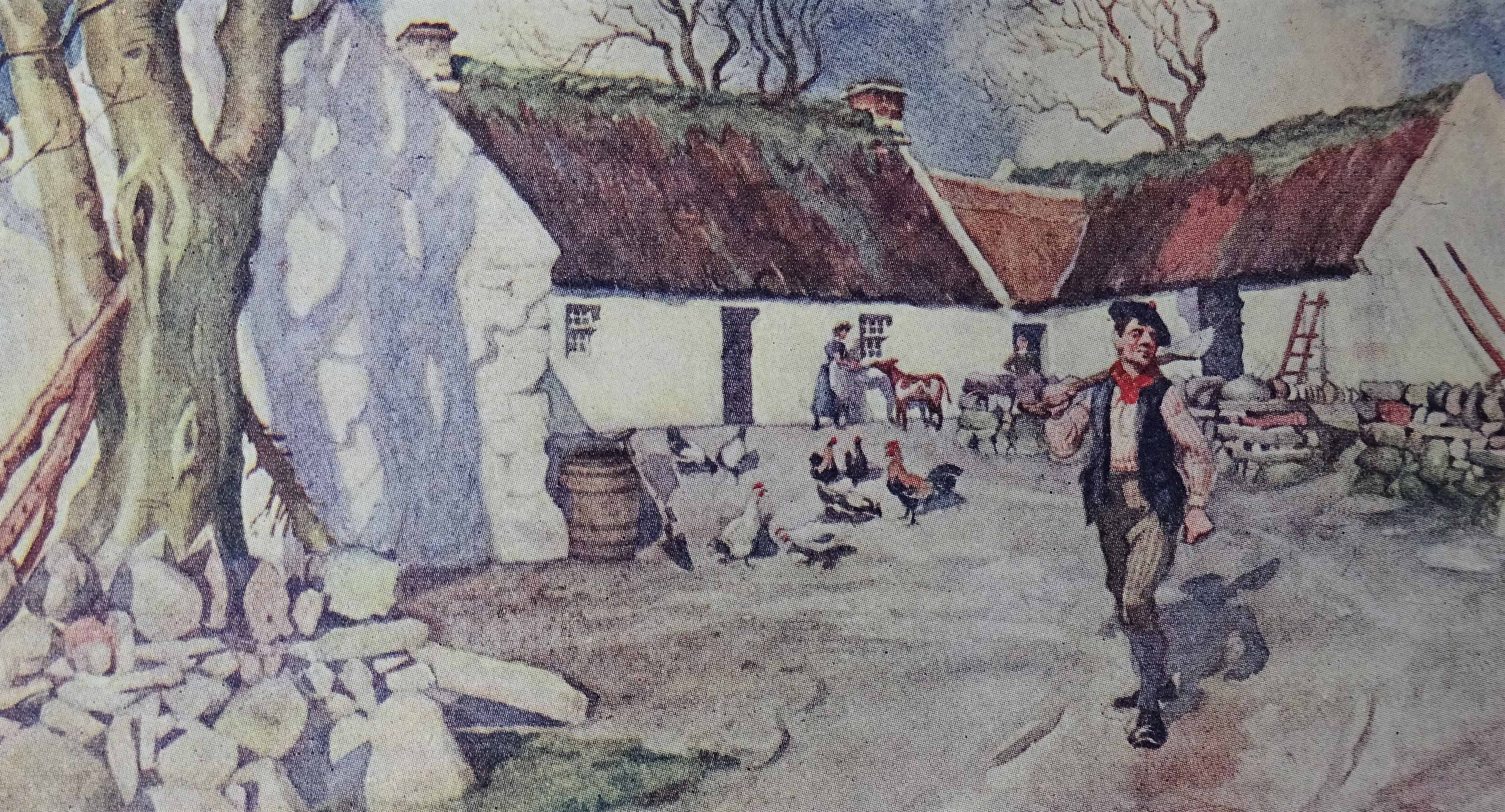
Gilbert also remembered his sisters and an adult uncle learning at home. Read William Burnes and the winter evening lessons. [4][4][5]
Books reached Robert through people around him. Murdoch lent him a Life of Hannibal; some years later, the blacksmith who shod the family’s horses lent him a Life of Wallace. His father borrowed books on geography, astronomy and natural history. [6][7]
Reading about Wallace also sent Burns out to explore Leglen Wood. He remembered a Sunday walk and a wish to make a song worthy of his hero. Read The books that sent Burns to Leglen Wood. [8][8]
Before leaving the district, Murdoch spent an evening with the family. Gilbert recalled Murdoch reading Titus Andronicus until the family became so distressed that they asked him to stop. Robert threatened to burn the play if it were left with them. Read The play Robert Burns wanted to burn. [9]
In his autobiographical letter to John Moore, Burns remembered an older woman in the household whose supernatural tales and songs stayed with him. He credited the stories with nurturing his poetry and admitted that their terrors still affected him on adult night walks. Read The ghost stories that stayed with Burns. [10][11][12]
Learning accompanied agricultural work. At Mount Oliphant, Robert later recalled ploughing and threshing with Gilbert. His account of beginning to make verse places him beside a harvest partner whose singing encouraged his first attempt. Read A harvest partner and the beginning of verse. He continued farming and writing at Lochlea and Mossgiel. [13][14][15]
At Tarbolton, Robert and Gilbert joined other young men in a debating society. Its rules gave them turns to speak, a vote on the next question and a shared responsibility for listening. Read Learning to argue at the Bachelors’ Club.
A summer at Kirkoswald brought further study in surveying and mathematics. Burns remembered unfamiliar company on a smuggling coast and school friendships that continued through letters. Read Geometry and a wider world at Kirkoswald. [16][17][18]
References
- The works of Robert Burns; with an account of his life, volume I · I p60; PDF98
- The works of Robert Burns; with an account of his life, volume I · 89–91
- The works of Robert Burns; with an account of his life, volume I · 62;92
- The works of Robert Burns; with an account of his life, volume I · 62
- The works of Robert Burns; with an account of his life, volume I · 65
- The works of Robert Burns; with an account of his life, volume I · 60–61
- The works of Robert Burns; with an account of his life, volume I · 64–65
- Robert Burns and Mrs. Dunlop, volume I · I3
- The works of Robert Burns; with an account of his life, volume I · 62–63
- The works of Robert Burns; with an account of his life, volume I · I pp37–38; PDF75–76
- The works of Robert Burns; with an account of his life, volume I · Currie1800 I pp37–38
- The works of Robert Burns; with an account of his life, volume I · Currie1800 I pp38
- The works of Robert Burns; with an account of his life, volume I · I p62; PDF100
- The works of Robert Burns; with an account of his life, volume I · I pp40-42; PDF78-80
- University of Glasgow Burns booklet, including timeline · pp4-5; PDF4
- The works of Robert Burns; with an account of his life, volume I · 67
- The works of Robert Burns; with an account of his life, volume I · 47
- The works of Robert Burns; with an account of his life, volume I · 48