← Back to the work and its versions
O, were I on Parnassus' hill
Dick (1903) · no. 74
O, were I on Parnassus' hill,
Or had o' Helicon my fill,
That I might catch poetic skill
To sing how dear I love thee!
But Nith maun be my Muse's well,
My Muse maun be thy bonie sel',
On Corsincon I'll glow'r and spell,
And write how dear I love thee.

Then come, sweet Muse, inspire my lay!
For a' the lee-lang simmer's day
I couldna sing, I couldna say,
How much, how dear I love thee.
I see thee dancing o'er the green,
Thy waist sae jimp, thy limbs sae clean,
Thy tempting lips, thy roguish een—
By heaven and earth I love thee!

By night, by day, a-field, at hame,
The thoughts o' thee my breast inflame,
And ay I muse and sing thy name—
I only live to love thee.
Tho' I were doom'd to wander on,
Beyond the sea, beyond the sun,
Till my last weary sand was run;
Till then—and then—I'd love thee!
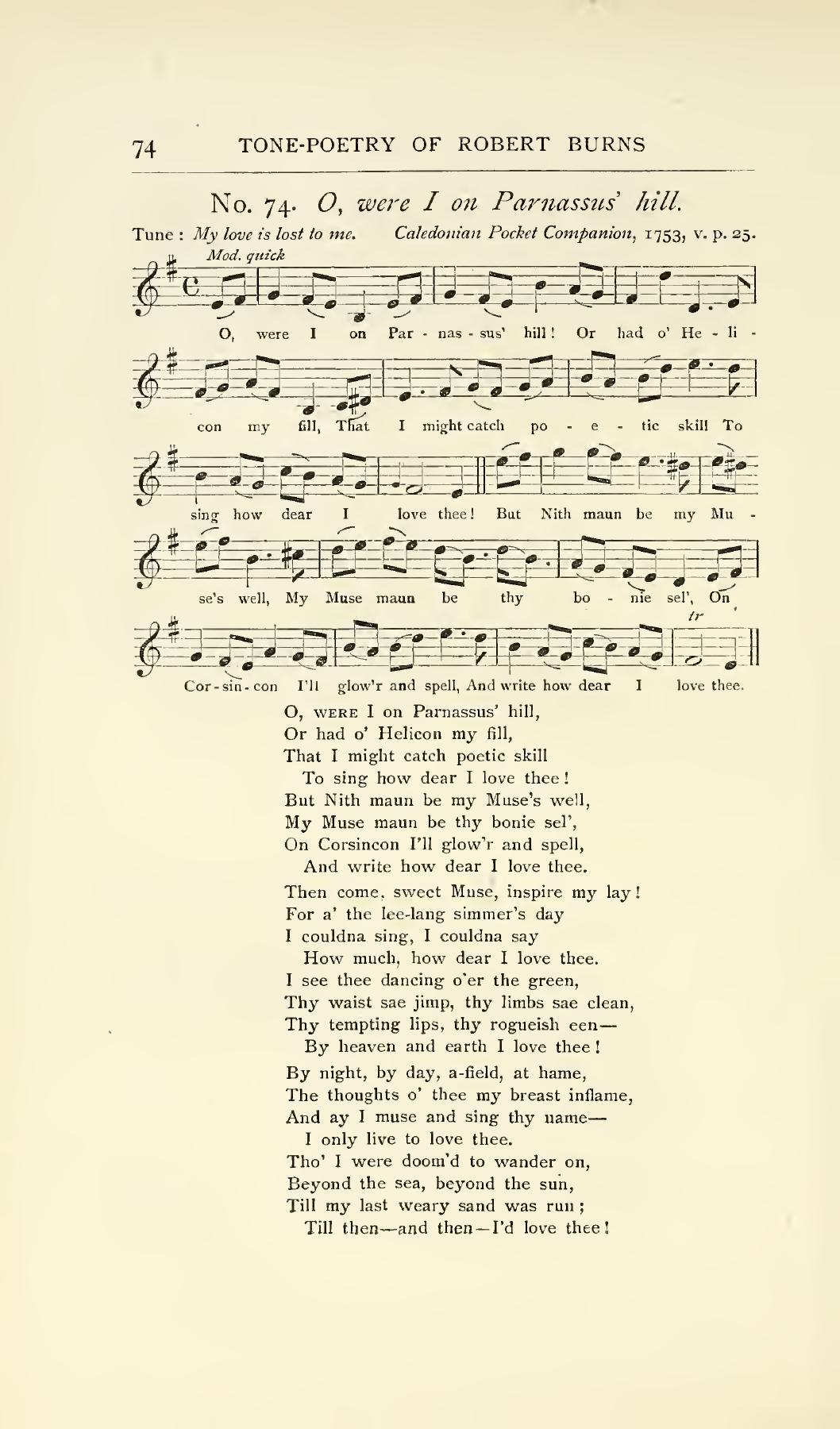
These are the words printed below the score.
View the source edition · no. 74; p. 74
About this edition
Three octaves in both texts. Dick has “couldna”, Cunningham “coudna”; Dick ends “Till then—and then—I’d love thee!”, Cunningham “Till then—and then I love thee.” The tune’s extended compass is Dick’s editorial explanation of its reception, not a fresh performance assessment.
View historical scores
Dick’s Songs of Robert Burns (1903)
no. 74; p. 74