← Back to the work and its versions
Now Westlin Winds and Slaughtering Guns
Dick (1903) · no. 11
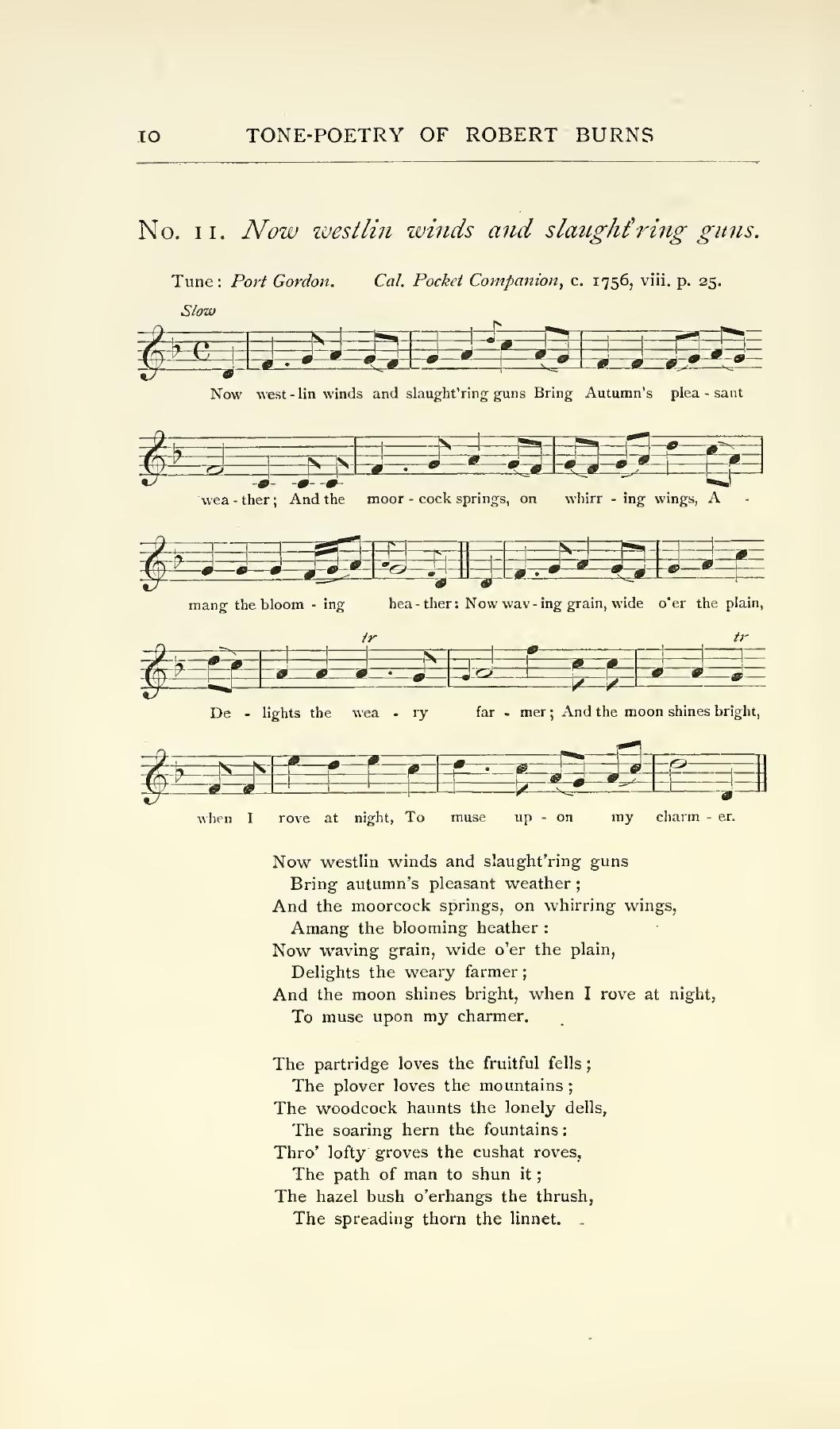
Now westlin winds and slaught'ring guns
Bring autumn's pleasant weather;
And the moorcock springs, on whirring wings,
Amang the blooming heather:
Now waving grain, wide o'er the plain,
Delights the weary farmer;
And the moon shines bright, when I rove at night,
To muse upon my charmer.

The partridge loves the fruitful fells;
The plover loves the mountains;
The woodcock haunts the lonely dells,
The soaring hern the fountains:
Thro' lofty groves the cushat roves,
The path of man to shun it;
The hazel bush o'erhangs the thrush,
The spreading thorn the linnet.

Thus ev'ry kind their pleasure find,
The savage and the tender;
Some social join, and leagues combine;
Some solitary wander:
Avaunt, away! the cruel sway,
Tyrannic man's dominion;
The sportsman's joy, the murd'ring cry,
The fluttering, gory pinion!

But Peggy dear, the evening's clear,
Thick flies the skimming swallow;
The sky is blue, the fields in view,
All fading green and yellow:
Come let us stray our gladsome way,
And view the charms of Nature;
The rustling corn, the fruited thorn,
And ev'ry happy creature.

We'll gently walk, and sweetly talk,
Till the silent moon shine clearly;
I'll grasp thy waist, and fondly prest,
Swear how I love thee dearly:
Not vernal show'rs to budding flow'rs,
Not autumn to the farmer,
So dear can be, as thou to me,
My fair, my lovely charmer!
These are the words printed below the score.
View the source edition · no. 11; pp. 10–11
About this edition
All four inspected texts have five eight-line stanzas. The 1786 opening has “And the moorcock”; 1787 and Cunningham have “The moorcock”, against Dick’s “And the moorcock”. The 1786 and 1787 closing hunting line has “flutt’ring”, against Dick’s “fluttering”. Cunningham uses “every happy creature”, where Dick and the two early editions have “ev’ry happy creature”.
View historical scores
Dick’s Songs of Robert Burns (1903)
no. 11; pp. 10–11